







The Testaments
DramaAmericanApr 8, 2026
The Testaments
Details
Rating · Quality score from voters
Popularity · Search interest now
Based on TMDb activity
Links may earn Incoming a commission at no extra cost to you. Streaming data via JustWatch — may not reflect today's catalog.
Incoming Editorial TeamVerified
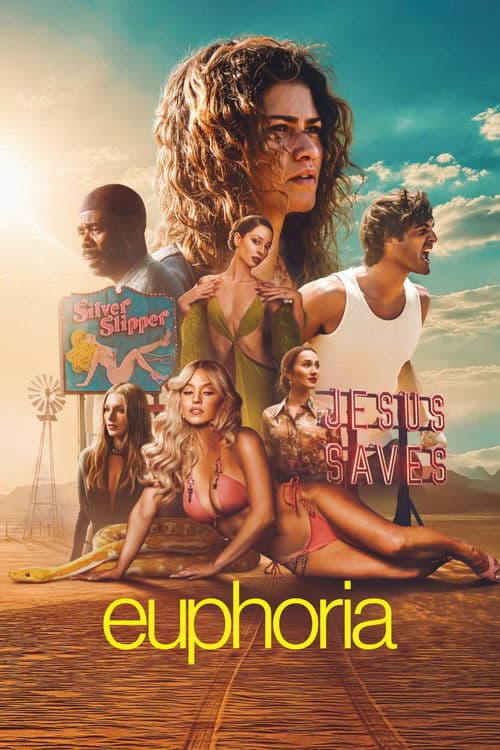
Euphoria is a drama series produced by A24 that follows a group of high school students navigating love, friendship, drugs, sex, trauma, and social media. The series streams on HBO Max and premieres June 16, 2019.
Euphoria premieres on Sunday, June 16, 2019. It is available on HBO Max and HBO Max Amazon Channel from that date.
Euphoria streams on HBO Max, HBO Max Amazon Channel, and Spectrum On Demand. Individual episodes and seasons can also be purchased on Amazon Video, Apple TV Store, and Google Play Movies.
Euphoria has 24 episodes in total across three seasons. The episode count varies by season.
Euphoria is a drama series. It deals with themes of drug use, sexual relationships, trauma, and social media among high school-aged characters.
Euphoria has three seasons, comprising 24 episodes in total.
Euphoria, the American drama series produced by A24, The Reasonable Bunch, and Little Lamb Productions, premiered on HBO on June 16, 2019. Now running to three seasons and a total of twenty-four episodes, the show has accumulated a substantial audience over its run — reflected in a TMDB vote average of 8.29 across more than ten thousand ratings — and remains one of the more discussed television dramas of the past several years. It is available to stream on HBO Max and HBO Max's Amazon Channel, as well as through Spectrum On Demand, with purchase options on Amazon Video, Apple TV Store, Google Play Movies, and Fandango At Home.
The series centers on a group of high school students moving through a landscape defined by drugs, sex, trauma, and the ambient pressure of social media. That is a crowded territory for prestige television — teen-focused dramas have existed in one form or another since the medium's earliest decades, running from the comparatively sanitized anxieties of after-school programming through the more frank depictions that began appearing in the late 1990s and accelerated through the streaming era. What distinguishes Euphoria within that tradition, at least in terms of its cultural reception, is the degree to which it treats its adolescent subject matter with the visual and tonal register typically reserved for adult prestige cable drama: high-contrast cinematography, formally composed shots, an aesthetic that critics and viewers have associated more readily with art cinema than with network teen serials.
The involvement of A24 is worth noting in that context. The studio built its reputation largely through feature films — often formally ambitious, frequently uncomfortable — before extending into television production. Its participation alongside The Reasonable Bunch and Little Lamb Productions signals a particular kind of institutional backing: one less oriented toward broad demographic capture and more toward the kind of quality-signaling that tends to cluster awards attention and critical column inches, whatever the actual viewing numbers.
What the existing metadata does not resolve — and what any viewer approaching the series cold would reasonably want to know — is how the show's ambitions hold across its three seasons. A drama tackling adolescent trauma, substance use, and the social-media-mediated self is working with material that has both genuine urgency and real risk of melodrama or exploitation. The premise makes no promises in either direction. Twenty-four episodes spread across three seasons represents enough runway to develop its characters considerably, or enough rope, depending on the execution. The show's popularity score and vote average suggest sustained audience engagement rather than the kind of precipitous dropoff that sometimes signals a series that opened strongly and then lost its footing, but raw aggregated numbers cannot tell you whether that audience stayed for the drama's insights or for its provocations.
There is also the question of social media as subject matter — one of the four pillars named in the show's premise — and how a television series produced starting in 2019 grapples with that theme across multiple seasons. Social platforms, their mechanics, and the particular psychologies they cultivate shifted noticeably even within the years the show has been in production. Whether Euphoria's treatment of that dimension feels durable or datedly tied to a specific cultural moment is a question the premise alone cannot answer.
The setting — American high school, present-day — is among television's most thoroughly excavated environments, and the genre of teen drama carries with it a set of formal expectations: ensemble casts, interlocking romantic and social hierarchies, the compression of adult anxieties into the crucible of adolescence. Euphoria has operated largely within that structural framework while pushing against its tonal conventions. Whether the tension between those genre obligations and the show's more stylized instincts remains productive across all three seasons, or whether it creates unevenness, is the kind of question that only a sustained watch can answer.
The drama genre label applied to the show is accurate but broad. Euphoria sits somewhere between social realism and heightened melodrama by design — the combination of subject matter (addiction, sexual violence, identity) and aesthetic ambition (the A24 imprint alone suggests a certain visual seriousness) places it in the company of shows that use the conventionally lowbrow teen format to make arguments about contemporary American life that straight adult drama might approach more directly but perhaps less viscerally. Whether it succeeds in that project is, again, not something the metadata resolves. What it does confirm is that a significant number of viewers have engaged seriously enough with the series to form and register opinions, and that those opinions tilt sharply positive.
The audience most likely to seek Euphoria out falls into a few overlapping categories: viewers already oriented toward A24's particular sensibility in film who are curious how that aesthetic translates across the longer form; people who followed the show during its initial cultural moment and are returning or catching up; and viewers drawn to prestige drama centered on younger characters, particularly those for whom the subject matter — addiction, trauma, the psychic weight of growing up online — carries personal resonance. At twenty-four episodes across three seasons, it is a considerable time commitment, but one the streaming availability on HBO Max makes relatively frictionless to begin.
Euphoria returned after a four-year hiatus to 25 million viewers and a 43% Rotten Tomatoes score. One cast member died waiting for it. Its star became the biggest actress in Hollywood. Here's why the show couldn't survive its own absence.
The Testaments
DramaAmericanApr 8, 2026
The Testaments
Off Campus
DramaAmericanMay 13, 2026
Off Campus 📈 Trending
Spider-Noir
CrimeAmericanMay 25, 2026
Spider-Noir
Daredevil: Born Again
DramaAmericanMar 4, 2025
Daredevil: Born Again
The Lead
DramaChineseMay 10, 2026
The Lead
Margo's Got Money Troubles
DramaAmericanApr 14, 2026
Margo's Got Money TroublesSign in to join the conversation.