


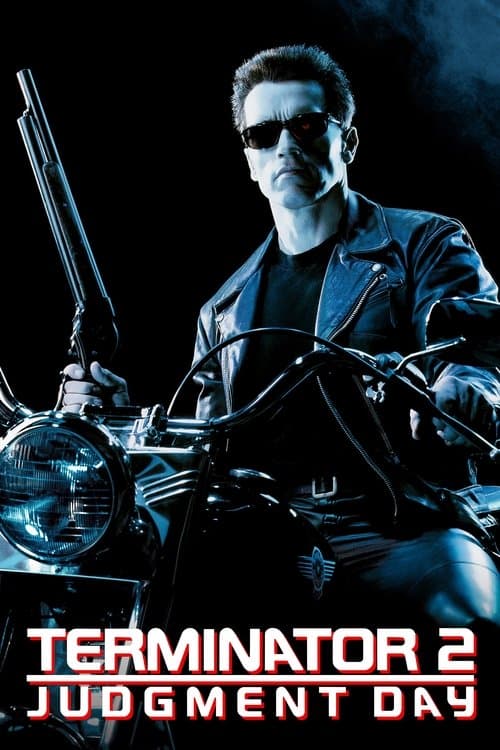
Terminator 2: Judgment Day
movie · prequel of
Terminator 2: Judgment Day

Details
Rating · Quality score from voters
Popularity · Search interest now
Based on TMDb activity
Links may earn Incoming a commission at no extra cost to you. Streaming data via JustWatch — may not reflect today's catalog.
Incoming Editorial TeamVerified
The Terminator is a 1984 action science-fiction thriller produced by Hemdale. It follows a cyborg assassin sent back in time from a post-apocalyptic future to kill Sarah Connor, whose unborn son is destined to lead a human resistance against machine rule. The film released theatrically on October 26, 1984.
The Terminator released theatrically on October 26, 1984. It was produced by Hemdale and has since become available on multiple streaming and digital rental platforms.
The Terminator is available to stream on HBO Max, YouTube TV, HBO Max Amazon Channel, and MGM+ Amazon Channel. It can also be rented digitally through Amazon Video, Apple TV Store, and Google Play Movies.
Yes, The Terminator is the first entry in The Terminator Collection franchise. The franchise has expanded through multiple sequel films following the central conflict between humanity and machine rule.
In the post-apocalyptic future, supercomputers send a cyborg assassin back to 1984 to kill Sarah Connor, whose unborn son is destined to lead a human resistance movement. The resistance counters by sending a lone warrior back to protect her from the virtually indestructible machine.
The Terminator spans the action, thriller, and science-fiction genres. The story combines time-travel science fiction with a chase-thriller structure set in 1984 Los Angeles.
The Terminator opens in theaters on October 26, 1984, produced by Hemdale and Pacific Western. It is a science-fiction action thriller directed — based on the available production record — by way of a premise that places two men from the future in present-day Los Angeles, each with opposing mandates concerning the same young woman. The film belongs to The Terminator Collection, indicating it is the first entry in what has been structured as a continuing franchise.
The central architecture of the story is a time-travel paradox built around a specific kind of dread. In a future where supercomputers have seized control and are fighting a war against human survivors, the machines identify a strategic vulnerability: a woman named Sarah Connor, whose son, not yet born in 1984, is fated to lead the human resistance against mechanical rule. The machine solution is to reach backward through time and eliminate her before that son can exist. To do this, a cyborg — the Terminator of the title — is sent to 1984 with a straightforward kill order. The human resistance, anticipating this move, sends a single soldier back through the same mechanism to protect her. The film's dramatic question, plainly stated in its own synopsis, is whether that one man can stop a killing machine described as virtually indestructible.
What gives that question its particular texture is the asymmetry of the contest. The human defender is exactly that — human, mortal, operating without backup, without the institutional support of the future movement he represents, and without any real standing in 1984. He arrives with no weapons, no identification, no resources beyond whatever he can improvise. The Terminator, by contrast, is a machine underneath a human exterior, engineered for this purpose. The genre tradition this engages is less the straightforward action film and more the pursuit thriller — a subgenre in which the mechanics of escape and evasion carry as much narrative weight as any direct confrontation. The science-fiction framing, with its post-apocalyptic future and time-displacement mechanics, gives that pursuit an unusual deterministic pressure. If the machines calculated correctly, Sarah Connor is already dead. If the resistance calculated correctly, she survives. The film positions itself inside that gap.
The production comes from Hemdale and Pacific Western, two companies operating well outside the major studio system of the early 1980s. That context is worth noting, not as background color, but because it shapes what kind of film this is likely to be. Independent productions working at this scale tend to solve problems through ingenuity rather than resources — through camera choices, editing rhythms, and creature or mechanical design that has to do more with less. Science-fiction films made outside the studio system in this period occupy an interesting position in the genre's history, sometimes producing work that operates through atmosphere and conceptual clarity rather than spectacle alone.
The premise itself carries several unresolved tensions that the film will need to address or deliberately leave open. The time-travel mechanism is described as teleportation, but the logic of what can and cannot be sent back — and by whom, under what conditions — is not elaborated in any available material. The decision to send only one soldier against a cyborg described as virtually indestructible raises an obvious question about the resistance's resources and strategic thinking. Whether the film treats these questions as plot problems to be explained or as background assumptions to be accepted is something the available information cannot answer. Similarly, the nature of Sarah Connor herself — what she knows, how she responds, whether she is passenger or participant in her own survival — is left entirely open. Her unborn son is the stated reason for the machine's mission and the resistance's intervention, which puts her in the structural position of a vessel for someone else's significance. Whether the film complicates or simply accepts that positioning is among the more interesting questions a viewer might carry in.
The Terminator holds a TMDB vote average of 7.7 across nearly fifteen thousand votes, which places it well above the median for its category and suggests a degree of durability that pure genre exercises rarely sustain. A film can collect votes in volume simply through cultural visibility, but a sustained average at that level across that many responses typically indicates that audiences are finding something in repeated viewings or in initial experience that holds up to some scrutiny. What that something is, in this specific case, is not something any aggregate score can explain — it records a fact without illuminating a cause.
The film is available to stream through HBO Max and YouTube TV, among other platforms, and can be rented or purchased through Amazon Video, Apple TV Store, Google Play Movies, YouTube, and Fandango At Home, with additional rental options through Spectrum On Demand and Plex. That breadth of availability reflects its position as the founding entry in an ongoing franchise collection.
Viewers most likely to seek this out in advance of or alongside later entries in The Terminator Collection will find a film that establishes the central figures and the mechanical logic that subsequent installments will inherit. Those coming to it through general interest in science-fiction action thrillers from the period will encounter a story organized almost entirely around a single, escalating pursuit — stripped of subplot and secondary maneuvering in a way that was not universal for the genre even then. The question of whether that stripped quality reads as discipline or limitation is precisely the kind of thing a viewer's own tolerance for concentrated premise will determine.
Terminator 2: Judgment Day
movie · prequel of
Terminator 2: Judgment Day
Greenland 2: Migration
AdventureJan 7, 2026
Greenland 2: Migration 🔥 Hot
Fall 2: Deadpoint
ThrillerSep 1, 2026
Fall 2: Deadpoint 📈 Trending
Demon Slayer: Kimetsu no Yaiba Infinity Castle
AnimationJul 18, 2025
Demon Slayer: Kimetsu no Yaiba Infinity Castle ⬆️ Rising
Deep Water
HorrorApr 30, 2026
Deep Water
Shelter
ActionJan 28, 2026
Shelter
Scream 7
HorrorFeb 25, 2026
Scream 7Sign in to join the conversation.