
The Terminator
movie · prequel of
The Terminator
Details
Rating · Quality score from voters
Popularity · Search interest now
Based on TMDb activity

Arnold Schwarzenegger
The Terminator

Linda Hamilton
Sarah Connor

Edward Furlong
John Connor

Robert Patrick
T-1000

Earl Boen
Dr. Silberman

Joe Morton
Miles Dyson

S. Epatha Merkerson
Tarissa Dyson

Castulo Guerra
Enrique Salceda

Danny Cooksey
Tim

Jenette Goldstein
Janelle Voight

Xander Berkeley
Todd Voight

Leslie Hamilton Gearren
Twin Sarah
Ken Gibbel
Douglas
Robert Winley
Cigar Biker
Pete Schrum
Lloyd
Links may earn Incoming a commission at no extra cost to you. Streaming data via JustWatch — may not reflect today's catalog.
Incoming Editorial TeamVerified
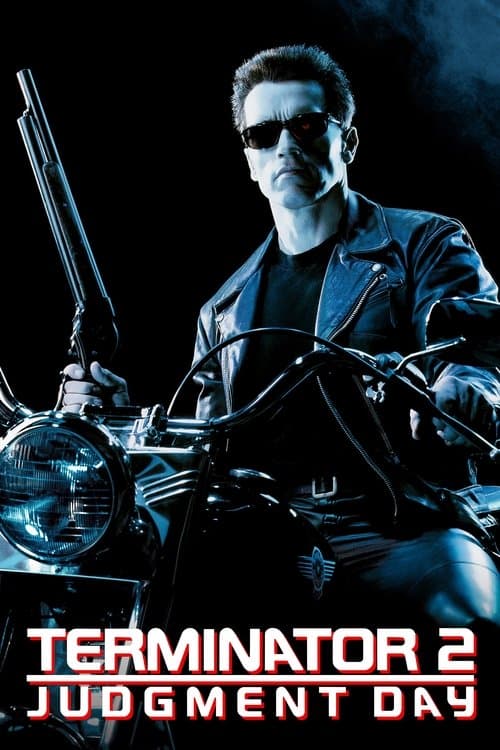
Terminator 2: Judgment Day is a 1991 action science-fiction thriller produced by Carolco Pictures. Set ten years after the original film, it follows a reprogrammed T-800 sent back in time to protect John Connor from a shape-shifting assassin known as the T-1000. It released theatrically on July 3, 1991.
Terminator 2: Judgment Day released theatrically on July 3, 1991. It is now available to stream on fuboTV, Paramount Plus Essential, Paramount Plus Premium, and the Paramount+ Amazon Channel, and can be rented on Amazon Video, Apple TV Store, and Google Play Movies.
The film is available to stream on fuboTV, Paramount Plus Essential, Paramount Plus Premium, and the Paramount+ Amazon Channel. It can also be rented digitally via Amazon Video, Apple TV Store, and Google Play Movies.
Yes, it is the second film in The Terminator Collection franchise. The story picks up ten years after the events of the original, continuing the conflict between humanity and Skynet's machines.
The film spans the action, thriller, and science-fiction genres. It follows a time-travel premise in which a reprogrammed T-800 and a shape-shifting T-1000 are both sent back in time, with the fate of humanity at stake.
The film was produced by Carolco Pictures, the studio behind a number of major action productions of the late 1980s and early 1990s.
Set ten years after the original film, a reprogrammed T-800 is sent back in time to protect young John Connor from the T-1000, a more advanced shape-shifting machine. John's mother Sarah Connor joins the effort as they attempt to prevent Skynet from triggering a nuclear apocalypse.
Terminator 2: Judgment Day, produced by Carolco Pictures, Pacific Western, and James Cameron's Lightstorm Entertainment, opens in theaters on July 3, 1991 — positioning itself squarely in the heart of summer blockbuster season, where competition for audience attention is at its most brutal and studios tend to stake their largest bets.
The film is the second entry in The Terminator Collection, following Cameron's 1984 original, which introduced the premise of a cyborg assassin sent from a post-apocalyptic future to kill Sarah Connor before she could give birth to the man who would lead humanity's resistance against the machine intelligence called Skynet. That first film worked on a relatively lean budget and functioned essentially as a chase thriller — Sarah as prey, the T-800 as an implacable, near-silent pursuer. It found a large audience and left behind a clean, durable mythology: Skynet, Judgment Day, the paradoxes of time-travel intervention, and the particular dread of a threat that cannot be reasoned with or outrun.
Seven years separate that film from this one. The premise laid out for Judgment Day picks up a decade after the events of the original. John Connor — the future resistance leader, then only a child — is the target this time, hunted by a new model designated the T-1000. The T-1000 is described as shape-shifting, which represents a meaningful escalation over the original's humanoid-but-fixed T-800 design. Opposing it is another T-800, this one reprogrammed and sent back not to kill but to protect John. Sarah Connor, John's mother and the original film's primary protagonist, returns as well, now fighting alongside both her son and the machine that once served as the face of the threat against her family.
The inversion at the center of that setup — the T-800, previously the franchise's monster, recast as protector — is the most structurally interesting thing the available premise information suggests about the film's construction. Whether Cameron uses that reversal for tonal commentary, straightforward action mechanics, or something more psychologically textured is a question the plot description alone cannot answer. What it does indicate is that the film is working with audience familiarity as a deliberate variable: those who saw the original bring specific associations to the T-800's appearance, and the film is apparently designed to exploit the tension between that memory and the new dramatic reality.
The T-1000's shape-shifting capability introduces a different kind of threat than the first film offered. The original T-800's menace derived partly from its fixedness — it looked like one thing and was exactly that thing, relentless and unvarying. A shape-shifting antagonist operates on different terms, introducing instability into every scene where identity or trust is at stake. How that quality is realized in practice — whether it functions primarily as an action-sequence device or carries any deeper narrative weight — remains to be seen.
The studio configuration behind the film is notable for what it suggests about scale. Carolco Pictures, by 1991, had established itself as the production company most willing to spend aggressively on physical action spectacle, having backed the Rambo sequels and Total Recall. Pacific Western had co-produced the original Terminator. Lightstorm, Cameron's own company, gives the director an unusual degree of structural control over the production. That combination of a risk-tolerant independent studio, franchise continuity, and director-led production infrastructure suggests the film was built with significant resources and without the typical degree of studio interference that might moderate creative ambition in a property of this commercial profile. What those resources were actually directed toward — what proportion went to practical effects, to the T-1000's shape-shifting sequences specifically, or to the film's action choreography — is not detailed in the available information.
Cameron wrote and directed the original, and the available data situates this as a continuation of that franchise rather than a reboot or lateral entry. What isn't clear from the information at hand is precisely how much of the film's concern lies with the mechanics of the action and chase — the genre obligation — versus with the Connor family dynamic that the premise description places at the center of things. Sarah Connor's arc in the first film ended in a specific emotional and physical state, and the decade-jump suggests the sequel is inheriting a version of that character shaped by years of anticipating a war that most people around her presumably don't believe is coming. Whether the film treats that psychological history as a significant dramatic element or as background texture for the action is unknown.
The summer 1991 placement puts Judgment Day into a competitive season and into conversation with the general appetite of audiences who had, through the late 1980s, demonstrated sustained interest in large-scale action science fiction. The franchise's core concerns — technological determinism, the question of whether catastrophe is inevitable or preventable, the specific anxiety of human civilization rendered fragile by its own creations — are durable enough to function independently of any particular cultural moment, though they are never entirely separable from it either.
Those most likely to seek this out immediately are viewers who followed the original and have been waiting to see how the mythology develops — particularly how the series handles the logical and emotional complications of placing a T-800 on the side of the humans it was originally built to destroy. Audiences newer to the franchise have a coherent entry point in the Connor family's situation, which the premise describes in terms accessible without deep prior knowledge, even if certain reversals will land differently for those carrying memory of the first film.
The Terminator
movie · prequel of
The TerminatorSign in to join the conversation.