Details
- Language
- English
- Studio
- Magenta Light Studios
- TMDb Rating
- 7.1 (473 votes)
- Directed by
- Renny Harlin
- Written by
- Shayne Armstrong, S.P. Krause, Damien Power, Pete Bridges, John Kim, Dan Luo
Rating · Quality score from voters
TMDb
7.1/10
IMDb
5.4/10
Rotten Tomatoes
69%
Metacritic
53/100
Popularity · Search interest now
Popular
82.0
Based on TMDb activity
Starring




Where to watch
Links may earn Incoming a commission at no extra cost to you.
Incoming Editorial TeamVerified
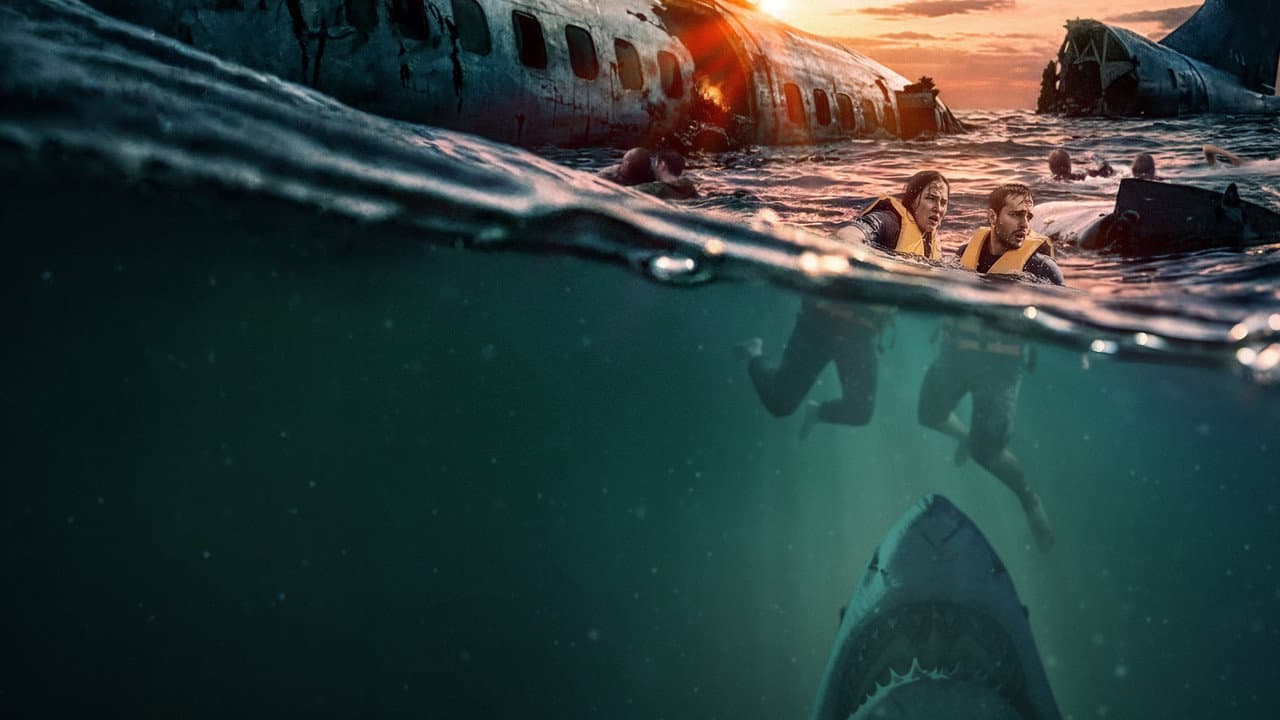
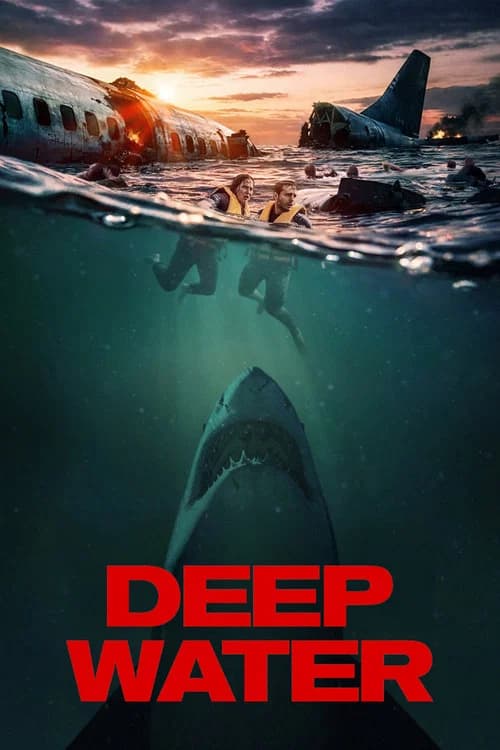
A group of international passengers on a flight from Los Angeles to Shanghai is forced to make an emergency landing in shark-infested waters. The terrified group is forced to work together and overcome their differences if they hope to escape their sinking plane and the frenzy of sharks drawn to the wreckage.
Trailer
Gallery (9)
About this release
Arriving on April 30, 2026, Deep Water is a horror-thriller produced by Magenta Light Studios, Arclight Films, and Simmons/Hamilton Productions. The premise is as stripped-down as disaster cinema gets: a group of international passengers aboard a flight from Los Angeles to Shanghai is forced into an emergency water landing, their downed aircraft sitting somewhere in shark-infested ocean while the survivors try to hold themselves together long enough to get out alive.
The scenario belongs to a well-worn tradition in horror filmmaking — the survival picture that strips its characters of every ordinary resource and asks what remains. Shark films in particular occupy a peculiar niche. Since the genre was more or less codified by Steven Spielberg's 1975 Jaws, filmmakers have returned again and again to the premise that open water is among the most legible of all horror settings. The danger is invisible until it isn't, the environment is uniformly hostile, and escape is a problem of geometry as much as courage. More recent entries in the cycle — The Shallows (2016), 47 Meters Down (2017), The Meg (2018) and its sequel — have tested different variations on the formula, ranging from single-character endurance studies to wide-canvas action spectacles. Deep Water appears to position itself somewhere in the middle of that range, using the confined architecture of a sinking commercial aircraft as its primary staging ground before, presumably, the ocean asserts itself more fully.
What distinguishes this particular setup, at least on paper, is the aircraft as a structural conceit. A downed plane introduces complications that a beach or a diving cage does not. The fuselage offers both shelter and trap — a pressurized metal tube designed to keep people alive at altitude, now becoming a vessel that is actively filling with water. The dramatic logic is almost mechanical in its efficiency: any moment spent inside the plane extends survival time against the sharks outside, but also shortens it as the aircraft sinks. That tension between two simultaneous countdowns — one biological, one physical — gives the premise a built-in escalation that writers of survival horror tend to find useful.
The production involves three companies sharing credit, which itself suggests a production model common to mid-budget genre pictures that assemble international financing and distribution networks before principal photography. Arclight Films, one of the attached studios, has a history with genre and action co-productions aimed at broad international markets. The English-language production with its Los Angeles–to–Shanghai flight path and presumably international passenger roster gestures toward a similar international commercial appetite, though no country of origin is formally listed in the available metadata.
Several questions hover over the project that its marketing has not yet resolved, at least not in available materials. The ensemble framing — "a group of international passengers" — raises the obvious structural question of how much time the film actually spends underwater versus inside the sinking cabin, and whether it leans into claustrophobic interior horror or opts for the more kinetic, open-water action that shark films increasingly favor. The two modes ask very different things of a cast and a director. Closed-space tension relies heavily on performance and editing rhythm; open-water sequences depend on photography, creature design, and the management of spatial confusion that makes underwater filmmaking difficult and expensive.
The film's international passenger roster is also, as a story element, a premise that promises interpersonal conflict as a parallel track to the external threat. Survival films that group strangers together — particularly strangers coded as culturally or temperamentally different — tend to use the disaster scenario as a pressure cooker for social dynamics that would otherwise remain polite. Whether Deep Water uses its ensemble with any particular sophistication, or whether the character work is primarily functional scaffolding for set pieces, is not something the logline can answer. The phrase "overcome their differences" is doing a good deal of work in the premise description without specifying what those differences actually are.
No cast names, director, or writer credits appear in the available production information, which is notable this close to an April 2026 release. That absence may reflect where the project sits in its marketing cycle, or it may indicate that talent announcements are being staged for later. What can be said is that the film's current TMDB user score — 7.461 based on 257 votes — suggests at least some audience awareness and early positive engagement for a title that has not yet formally opened, which is a modest but not negligible early signal.
The rental and purchase availability listed across Amazon Video, Apple TV, Google Play Movies, YouTube, Fandango at Home, and Plex, with no streaming platform attached, suggests a transactional video-on-demand release strategy rather than a theatrical-to-streaming pipeline deal, at least as it currently stands. That distribution shape tends to characterize genre pictures that either skipped wide theatrical release or are releasing simultaneously or shortly after a limited theatrical window, and it will likely shape how the film finds its audience.
The viewers most likely to seek this out are genre regulars who follow the shark-horror cycle closely and audiences drawn to contained-space disaster thrillers. Anyone who found the underwater sequences of 47 Meters Down or the cabin-pressure mounting tension of survival ensemble pictures appealing has an obvious reason to pay attention. The question of whether Deep Water brings enough formal ingenuity to its very familiar materials — or whether its premise is sufficient structure on its own — will settle itself after April 30.
Comments
Sign in to join the conversation.
Loading…