



 📈 Trending
Rosebush Pruning
ComedyApr 23, 2026
Rosebush Pruning
 Cool
Details
Popularity · Search interest now
Based on TMDb activity
Incoming Editorial TeamVerified
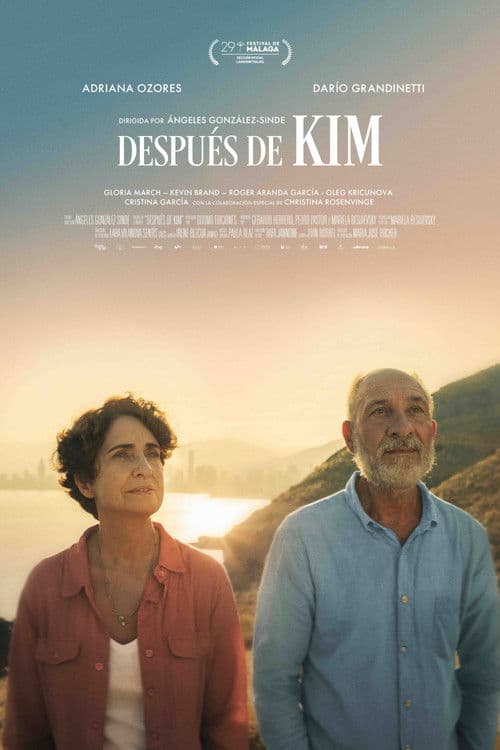
Después de Kim is a Spanish-language film in which two estranged parents travel from Buenos Aires to Spain after learning their long-lost daughter has died. The film is scheduled for release on April 24, 2026.
Después de Kim is scheduled for release on April 24, 2026.
The film follows two divorced and estranged parents who travel from Buenos Aires to Spain after learning their long-lost daughter has died, then discover she left behind a grandson whose location is unknown.
The film is in Spanish.
Después de Kim, a Spanish-language film, is scheduled for release on Friday, April 24, 2026. Beyond its title and the outline of its premise, relatively little has surfaced publicly about the production — its director, cast, and financing remain unconfirmed in available materials — but the story it proposes is specific enough in its emotional architecture to warrant attention on its own terms.
The film follows Juan and Gloria, a divorced couple who have been estranged for two decades, as they travel together from Buenos Aires to Spain after learning that Kim, a daughter with whom they had lost all contact, has been found dead. The setup belongs to a recognizable lineage of road-movie grief narratives, films in which physical displacement and the logistics of death — travel arrangements, bureaucratic formalities, unfamiliar cities — force characters who would otherwise never occupy the same room to share space, time, and eventually conversation. What distinguishes the premise here from a straightforward reunion drama is the third revelation that arrives after Juan and Gloria land in Spain: Kim has left behind a grandson whose whereabouts are unknown. The search for this child, a person neither of them knew existed, becomes the engine that keeps them in a foreign country together rather than allowing each to retreat back to the separate lives they have built over twenty years.
That structural choice — layering a missing-person search onto an estrangement story — does a particular kind of narrative work. It means the film isn't simply asking Juan and Gloria to process loss and revisit the wreckage of their marriage in the abstract. It gives them a concrete, external task that runs alongside, and presumably intersects with, whatever emotional reckoning the situation demands. The grandson is both a practical problem and a symbol of everything they missed in Kim's life during the years of estrangement, a life that apparently continued, expanded, and produced a child without either parent present to witness any of it. Whether the film leans toward procedural tension or interior character study — or attempts to hold both simultaneously — is one of the more interesting open questions about how the material will be handled.
The Buenos Aires-to-Spain axis is worth noting as a geographical and cultural choice. Argentina and Spain share a language and deep historical connections, but they are not the same place, and the sense of Juan and Gloria operating in an environment that is familiar in some ways and foreign in others has the potential to compound their disorientation. They arrive to handle the affairs of a daughter they effectively did not know, in a country where she apparently built her adult life, surrounded by people and circumstances entirely outside their experience of her. The degree to which the film uses Spain as an active setting — its institutions, its geography, the social world Kim inhabited there — rather than as a neutral backdrop is something the available information doesn't yet answer.
The question of Kim herself is one the film will have to navigate carefully. She is the catalyst for everything that happens, but she is dead before the story begins. Films structured this way — around a character whose life is reconstructed posthumously through the investigations of the living — vary enormously in how much interiority they extend to the absent figure. Kim's estrangement from both parents is the wound at the center of the premise, and the question of why that estrangement happened, who bears responsibility for it, and whether Juan and Gloria's accounts of that history will align or diverge is precisely the kind of tension that could animate the relationship between the two leads throughout the film. At the same time, the discovery of the grandson suggests that Kim's story had considerable shape and texture on its own terms, independent of her parents. How the film balances its obligation to her as a character against its focus on Juan and Gloria as the people the audience follows is an unresolved and genuinely interesting formal problem.
The film is in Spanish, which positions it primarily within the Spanish-language cinema market while also making it a likely candidate for international festival circulation and streaming distribution in markets with established appetite for Spanish-language drama. Argentina in particular has a robust tradition of producing films that travel well internationally, and a story that moves between Buenos Aires and Spain has a built-in geographic range that tends to facilitate that kind of reception. None of that is confirmed by what's currently available, but the premise has the structural profile of a festival-oriented drama rather than a genre picture.
The audience most likely to seek out Después de Kim will include viewers drawn to character-driven family dramas, particularly those willing to sit with the complicated emotional geometry of estrangement, grief, and the partial knowledge parents have of their children's lives. The Buenos Aires setting and the bilingual-adjacent Spain connection will draw Spanish-language cinema audiences specifically. For anyone who has followed films about adults confronting the gaps in their family histories, the premise offers a framework that is familiar enough to be legible and specific enough in its details — the twenty-year silence, the dead daughter, the unknown grandchild — to suggest that the familiar framework is being applied to something genuinely particular.
📈 TrendingRosebush Pruning
ComedyApr 23, 2026
Rosebush Pruning 🔥 Hot
Spider-Man: Brand New Day
Science FictionJul 28, 2026
Spider-Man: Brand New Day ⭐ Popular
The Odyssey
AdventureJul 15, 2026
The Odyssey
The Shawshank Redemption
DramaSep 23, 1994
The Shawshank Redemption
Nightborn
HorrorJul 1, 2026
Nightborn 📈 Trending
Hope
Science FictionJul 15, 2026
HopeSign in to join the conversation.