
Details
- Language
- Korean
- Studio
- Forged Films
- TMDb Rating
- 6.7 (493 votes)
- Directed by
- Na Hong-jin
- Written by
- Na Hong-jin
- For
- adult
Rating · Quality score from voters
TMDb
6.7/10
Popularity · Search interest now
Trending
376.7
Based on TMDb activity
Starring








Where to watch
Links may earn Incoming a commission at no extra cost to you.
Incoming Editorial TeamVerified
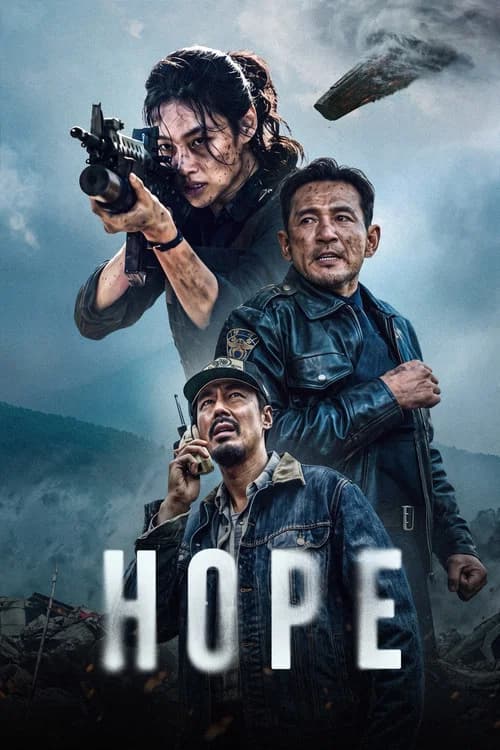
Hope (호프) is a Korean-language mystery thriller set in a remote harbor town near the Demilitarized Zone. The film releases on May 17, 2026.
Trailer
Gallery (15)
Key features
- ·Korean-language mystery thriller
- ·Set near the Korean Demilitarized Zone
- ·Coastal small-town setting
- ·Theatrical release May 17, 2026
FAQ
When does Hope (호프) release?
Hope is scheduled for release on May 17, 2026.
What is Hope (호프) about?
The film follows a police officer named Bum-seok and the residents of Hope Harbor, a remote coastal town near the DMZ, as a local emergency escalates into a deeper and more terrifying mystery.
What language is Hope (호프) in?
The film is in Korean.
About this release
Hope (호프), a South Korean science-fiction mystery produced by Forged Films, Plus M Entertainment, and Westworld Story, is scheduled for release on July 15, 2026. Shot in Korean and built around a premise that fuses rural isolation with something stranger and harder to classify, the film arrives at a moment when Korean genre cinema continues to occupy an increasingly prominent position in international distribution pipelines.
The setup is deceptively procedural. Police chief Bum-seok and officer Sung-ae are called to investigate a mysterious creature causing havoc in the remote coastal community of Hope Harbor. That framing — local law enforcement, an unknown threat, a tight-knit village — recalls a lineage of Korean genre films that use provincial settings as pressure chambers, places where institutional authority is thin, information travels slowly, and the social fabric frays under stress in ways it would not in a city. The creature-investigation premise also places Hope in conversation with a broader tradition of Korean monster cinema, a cycle that has generated some of the more formally ambitious entries in the international genre canon over the past two decades. Whether Hope is working in dialogue with that tradition, against it, or simply alongside it is not yet clear from what has been disclosed.
What distinguishes the official synopsis from a straightforward genre description is its emphasis on perception and misunderstanding as structural elements rather than incidental complications. The language is pointed: ignorance plants the seed of disaster, human conflict escalates the situation, and the outcome is described as a tragedy of cosmic proportions. That last phrase is conspicuously large for a story that begins with two police officers responding to what sounds like a wildlife disturbance. The filmmakers appear to be signaling that the creature — whatever it is — functions as a catalyst rather than a villain, and that the real engine of destruction is the community's response to what it does not understand. This is a familiar moral architecture in science fiction, but the specific escalation described here, moving from ignorance through conflict to something cosmically scaled, implies a story that expands in scope considerably beyond its opening scenes.
The three production companies behind the film — Forged Films, Plus M Entertainment, and Westworld Story — represent a co-production arrangement that is not unusual for mid-to-large Korean genre productions seeking both domestic and international reach. Plus M Entertainment has a track record in Korean theatrical distribution and production. Beyond that, the available information does not specify directors, writers, or lead cast members by name, which is a notable gap for a film less than a year from release. In Korean genre cinema, the director's identity tends to carry significant weight in shaping audience expectations and critical framing, so the absence of that information here leaves a large portion of the interpretive picture blank.
The subtitle pairing — Hope in English, 호프 as a phonetic transliteration rather than a semantic Korean translation — is itself a quiet curiosity. The village is named Hope Harbor, and the film takes its title from that location, but the choice to render the title as a transliteration rather than a Korean word meaning hope (which would be 희망, huimang) suggests the English name of the place is being preserved as part of the film's identity. It is a small detail, but it hints at something deliberate in how the filmmakers are positioning the story's geography — Hope Harbor as a proper noun with its own weight, not simply a backdrop.
Several things remain genuinely open. The nature of the creature has not been described in any available material — whether it is biological, extraterrestrial, or something else entirely is unspecified. The "cosmic proportions" language in the synopsis could point toward science fiction in the classical sense, toward something more metaphysical, or toward a kind of tonal escalation where the stakes become existential rather than literally astronomical. The film is categorized across science fiction, mystery, and action, a combination that suggests movement between registers, but how those genres are weighted against one another is unknown. Mystery implies a puzzle structure; action implies kinetic sequences; science fiction implies a speculative premise with its own internal logic. Whether Hope balances these or subordinates two of them to the third is not something the available material resolves.
The claim that "perceptions can be misleading" and that the situation "is not as it seems" also raises questions about narrative structure. These phrases are consistent with a film that has a significant reveal — about the creature, about the community, about the nature of the threat — built into its architecture. That kind of structural misdirection requires careful plotting, and it is the element most likely to determine whether Hope lands as a coherent genre film or a collection of tonal ambitions that do not cohere.
The audience most likely to seek out Hope on or around its July 2026 release will overlap considerably with the viewership that followed Korean genre cinema into international streaming and theatrical markets over the preceding years — viewers attentive to the way Korean filmmakers have used genre conventions as vessels for social and moral inquiry. The premise's emphasis on communal failure, misreading, and escalation toward catastrophe gives it the shape of a film with something to say beyond its creature-feature surface, and that combination tends to travel.
Our coverage
- Hope Is Now on Digital. Na Hong-jin's Cannes Sci-Fi Has 79% on Rotten Tomatoes and a Divided Audience
Na Hong-jin's Hope, with Hwang Jung-min, Michael Fassbender and Alicia Vikander, hit digital on October 13. Reviews, Korean and U.S. box office, awards, the budget question and where to watch.
- Four Films Jumped Eightfold in Popularity in Two Weeks. Their Reviews Ranged From 18% to 79%
Hope, Other Mommy, Sacrifice and The Social Reckoning all saw their TMDb popularity score rise 8x to 10x in two weeks. Our data shows what moves the score, and what doesn't.
Comments
Sign in to join the conversation.
Loading…