






🔥 Hot
Off Campus
DramaAmericanMay 13, 2026
Off Campus
Details
Popularity · Search interest now
Based on TMDb activity
Hype score
leaderboard →Smile After Tears reaches top 21% television Wikipedia traffic this week.
Not currently available for streaming or purchase.
Links may earn Incoming a commission at no extra cost to you.
Incoming Editorial TeamVerified
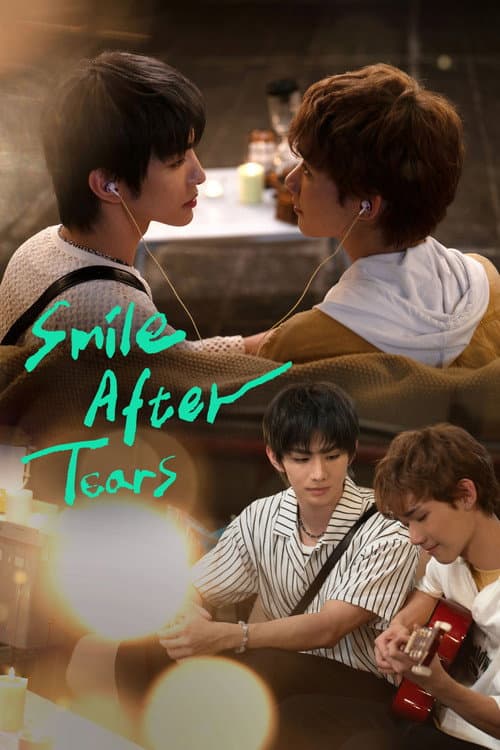
Smile After Tears (轉過頭幫你擦眼淚) is a Chinese-language television series set to release on May 20, 2026. The series follows a cheerful student who finds healing and connection through the boy who remained by his side after a tragic accident separates them from someone they cared for.
Smile After Tears is scheduled to release on May 20, 2026.
The series follows a cheerful student who, after a tragic accident, finds healing and an unexpected romantic connection through the boy who remained by his side.
The original Chinese title is 轉過頭幫你擦眼淚.
The series is produced in Chinese (Mandarin).
A Taiwanese youth drama titled Smile After Tears — subtitled in Chinese as 轉過頭幫你擦眼淚, roughly translating to "Turn Around and Wipe Your Tears" — is set to release on May 20, 2026. The series is a production of BRAINS and TPOP Entertainment Co., Ltd., and arrives as a single-season, single-episode entry, an unusual structural choice that immediately distinguishes it from the episodic format most viewers associate with the genre.
The story centers on three young people whose trajectories converge: an optimistic transfer student, a lead singer described as dazzling, and a quiet basketball player. What draws them together is the familiar architecture of youth — the bittersweet pressures of self-discovery, the particular ache of first or formative love, and the way adolescence has a habit of forcing people into one another's orbit before any of them are ready. These are well-worn coordinates in Taiwanese teen drama, a genre with a long and culturally significant history on the island. Series built around school settings, love triangles or threesomes of entangled feeling, and coming-of-age emotional reckoning have been a fixture of Taiwanese television for decades, and Smile After Tears positions itself squarely within that tradition.
What is less immediately legible is why the production has chosen the format it has. A series catalogued as having one season and one episode sits somewhere between a feature-length special, a pilot, and a standalone film — categories that carry different expectations for pacing, character development, and resolution. Youth dramas in particular tend to rely on serial structure to let relationships breathe, to allow the slow accumulation of glances and misunderstandings and late-night conversations that makes the emotional payoff feel earned. Compressing that into a single episode could mean the production is operating closer to a short film or an extended teaser, or it could reflect a release strategy in which the episode is feature-length. None of that is clarified by what is currently known about the project.
The genre tagging is also worth noting. Smile After Tears is categorized under both drama and science fiction/fantasy, a pairing that sits somewhat in tension with the grounded, emotionally realist description of its premise. A transfer student, a singer, a basketball player navigating love and identity — nothing in that framing suggests fantastical or speculative elements. Whether the science fiction and fantasy classification reflects a supernatural subplot, a stylistic flourish like time manipulation or alternate timelines (devices that have appeared in comparable Taiwanese youth productions), or simply an imprecise metadata tag remains unclear. It is a gap that attentive viewers will likely notice once the episode is available.
BRAINS and TPOP Entertainment Co., Ltd. are listed as the producing studios. TPOP's name suggests a possible connection to Taiwanese pop music infrastructure, which would be consistent with the emphasis on a lead singer character — a figure whose world sits at the intersection of performance, public identity, and private vulnerability. That type of character has proven durable in youth dramas across East Asia precisely because the performance-versus-authenticity tension maps neatly onto adolescent questions of self-presentation. The musician who appears one way on stage and another in quieter moments offers a built-in dramatic engine. Whether the production draws that contrast out or treats the character's musical life as primarily atmospheric backdrop is another open question.
The basketball player occupies the other pole of a familiar binary. Quiet, physically present, communicating through action rather than words — this character type recurs across the genre as a counterweight to more expressive or socially prominent figures. The transfer student, optimistic by description, often functions in these narratives as a catalyst: someone whose outsider status gives them license to see established social dynamics fresh, to disrupt equilibria that the other characters have long since stopped questioning. Whether Smile After Tears uses these archetypes as a starting point for something more textured, or leans into their familiarity as a form of comfort for an audience that comes to the genre partly for the pleasure of recognition, is something the production itself will have to demonstrate.
The subtitle — 轉過頭幫你擦眼淚 — is quietly telling. Turning around to wipe someone's tears implies proximity, a moment where emotional composure has slipped and someone else is close enough to notice and respond. It is a gesture of intimacy that doesn't announce itself, one that happens in the space between people rather than in a declaration. That specificity of image, as a title choice, suggests the production has at least a clear emotional register in mind: something tender rather than grand, attentive to small gestures rather than sweeping ones. Whether the narrative earns that image is a question May 2026 will answer.
Viewers with an existing appetite for Taiwanese youth drama, or for the broader East Asian school-age romance genre, are the most obvious audience here. The single-episode format may make it a lower-commitment entry point for those curious about the genre but wary of investing in a longer run. Anyone drawn to stories about young people navigating love and identity in a contemporary setting — and willing to sit with some unresolved questions about format and genre classification until the release itself clarifies them — will find this worth tracking.
Off Campus
DramaAmericanMay 13, 2026
Off Campus 📈 Trending
The WONDERfools
Action & AdventureKoreanMay 15, 2026
The WONDERfools
For All Mankind
DramaAmericanNov 1, 2019
For All Mankind 🔥 Hot
Euphoria
DramaAmericanJun 16, 2019
Euphoria
Margo's Got Money Troubles
DramaAmericanApr 14, 2026
Margo's Got Money Troubles
Every Year After
DramaAmericanJun 10, 2026
Every Year AfterSign in to join the conversation.