












The Shawshank Redemption
DramaSep 23, 1994
The Shawshank Redemption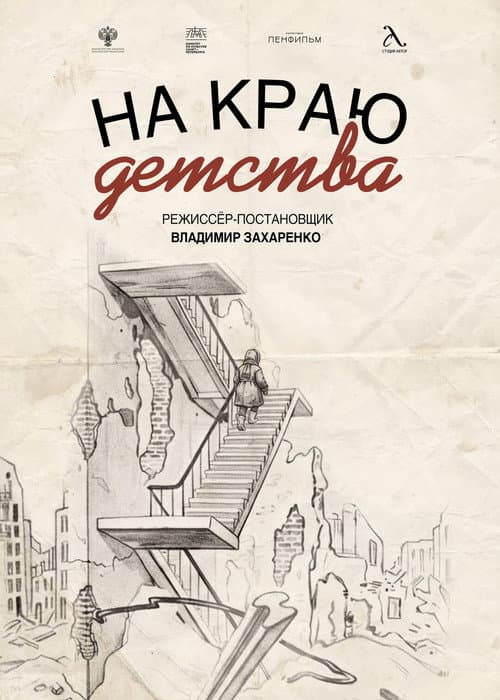
Details
Popularity · Search interest now
Based on TMDb activity
Hype score
leaderboard →On The Edge Of Childhood's trailer ranks in the top 7% for movie YouTube views.
Not currently available for streaming or purchase.
Links may earn Incoming a commission at no extra cost to you.
Incoming Editorial TeamVerified
On the Edge of Childhood (На краю детства) is a Russian historical drama produced by Lenfilm, releasing on August 7, 2026. Set in besieged Leningrad during the winter of 1942, it follows 14-year-old Tamara Eremenko as she attempts to secure work as a mail carrier to survive and protect her sister.
On the Edge of Childhood releases on August 7, 2026. No specific theatrical or streaming platform distribution has been announced in the available data.
No streaming platform has been confirmed for On the Edge of Childhood at this time. Distribution details beyond the release date have not been announced.
The film is produced by Lenfilm, one of Russia's oldest film studios, historically based in Saint Petersburg (formerly Leningrad). No director has been specified in the available data.
The film follows Tamara Eremenko, a 14-year-old girl living through the Siege of Leningrad in the winter of 1942. When mail trucks reach the city for the first time in months, she takes on the task of delivering six letters to prove herself fit for a job as a postal carrier, driven by the need to survive the winter and protect her sister.
On the Edge of Childhood is a drama and history film. It is set against the documented historical backdrop of the Siege of Leningrad and focuses on the personal survival of its protagonist during that period.
A Russian-language historical drama titled On the Edge of Childhood — known in its original Russian as На краю детства — is scheduled for release on August 7, 2026. The film is a production of Lenfilm and Author Studio, two Russian production entities, and centers on a fourteen-year-old girl named Tamara Eremenko navigating the siege of Leningrad during the winter of 1942.
The premise is narrow and specific in the way that the strongest wartime dramas often are: not the sweep of a military campaign, but a single character's survival compressed into a concrete task. Tamara arrives at the Leningrad Main Post Office during a period when a convoy of mail trucks has reached the city for the first time in months — a small logistical miracle amid catastrophic conditions. The post office is desperately short of carriers. Tamara must deliver six letters and demonstrate she is capable of the work, with the aim of securing employment that will allow her and her sister to survive the winter. The dramatic architecture is almost classical in its economy: a defined test, a defined stakes, a character with no margin for failure.
It is worth pausing on the setting, because the siege of Leningrad carries a particular weight in Russian cultural memory and in the broader history of twentieth-century urban warfare. The blockade lasted roughly 872 days in total; the winter of 1942 fell within its most lethal phase, when starvation, cold, and the near-complete severance of supply lines killed civilians in enormous numbers. Films and literature set during this period are not uncommon in Russian cinema, but the choice to filter the siege through the perspective of a fourteen-year-old girl — and specifically through the mundane, almost absurdist task of postal delivery — sets this production apart from the more familiar battle-centered or political treatments of the subject. The film appears less interested in the siege as historical spectacle than in what ordinary civic infrastructure meant to the people trapped inside it: a letter arriving in a city under blockade is not a small thing.
The involvement of Lenfilm is notable in this context. The studio, based in St. Petersburg — the city that was Leningrad — has a long history with material drawn from that city's wartime experience, and its geographic and institutional connection to the subject gives the project a certain rootedness that an outside production might lack. Author Studio's role in the production is not elaborated upon in the available information, so the precise creative division of labor between the two companies remains unclear from what has been made public.
Several questions about the film remain open. The director is not identified in the available materials, which makes it difficult to gauge the project's tonal and stylistic orientation — whether it leans toward the restrained, documentary-inflected tradition of Soviet-era war films, toward something more contemporary in its approach to subjective experience, or toward a more conventional prestige-drama register. Similarly, the screenplay's origins are unspecified. It is not clear whether the story of Tamara Eremenko is drawn from a documented historical account, a literary source, or an original script — a distinction that matters when the subject is as historically charged as the Leningrad siege, where the line between dramatization and testimony has always been contested. The cast has not been announced in the materials provided, which means there is no performer's prior work to use as a frame of reference for how the central role might be interpreted.
The film's release date — August 7, 2026 — places it in late summer, a scheduling position that in many markets sits between the festival-driven prestige window of autumn and the commercial orientation of summer. Whether the film will follow a festival circuit before its release, or whether the August date represents a domestic Russian theatrical opening, is not specified. The absence of a noted origin country in the metadata is a minor curiosity given the clearly Russian-language production and the Lenfilm affiliation, though it has no practical bearing on what the film appears to be.
The emotional logic of the story is straightforward enough to be legible without further context: a child, a city dying, and a task that is simultaneously trivial in peacetime and freighted with survival under siege conditions. The six letters Tamara must deliver function as the film's structural spine — each delivery presumably a small encounter with the city's condition and its remaining inhabitants — and the question of what she finds when she delivers them, or what delivering them costs her, is where the film's actual drama will live. The ending point described in the premise, in which she is hired as a postman, is less a resolution than a beginning: she has proven herself fit to keep doing this dangerous, necessary work. Whether the film treats that outcome as a kind of victory or as a more ambiguous absorption of a child into the machinery of a city's desperation is one of the genuinely interesting interpretive questions the available information leaves open.
Audiences drawn to this film are likely those with an existing interest in World War II's Eastern Front as depicted through civilian rather than military experience, in Russian-language cinema, or in stories centered on young protagonists placed under conditions of genuine historical extremity. The subject matter is not light, and the setting — winter in a blockaded city, 1942 — does not suggest a film that softens its historical ground. The Lenfilm connection may also attract viewers familiar with the studio's legacy who are curious about how a contemporary production from that house approaches one of the defining catastrophes in the city's history.
The Shawshank Redemption
DramaSep 23, 1994
The Shawshank Redemption 📈 Trending
Rosebush Pruning
ComedyApr 23, 2026
Rosebush Pruning ⭐ Popular
The Odyssey
AdventureJul 15, 2026
The Odyssey 📈 Trending
Your Heart Will Be Broken
RomanceMar 26, 2026
Your Heart Will Be Broken 📈 Trending
Obsession
HorrorMay 13, 2026
Obsession
Never After Dark
HorrorJun 5, 2026
Never After DarkSign in to join the conversation.