


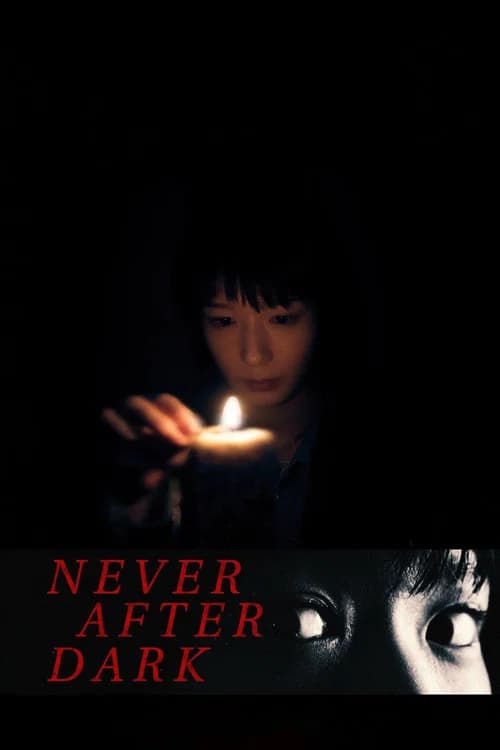
Never After Dark
HorrorJun 5, 2026
Never After Dark
Details
Rating · Quality score from voters
Popularity · Search interest now
Based on TMDb activity
Not currently available for streaming or purchase.
Links may earn Incoming a commission at no extra cost to you.
Incoming Editorial TeamVerified
In the Realm of the Senses (愛のコリーダ) is a Japanese drama-romance film produced by Argos Films, releasing September 15, 1976. It dramatizes the real-life story of Sada Abe, whose obsessive sexual relationship with her master ended in destruction.
In the Realm of the Senses releases on September 15, 1976. It is available for streaming on the Criterion Channel.
In the Realm of the Senses is available to stream on the Criterion Channel, which specializes in classic and art-house cinema.
The film dramatizes the true story of Sada Abe, a Japanese woman whose affair with her master developed into an obsessive and destructive sexual relationship. The case became one of the most notorious criminal incidents in 1930s Japan.
The film is categorized as drama and romance. It focuses on an intense, obsessive relationship drawn from a real historical event.
In the Realm of the Senses (Japanese title: 愛のコリーダ, Ai no korīda), directed by Nagisa Oshima and produced through a collaboration between Argos Films, Oshima Productions, and the Shibata Organisation, was released on September 15, 1976. It arrives — or rather, arrived and has continued to circulate — as one of the more persistently debated works in postwar Japanese cinema, a film whose reputation precedes it so thoroughly that the work itself can be difficult to see clearly.
The film draws from the historical case of Sada Abe, a woman whose intensely obsessive sexual relationship with her employer escalated toward a conclusion that became one of prewar Japan's most sensational criminal episodes. Oshima's treatment is direct in a way that distinguishes it sharply from most fiction films: the relationship between Sada and her master is rendered with an explicitness that placed the film in a legal and cultural category of its own at the time of release. It was shot in Japan but processed and edited in France — specifically through the involvement of Argos Films, the Paris-based producer with a long history of backing transgressive European art cinema — in part to navigate the censorship environment that governed film distribution in Japan. That production arrangement meant the film existed in a kind of jurisdictional limbo for years, screened internationally while remaining legally complicated in its country of origin.
The involvement of Argos Films is worth dwelling on briefly. The company had been associated with directors like Alain Resnais and Chris Marker, and its backing of Oshima placed In the Realm of the Senses within a lineage of European art-house production that treated explicit content as a legitimate province of serious filmmaking rather than a category to be cordoned off. Whether or not that framing fully resolved the questions the film raised — about the boundary between cinema and pornography, about the ethics of depicting actual sex acts within a narrative context — is something critics and censors in multiple countries have continued to argue over in the decades since.
What is known about the source material is relatively spare in useful ways. The Sada Abe case was real, and the broad outlines of what happened — an affair, an obsession, a death, an act of mutilation that Abe carried out and was subsequently arrested for — are matters of historical record. Oshima's film is described as a "passionate telling" of that story, which signals adaptation rather than documentary reconstruction. The degree to which the film departs from, compresses, or reinterprets the historical record is a question the film's premise raises but does not fully answer in advance. Viewers arriving with knowledge of the Abe case will likely find themselves measuring the film against history; those arriving without that knowledge will encounter the events on their own terms.
The film is classified as drama and romance in its genre designations, which is technically accurate and also somewhat insufficient. The romance classification situates it within a tradition of films about destructive love — works in which desire and annihilation are depicted as aspects of the same impulse — but the explicitness of Oshima's approach sets it apart from most films that would occupy that category in a standard release calendar. That distinction has been central to how the film has been received and discussed: as an object of censorship battles, as a provocation, as a work of art, as all of these simultaneously.
Its current streaming availability on the Criterion Channel is the clearest contemporary context for approaching the film. The Criterion Collection has long functioned as a kind of institutional endorsement within arthouse cinema, and the film's placement there signals that it is being framed, in 2024, as a work of cinema history rather than primarily as a confrontational or transgressive act. That reframing does not dissolve the questions the film raises, but it does alter the conditions under which a viewer encounters it. Watching something on a subscription streaming platform, recommended alongside other canonical works, is a fundamentally different experience from encountering a film that could not legally be screened in its country of origin.
The film holds an 84 percent score on Rotten Tomatoes alongside an IMDB rating of 6.6 across roughly 24,000 votes — a split that is itself interesting. Critical consensus and audience response have not converged neatly, which is perhaps unsurprising for a film whose content guarantees that a portion of viewers will approach it with expectations the film may not satisfy in conventional terms. Neither number should be taken as a definitive verdict, and neither is offered as one here.
The audience most likely to seek out In the Realm of the Senses at this point falls into a few overlapping groups: viewers working through the canon of Japanese art cinema, those interested in the history of censorship and its relationship to film form, and viewers drawn to films that treat erotic subject matter with directorial seriousness rather than genre convention. For any of these viewers, the Criterion Channel availability makes access more straightforward than it has been at various points in the film's history — which is itself a minor historical fact worth noting.
Never After Dark
HorrorJun 5, 2026
Never After Dark 📈 Trending
Rosebush Pruning
ComedyApr 23, 2026
Rosebush Pruning
The Last Sunrise
RomanceAug 26, 2026
The Last Sunrise ⭐ Popular
Pinocchio: Unstrung
HorrorJul 22, 2026
Pinocchio: Unstrung 📈 Trending
Obsession
HorrorMay 13, 2026
Obsession
Nightborn
HorrorJul 1, 2026
NightbornSign in to join the conversation.