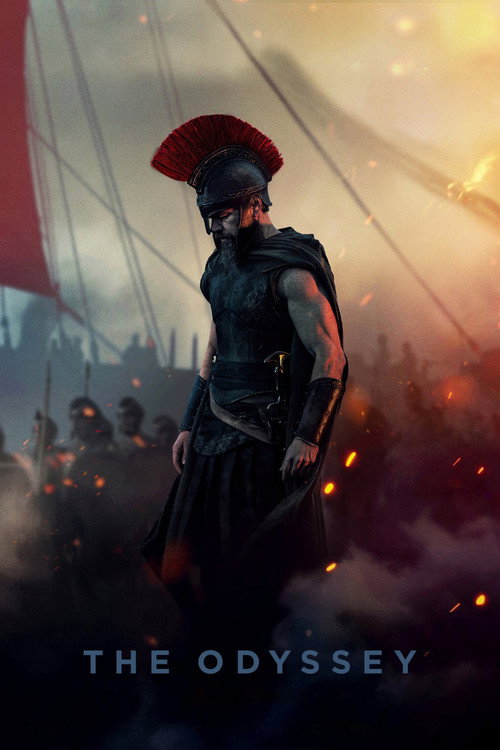
When the casting announcement dropped in early 2025, the reaction was swift and not particularly kind. Matt Damon. As Odysseus, King of Ithaca, cunning survivor of Troy, wanderer of mythological seas. The man who played Jason Bourne and an astronaut stranded on Mars was supposed to carry one of the most ambitious literary adaptations in cinema history.
The skepticism was understandable. Damon carries a distinctly American everyman energy that feels nothing like the marble-statue heroism people associate with Greek mythology. He's not a physical marvel. He doesn't radiate ancient grandeur. And with Christopher Nolan directing an IMAX 70mm epic built entirely on practical effects, the stakes for every performance choice were unusually high.
Three weeks after release, The Odyssey sits at 8.5 on IMDb with over 318,000 votes, 88 on Metacritic, 95% on Rotten Tomatoes, and — the one that matters most to the cinephile crowd — 4.4/5 on Letterboxd. That last number is genuinely rare for a summer blockbuster. The debate is settled.
| Director | Christopher Nolan |
|---|---|
| Key Cast | Matt Damon, Anne Hathaway, Tom Holland, Zendaya |
| Runtime | 173 mins • Native 70mm IMAX |
| IMDb | 8.5 / 10 (318k votes) |
| Metacritic | 88 / 100 |
| Rotten Tomatoes | 95% critics / 97% audience |
| Letterboxd | 4.4 / 5 |
Why Casting Matt Damon Was Nolan's Most Brilliant Gamble

Here's the thing the skeptics missed: Homer never described Odysseus as physically imposing. The Greek word used repeatedly throughout the Odyssey is polytropos, meaning something close to "of many turns" or "many-minded." Not strongest. Not tallest. Not most beautiful. Wily. Adaptable. Burdened.
Nolan understood this. His Odysseus isn't the kind of hero who wins through brute strength — he's a man who has been fighting for a decade, who has watched people die, who wants nothing more than to sit in his own home and sleep in his own bed. The exhaustion isn't a weakness in the performance. It's the entire point.
Damon brings exactly that. Watch the scene midway through the film where Odysseus reaches Calypso's island — Charlize Theron, in what is genuinely the most quietly devastating performance in the supporting cast — and the first thing he does is sit down heavily on a rock and stare at the water. No speech. No dramatic declaration. Just a man who has been running for too long, finally stopping. It's a 45-second scene that does more character work than most films manage in an hour.
Beyond Damon: Tom Holland, Anne Hathaway, and the Scene-Stealers






Tom Holland as Telemachus deserves more attention than he's getting. Coming off Spider-Man: Brand New Day in the same summer, Holland is doing something completely different here — quieter, angrier, working through the resentment of a son who grew up without a father while also desperately wanting that father to come home. His scenes with Damon in the final act are genuinely affecting in ways the trailers didn't hint at.
Anne Hathaway's Penelope is the film's structural anchor. While Odysseus is out navigating gods and sea monsters, Penelope is doing the harder political work: managing a household full of men who assume she's available, buying time through a weaving ruse that has gone on long enough to become its own kind of torment. Hathaway plays her with a controlled fury that never tips into melodrama.
Robert Pattinson as Antinous is exactly as unsettling as he needs to be. Pattinson has spent the last several years picking roles that let him be weird, and Antinous — entitled, casually cruel, genuinely convinced of his own right to take what he wants — fits that instinct well. Zendaya gets less screen time as Athena than her billing suggests, but her appearances carry enough authority that the imbalance doesn't register while you're watching.
To be fair: the film's structure is uneven in its middle section. The Circe episode, which should be a highlight, feels compressed in ways that suggest significant material ended up on a cutting room floor. At 173 minutes, The Odyssey is already long. It's worth knowing going in that it earns its runtime in the first and third acts more convincingly than the second.
70mm IMAX Practical Magic: Why You Can't Watch This on a Normal Screen

Nolan shot on 70mm IMAX film and refused to use CGI as a primary visual tool. The Cyclops is a practical effects achievement. The storms are real water, real wind, real actors on real rigs. On a standard screen this would still be a handsome film. On IMAX, it's something else.
The format does something specific to Damon's performance: it catches detail that digital would smooth over. The lines around his eyes. The way his hands move when he's thinking. The grain of the film itself works in the story's favor — this is a 3,000-year-old poem, and the images feel like they have weight and age in them.
If you haven't seen it yet, IMAX is not optional. This is a film designed for the largest possible frame, and seeing it on a laptop would be like reading the poem in a bad translation.
The 4.4 Letterboxd Phenomenon: How Nolan Silenced the Critics
A Letterboxd average of 4.4/5 is the kind of number that happens maybe twice a year. It means critics liked it, yes — but it also means the cinephile audience, which is typically more hostile to prestige Hollywood epics, came away convinced. That audience is hard to impress and quick to punish anything that feels like an expensive middle of the road.
The Odyssey isn't middle of the road. It's an 88 Metacritic film that also performed commercially at scale, which is an increasingly rare combination in contemporary studio filmmaking. It's the second time since The Dark Knight Rises that Nolan has combined a Metacritic score in the high 80s or above with a number-one opening, after Dunkirk (94 Metacritic) in 2017. Few directors working in studio filmmaking can point to that kind of track record.
Damon's performance is the reason the score is 4.4 and not 3.8. A weaker central performance and this becomes a technically impressive but emotionally cold epic. Instead it's a film that people are watching twice.
Frequently Asked Questions
Is The Odyssey (2026) based directly on Homer's poem? Yes. Nolan wrote the screenplay himself, adapting Homer's Odyssey directly rather than using an intermediate source. The film follows the broad structure of the poem — Troy, the sea journey, Ithaca — while compressing several episodes and streamlining the subplot involving Telemachus.
Do you need to know the original poem to follow the film? No prior knowledge required. The film is designed to work for audiences with no background in Greek mythology. Knowing the story in advance will sharpen your appreciation of certain choices Nolan makes, but it's not necessary.
How long is The Odyssey (2026)? 173 minutes, including credits. Plan accordingly.
Is it worth seeing in IMAX? Emphatically yes. Nolan shot the film on 70mm IMAX film stock with practical effects throughout. The format is central to the experience in a way that most IMAX releases are not.
What is Matt Damon's role in The Odyssey? Damon plays Odysseus, King of Ithaca, returning home after ten years fighting in the Trojan War and another decade lost at sea. The role is the film's lead and its emotional center.
Where can I watch The Odyssey (2026)? Currently in theatrical release. A streaming release date has not been announced.