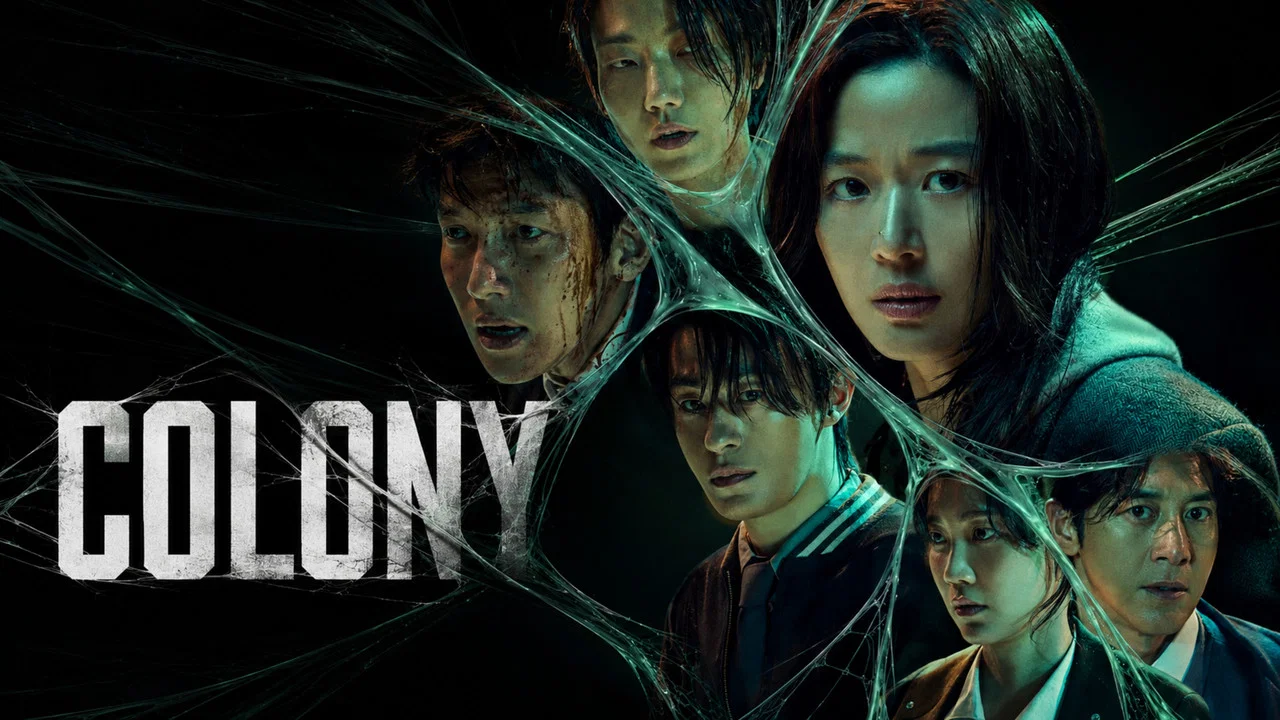
🍅71%Tomatometer
In May 2016, Yeon Sang-ho brought Train to Busan to the Midnight Screenings section at Cannes. The film about a high-speed train overrun by the undead became one of the most globally replicated zombie movies ever made — not because its zombies were novel, but because its humans were. The infection was standard viral horror. The survival calculus — who you sacrifice, who you protect, whether solidarity or self-interest wins — was not.
In May 2026, Yeon Sang-ho brought Colony to the Midnight Screenings section at Cannes. Same director. Same section. Same genre. Entirely different rules.
Before Colony even hits North American theaters on August 28, 2026, it has already crossed 5.95 million admissions in South Korea to become the highest-grossing domestic film of the year. Add pre-sales across 120+ international territories, strong early runs across Asia and Europe, and a worldwide box office approaching $50 million before a single American has bought a ticket.
None of this is unusual for Korean genre cinema in 2026. What is genuinely unsettling this time around is what the infected actually are.
The Slime-Mold Nightmare: Why Colony's Infected Don't Just Attack — They Learn
The setup starts simply enough: a biotech conference at the sealed Dongwoo-ri office tower in Seoul. A rogue scientist named Seo Young-cheol releases a mutated slime-mold pathogen into the ventilation system. Authorities seal the exits. The infection spreads.
This is where Colony abandons standard zombie tropes.
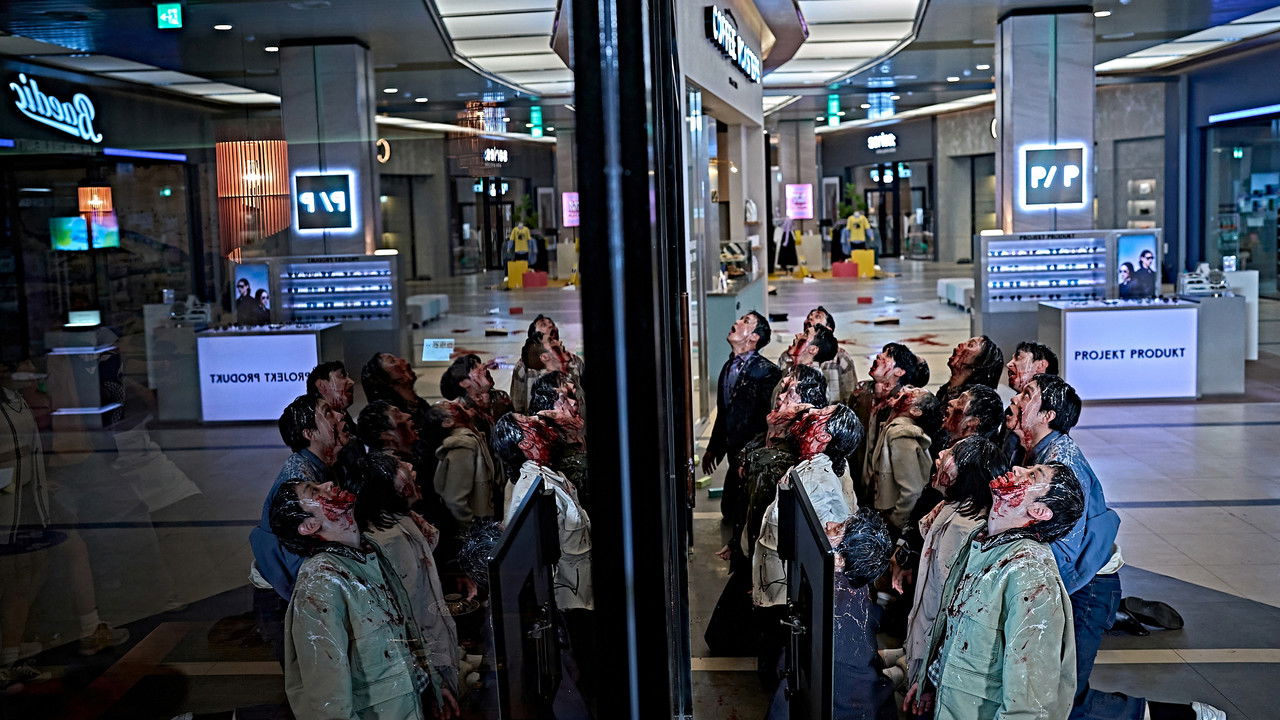
The pathogen does not turn people into mindless individual monsters. It creates a colony. Every infected host connects to every other through a shared neural network — a distributed biological superorganism operating much like a slime mold or a beehive. When one infected host discovers that a left-side barricade is weak, that tactical knowledge propagates instantly to every creature in the building. When one learns a survivor's hiding spot, the hive processes it simultaneously. The threat compounds in real time, constantly adapting. You cannot outmaneuver them the way you outrun a solitary attacker.
Yeon Sang-ho on the central visual challenge: "The hardest part was figuring out how to visually express zombies that exist in the form of a colony with collective intelligence. To convey that intuitively to the audience, the movement of the zombies had to be unique."
To pull it off, Yeon brought back zombie choreographer Jeon Young — the mastermind behind the frantic physical movement in Train to Busan, Peninsula, and Hellbound. In Colony, the infected move not as an uncoordinated mob but as a single fluid wave. They re-route around failed chokepoints and treat every human survival tactic as data to be solved. It is the chilling difference between being hunted by a predator and being solved by an algorithm.
From Pandemic Panic to AI Paranoia: The Evolution of Zombie Horror
Train to Busan's zombies were terrifying because of raw speed and exponential contagion. The horror of 2016 was viral: one bite, thirty seconds, an entire train car gone. The infected didn't care who you were — your identity, intellect, and emotional bonds were meaningless against the mindless surge.
Colony's infected represent a fundamentally different category of fear. The horror here is not exponential infection rate but real-time collective adaptation — a biological network that grows smarter with every failed defense, turning human ingenuity into data points to process. It shifts the stakes from the fear of being overrun to the fear of being outthought.
Yeon was explicit about this allegory at Cannes: "For me, the greatest fear is the high-speed communication exchange. It's like a living organism and, in a way, it reduces our individualism, our individuality."
The biological foundation is intentionally specific. Slime molds — Physarum polycephalum is the most studied — are single-celled organisms that fuse into coordinated collectives under environmental stress, solving maze problems and routing chemical signals across millions of nodes without a central brain. They are the biological proof-of-concept that distributed intelligence without a central director is not only possible but efficient.
Colony was written and filmed in 2024 and 2025. Every month of that period produced a new story about AI systems that learned faster from failure than humans could predict, about information networks that coordinated behavior across millions of nodes without a director, about the erosion of individual privacy into collective data. The film isn't a preachy parable. It is a high-octane genre mechanism built for contemporary paranoia.
Jun Ji-hyun's Genre Comeback Swaps Horror Tropes for Cold Logic
Leading the defense is Jun Ji-hyun — credited internationally as Gianna Jun — as Professor Kwon Se-jeong, a biotechnology researcher whose analytical mind becomes the survivors' primary weapon against the hive.
Jun Ji-hyun is one of South Korea's most iconic actors, having redefined global Hallyu drama with My Love from the Star (2013), anchored the spy-action blockbuster Assassination (2015) — one of the highest-grossing Korean films of that decade — and appeared in the zombie Netflix special Kingdom: Ashin of the North (2021). Colony is her first full theatrical horror film, and her most prominent genre lead role to date. She does not play a screaming victim or a stereotypical action heroine. She plays the strategist doing real-time research under siege — dissecting the biological mechanics of the hive, running experiments while the building falls apart around her, looking for the one weakness a networked organism might not have thought to protect.
Ji Chang-wook plays Choi Hyun-seok, the building's security guard and the film's action center, motivated by protecting his mobility-impaired sister trapped inside. Koo Kyo-hwan delivers tightly controlled menace as Seo Young-cheol, the scientist who released the pathogen and still holds the only existing vaccine.
The film is structured around two incompatible kinds of intelligence: Se-jeong's analytical understanding of what the colony is, and Young-cheol's operational knowledge of how to stop it. The building will not be unlocked until they interact. That interaction does not go smoothly.
Editorial note: Viewers expecting the tear-jerking family melodrama of Train to Busan should adjust expectations now. Colony is a cold, calculated chess match between human ingenuity and networked intelligence — and it is all the better for it. Jun Ji-hyun's precise, controlled performance gives the film its intellectual backbone precisely because she refuses to play it for sentiment.
Moving Past Peninsula: How Yeon Sang-ho Changed the Rules Again
Between Train to Busan (2016) and Colony (2026), Yeon Sang-ho navigated a mixed landscape. He directed Peninsula (2020), the sci-fi thriller Jung_E (2023), and hit Netflix series including Hellbound, Parasyte: The Grey, and Revelations.
Peninsula earned 55% on Rotten Tomatoes, largely because it abandoned the claustrophobic pressure cooker of the original for a sprawling post-apocalyptic open world. The strengths of Train to Busan were its constraints: a closed space, a small group, escalating stakes with nowhere to go. Expansion lost the mechanism.
Colony avoids that trap entirely by establishing an independent universe with no narrative ties to Train to Busan. Different virus, different environment, different rules.
The 71% Tomatometer and 56 Metacritic reflect a film that divides critics along a clear line: those who embrace tight logic-puzzle survival thrillers tend toward four or five stars, while those who came expecting Train to Busan's emotional heat find Colony colder in register. Brian Tallerico at RogerEbert.com was among the latter, arguing the film misses the sustained emotional siege that made the original so devastating — "Maybe Sang-ho needed the confined space of a train." The comparison is fair and also misses the point. Colony is not trying to replicate Train to Busan. It is trying to build a different kind of fear.
5.9 Million Tickets Later: Colony Proves Original K-Horror Still Dominates
Opening on May 21, 2026, across 2,110 Korean screens, Colony posted 199,768 opening-day admissions and crossed 3 million tickets in just ten days — the fastest of any 2026 Korean release to that milestone. At 5.95 million admissions, it stands as the year's top Korean domestic film.
For context: Train to Busan reached 11 million admissions in 2016, but today's theatrical window is significantly shorter. In a 2026 landscape where Hollywood tentpoles frequently struggle to find Korean audiences, crossing 5 million admissions as a standalone original IP — no franchise, no pre-existing fanbase — is a genuine commercial landmark.
The international rollout underlines Korea's dominant position in global genre cinema: pre-sold to 120+ territories before Cannes, rapid theatrical launches across France, Taiwan, Australia, and New Zealand, StudioCanal handling the UK, Gaga Corporation taking Japan. Well Go USA's August 28 North American release — the same distributor that brought Train to Busan to American theaters in 2016 — ensures the film gets the theatrical push it deserves.
What Hollywood Needs to Learn from Colony
Hollywood usually draws one conclusion from Korean genre success: buy the remake rights. That playbook has been running since Train to Busan in 2016 and Parasite in 2020. Remakes rarely capture the spark of the originals.
The real lesson of Colony is about genre evolution. The zombie has always been a container for the fears of its moment:
- 1960s — Racial tension, social conformity, and the violence of the American mainstream (Night of the Living Dead)
- 2000s — Global pandemic and biological dread (28 Days Later)
- 2016 — Collapse of social solidarity under survival pressure (Train to Busan)
- 2026 — Loss of individual agency to networked collective intelligence (Colony)
Yeon Sang-ho did not repeat himself. He asked what audiences are genuinely afraid of in 2026 and built a new mechanism around it. The monster changed because the fear changed. That is the lesson. The director who made Train to Busan is still asking the same question: what are you most afraid of right now, and what does it look like when it tries to kill you?
The answer has changed. The question has not.
Frequently Asked Questions
Is Colony a sequel to Train to Busan? No. Colony is a completely standalone film with no narrative connection to Train to Busan or Peninsula. It features an entirely new setting, characters, virus mechanism, and universe. Yeon Sang-ho has confirmed the two films share no continuity.
Who stars in Colony? Jun Ji-hyun (Gianna Jun) stars as Professor Kwon Se-jeong, a biotechnology researcher and the film's lead protagonist. Ji Chang-wook plays building security guard Choi Hyun-seok. Koo Kyo-hwan plays rogue scientist Seo Young-cheol. Go Soo also makes a special appearance.
What makes Colony's zombies different? Unlike traditional mindless zombies, Colony's infected are connected via a shared biological neural network derived from a mutated slime-mold pathogen. They operate as a hive-mind superorganism that learns from every failed attack and adapts its coordination in real time.
When does Colony open in the US? Colony opens in US and Canadian theaters on August 28, 2026, distributed by Well Go USA Entertainment.
How did Colony perform at the South Korean box office? Colony has sold over 5.95 million tickets in South Korea — the highest-grossing domestic film of 2026. It crossed 3 million admissions in just 10 days, the fastest of any Korean release that year.
What is Colony's Rotten Tomatoes score? Colony holds a 71% Tomatometer score based on 48 critic reviews, with an average rating of 6.9/10. A written consensus quote has not yet been published.
Did Colony premiere at the Cannes Film Festival? Yes. Colony made its world premiere in the Midnight Screenings section at the 2026 Cannes Film Festival on May 15 — the same section where Train to Busan debuted in 2016.