
Details
- Language
- German
- Country
- DE
- Studio
- Letterbox Filmproduktion
- Seasons
- 1 · 7 eps
Popularity · Search interest now
Low
2.0
Based on TMDb activity
Starring







Where to watch
Not currently available for streaming or purchase.
Links may earn Incoming a commission at no extra cost to you.
Incoming Editorial TeamVerified
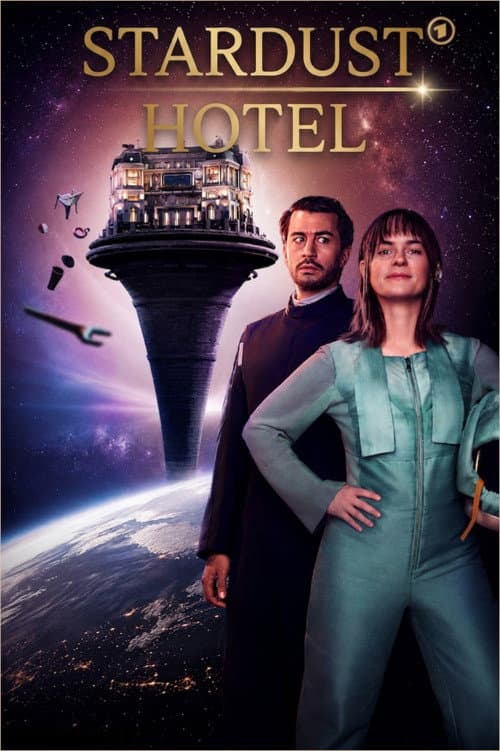
The Stardust Hotel is a German-language television series set to release on May 22, 2026. The show follows Nia, a woman burdened by debt who inherits a dilapidated grand hotel located in space, and her efforts to restore it alongside its staff.
Episodes
✓ Previously aired
Key features
- ·German-language television series
- ·Space-set hotel drama
- ·Romantic subplot between lead characters
- ·Ensemble cast including hotel staff
- ·Premieres May 22, 2026
FAQ
When does The Stardust Hotel release?
The Stardust Hotel is scheduled to release on May 22, 2026.
What is The Stardust Hotel about?
The series follows Nia, a debt-ridden woman who inherits a run-down grand hotel in space and must restore it to sell it, while navigating a chaotic staff and her feelings for head concierge Adam.
What language is The Stardust Hotel in?
The Stardust Hotel is a German-language production.
Who is the main character in The Stardust Hotel?
The main character is Nia, a homeless woman in debt who unexpectedly inherits the Stardust Hotel. Adam, the head concierge, is a central supporting character.
About this release
A German science-fiction comedy series called The Stardust Hotel is set to arrive on May 22, 2026, produced by Letterbox Filmproduktion. The show runs for a single season of seven episodes, and its premise is compact enough to state plainly: a woman named Nia, homeless and buried in debt, inherits a dilapidated grand hotel — one that happens to be located in space — and immediately begins calculating how to sell it before it consumes what little she has left.
The setup belongs to a recognizable comedic tradition, one that pairs an unwilling inheritor with a property that refuses to behave. The country house in disrepair, the failing family business, the crumbling estate that arrives with strings attached — these are reliable engines of situational comedy precisely because they trap a protagonist between two equally unappealing options: stay and suffer, or leave and lose. The Stardust Hotel transplants that structure into orbit, which does something interesting to the stakes. A rundown hotel on Earth can be abandoned; a rundown hotel in space presumably cannot be walked away from quite so easily, and that geographic (or astronomical) fact shapes the particular pressure Nia finds herself under. The science-fiction setting is not incidental window dressing. It is, at least structurally, what makes the trap inescapable.
Letterbox Filmproduktion is a German production company, and the show's original language is German, which situates it within a growing body of German-language genre television that has found international audiences through streaming platforms in recent years. The series does not appear to have accumulated viewer data yet — its TMDB vote count stands at zero ahead of release — which is consistent with a production that has not yet screened widely. Whether it arrives with subtitles, dubbing, or both for non-German-speaking audiences is not addressed in the available materials, though the question will matter considerably for how broadly it circulates.
What is known about the plot centers on a fairly classical tension between short-term pragmatism and longer-term investment. Nia's stated goal is to sell the Stardust quickly, which means she needs it to look viable, which means she needs guests, which means she needs staff, which means she needs Adam — the head concierge — to cooperate. The dynamic between Nia and Adam is framed as both a practical alliance and a romantic complication. She delivers what the synopsis describes as a passionate speech to convince him to join in restoring the hotel, which suggests the show understands that the heart of the series is less the hotel itself than the negotiation between these two characters over what the place is worth and what it might become.
Seven episodes is a tidy number for this kind of story. It allows for a structured arc without demanding the kind of sprawl that a longer season would require, and it suggests the creative team has a reasonably clear idea of where the season ends. Whether that ending resolves the central questions — Does Nia sell? Does the hotel recover? What happens between her and Adam? — or deliberately leaves threads open for a potential continuation is unknown. Given that the show is listed as a single season, it may have been conceived as a self-contained story, though that designation could also simply reflect what has been commissioned to date.
The comedy-science-fiction pairing is less common than either genre on its own, and the specific flavor here — workplace comedy in an unlikely setting, romantic tension between co-workers with competing interests, a property that must be made presentable against the clock — pulls more from the workplace sitcom tradition than from the kind of science fiction that concerns itself with technology or existential scale. The "grand hotel" framing is also worth noting. Grand hotels as settings carry their own cultural weight: they suggest faded glamour, a past that was more lustrous than the present, and a class of clientele that may or may not still exist. Placing that institution in space preserves all of that melancholy while adding a layer of absurdity that the show, based on its premise, appears to lean into rather than resolve.
What remains genuinely open is the show's tone. The premise can support everything from broad farce to something closer to dry, melancholic comedy, and without any footage or critical response yet available, it is difficult to know where on that spectrum The Stardust Hotel lands. The staff described as "chaos" could mean slapstick ensemble work or something more understated. The romantic subplot between Nia and Adam could be the emotional center of the series or a secondary thread. The science-fiction elements — beyond the fact of a hotel in space — are entirely undescribed, leaving open questions about how the show treats the logistics and visual grammar of its setting.
Viewers drawn to German-language genre productions, to workplace comedies with an unconventional physical setting, or to romantic storylines embedded in high-concept premises are the most natural audience for The Stardust Hotel. At seven episodes, the commitment is modest, and the central hook — a reluctant owner, a stubborn concierge, and a hotel that requires saving before it can be sold — is coherent enough to carry a first episode without demanding significant prior knowledge or investment.
Comments
Sign in to join the conversation.
Loading…