Details
- Language
- English
- Country
- GB
- Studio
- Lifted Entertainment
- Seasons
- 1 · 12 eps
Popularity · Search interest now
Low
0.9
Based on TMDb activity
Hype score
leaderboard →72
/ 100↓ -1.0 in 24h
#79 globally#30 in tv
30-day trendWP 83
The Neighbourhood's trailer ranks in the top 13% for TV YouTube views.
Starring

Where to watch
Not currently available for streaming or purchase.
Links may earn Incoming a commission at no extra cost to you.
Incoming Editorial TeamVerified
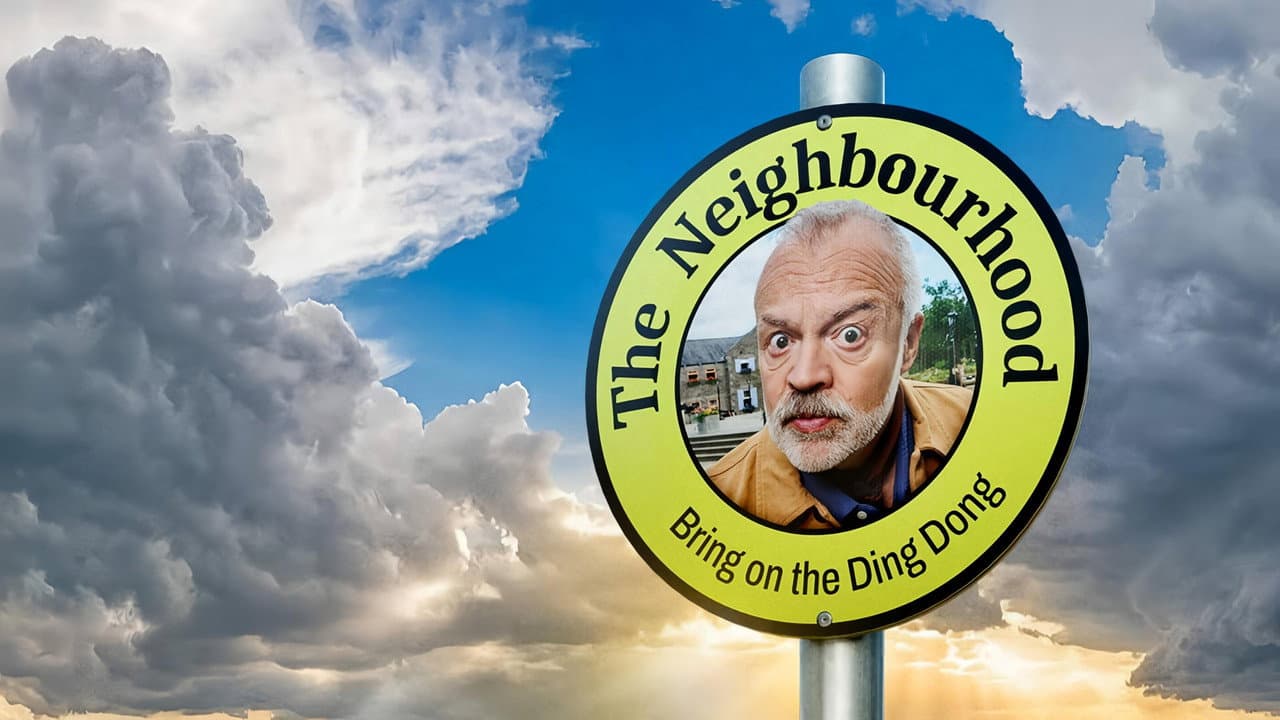
The Neighbourhood is an English-language reality competition series hosted by Graham Norton, premiering on 24 April 2026. Real households compete for a cash prize while contending with neighbours who can eliminate them from the competition.
Gallery (5)
Key features
- ·Reality competition series
- ·Hosted by Graham Norton
- ·Features real competing households
- ·Neighbours can eliminate contestants
- ·Cash prize for the winner
- ·English-language production
- ·Premieres 24 April 2026
FAQ
When does The Neighbourhood release?
The Neighbourhood premieres on 24 April 2026.
Who hosts The Neighbourhood?
The series is hosted by Graham Norton.
What is The Neighbourhood about?
Real households compete for a cash prize, with the added twist that their neighbours can vote to send them home.
Is The Neighbourhood a competition show?
Yes, it is a reality competition series in which households face elimination by fellow competing neighbours.
About this release
The Neighbourhood, a twelve-episode reality competition produced by Lifted Entertainment, The Garden Productions, and ITV Studios, is scheduled to arrive on Friday, April 24, 2026. Graham Norton hosts. The show is a British production, filmed in English, and its premise rests on a deceptively simple social experiment: real households are brought together to live as neighbours, a large cash prize sits at the centre of the arrangement, and the neighbours themselves hold the power to eliminate one another.
That last detail is where the format earns its tension. Community-based reality competition is not a new genre on British television — the country has a long tradition of shows that place strangers in constructed social environments and watch what happens when money applies pressure to civility. What distinguishes The Neighbourhood, at least on paper, is the specific framing of the domestic. These are not individuals assembled from casting calls and sorted into teams. The premise emphasises real households, units of people who already share a life together, dropped into a fabricated street or village arrangement and asked to get along with other such units — until they can't, or won't. The competitive mechanism, in which neighbours vote or otherwise act to remove one another, turns the ordinary suburban grammar of tolerance and small grievances into something with actual stakes.
Norton's involvement is worth noting. He has spent decades as one of British television's most reliable hosts, associated primarily with his long-running chat show on the BBC, and more recently with his return to ITV for various projects. His presence here signals that this is not a low-budget weeknight filler; a host of his profile and fee is typically attached to something the commissioning network intends to treat as an event. That said, hosting a reality competition of this kind is a different register from what Norton is best known for. Chat show hosting rewards wit and a kind of indulgent warmth; competition reality requires a host to manage elimination sequences, console the eliminated, and maintain the procedural logic of the format without letting warmth tip into sentimentality that undermines the competitive drama. Whether that translates is one of the things the premiere will answer.
The production itself carries three separate companies, which suggests a reasonably substantial operation. Lifted Entertainment and The Garden Productions are both experienced in the British unscripted space, and ITV Studios lends both infrastructure and a clear broadcast home. Twelve episodes is a meaningful commitment for a new format — long enough to develop genuine arcs across the households involved, and long enough for the show's elimination mechanics to acquire real consequence as the field narrows.
Several things about The Neighbourhood remain genuinely unclear from what has been disclosed. The physical setting — whether this is a purpose-built street, a closed community, a studio construction, or something else — hasn't been described in any detail that's publicly available. That matters more than it might seem, because the architecture of the space shapes almost everything about how the social dynamics will play out. A purpose-built outdoor set allows for a certain kind of naturalism; a studio environment tends to feel more gameshow-adjacent. Similarly, the elimination mechanism itself is described only loosely. Neighbours can send you packing, the premise states, but the specific structure — whether this operates through votes, challenges, collective decisions, or some combination — hasn't been spelled out. The number of households involved, how many people constitute each household, and whether any twist mechanisms exist to complicate the straightforward logic of elimination are all absent from available information.
The cash prize, likewise, is mentioned without a figure attached. In British reality competition, the size of a prize carries its own signalling function — it calibrates how seriously contestants are likely to take the competition, and how much the audience is invited to treat the stakes as meaningful. A substantial prize changes the show; a modest one changes it differently. The absence of a specific number leaves that calibration open.
There is also a question about tone that twelve episodes will have to resolve. The word "family" appears alongside "reality" in the show's genre classification, which suggests the production is aiming for something that can be watched across household age groups rather than skewing toward the more combative, occasionally cruel dynamics that adult-targeted competition reality sometimes courts. Norton's public persona — genial, sharp, not unkind — is consistent with that pitch. But the neighbour-elimination mechanic has a natural edge to it. Asking people to expel the family next door is an inherently uncomfortable act, and how the show handles that discomfort — whether it leans into it, papers over it, or finds some tonal middle ground — will define what kind of show this actually is.
The audience most likely to seek this out early is the one that has followed British competition reality through its various formats over the past two decades: viewers comfortable with shows built around social pressure and elimination who are also interested in the specific domestic framing Norton's involvement implies. Fans of the host will arrive out of loyalty and curiosity about how he handles a format different from his established work. The twelve-episode run gives the show enough room to find its audience gradually, which is either a sign of confidence in the format or a recognition that a new concept needs time to establish its own logic before viewers decide whether to stay.
Comments
Sign in to join the conversation.
Loading…