Details
- Language
- Japanese
- Country
- JP
- Studio
- Netflix
- Seasons
- 1 · 1 eps
- Theme
- true crime
- For
- adult
- Format
- limited series
Popularity · Search interest now
Low
2.5
Based on TMDb activity
Starring








Where to watch
Not currently available for streaming or purchase.
Links may earn Incoming a commission at no extra cost to you.
Incoming Editorial TeamVerified
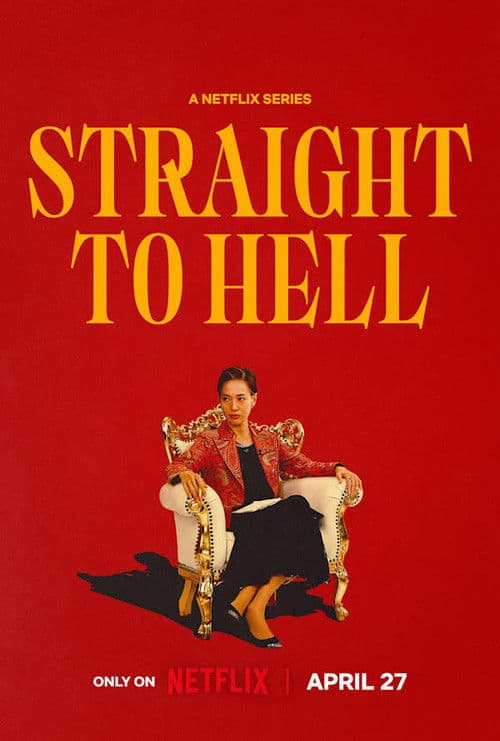
Straight to Hell (地獄に堕ちるわよ) is a Japanese-language television series releasing on April 27, 2026. The series examines the life and career of Kazuko Hosoki, a prominent fortune teller who became a major presence in Japanese television and publishing, amid allegations of spiritual fraud and ties to criminal circles.
Gallery (5)
Episodes
✓ Previously aired
Key features
- ·Japanese-language television series
- ·Premieres April 27, 2026
- ·Subject: fortune teller Kazuko Hosoki
- ·Covers TV, publishing, and scandal
- ·Biographical focus
FAQ
When does Straight to Hell release?
Straight to Hell is scheduled to release on April 27, 2026.
What is Straight to Hell about?
The series examines the life of Kazuko Hosoki, a high-profile Japanese fortune teller, including her career in television and publishing and the dark rumors surrounding her, such as allegations of spiritual fraud and underworld connections.
What language is Straight to Hell in?
The series is in Japanese. Its original title is 地獄に堕ちるわよ.
About this release
A single-episode Japanese drama produced by Netflix and Django Film, Straight to Hell — titled 地獄に堕ちるわよ in its original language — is scheduled for release on April 27, 2026. The project takes as its subject Kazuko Hosoki, a fortune teller who became one of Japan's most recognizable television personalities and a dominant presence in the country's publishing industry, and who accumulated, alongside that celebrity, a trail of dark rumors involving spiritual fraud and alleged connections to criminal underworld figures.
The phrase the subtitle translates to — roughly "you're going straight to hell" — was apparently a signature declaration associated with Hosoki, which gives the title a double function: it signals the show's biographical subject while also gesturing at the moral atmosphere the story seems to inhabit. Hosoki's public persona was built on a particular kind of unsparing certainty, the fortune teller as judge rather than comforter, delivering verdicts on her subjects rather than reassurances. That posture would have made her a compelling TV presence in any era, but in Japan's media landscape she achieved something closer to institutional status — a top-tier celebrity whose pronouncements carried genuine cultural weight. The drama, by taking her life as its material, is asking what was actually behind that authority.
What the structured production information establishes is relatively spare: this is a one-season, single-episode work, which places it formally somewhere between a feature film and a standard prestige drama series. That format is not unusual for Japanese Netflix productions, which have increasingly used the limited-run or single-long-episode structure to handle biographical and documentary-adjacent material. Whether Straight to Hell leans into dramatization or adopts something closer to a docudrama approach is not specified in the available material. Django Film's involvement alongside Netflix as a co-producing studio is noted, though no further background on Django Film's prior work or its specific role in the production is available here.
The "drama" genre classification is the only formal descriptor provided, which leaves open a number of questions about what the viewer is actually going to encounter. Biographical drama about a real and controversial figure — particularly one who died and whose estate or family may have views on her representation — tends to sit on a spectrum ranging from hagiography to hatchet job, with the more honest work occupying an uncomfortable middle where both the achievement and the damage are kept simultaneously in frame. The source description's phrasing is pointed: it asks who Hosoki was "behind the dark rumors," implying the production intends to do something more probing than simply celebrate a television legend. But how far that probing goes, whether the "underworld ties" are substantiated or treated as unresolved allegation, whether the "spiritual scams" are dramatized through specific incidents or treated as a general atmosphere — none of that is yet visible from the outside.
There is also the question of performance. A figure like Hosoki — whose public persona was so emphatic, so stylized, so defined by a specific verbal and physical register — presents a particular challenge for whoever is portraying her. The iconic quality of her TV presence would almost demand an actor capable of high-register performance without sliding into caricature. No casting information appears in the available metadata, which means that particular question remains entirely open for now.
The Japanese-language original is being distributed through Netflix, which means it will have the platform's subtitle and dubbing infrastructure behind it and will be accessible internationally on release day rather than through a delayed foreign distribution deal. That distribution context matters for a story that is, in many respects, culturally specific — Hosoki's fame was rooted in Japanese television culture, in the specific social role that fortune telling has occupied in that media environment, and in attitudes toward spiritual authority that have a distinct local texture. International viewers arriving without that background will be relying on the drama itself to supply context. Whether it does so, and how much it assumes prior knowledge of its subject, is another thing the production has not yet indicated.
At its core, the subject is a woman who turned a practice that operates in the margins of credibility — fortune telling — into a mainstream media career of considerable scale, and who did so while accusations about the ethics of that career circulated in the background. That combination of genuine cultural influence and persistent shadow is the kind of biographical material that tends to produce interesting drama when handled with care, precisely because it resists simple framing. The "dark rumors" mentioned in the source description are not peripheral to the story — they are structurally central to any honest account of what Hosoki's celebrity meant and how it was built.
Anyone with an interest in Japanese popular culture from the latter half of the twentieth century, or in the broader question of how spiritual and occult practices have been absorbed and monetized by mass media industries, has an obvious reason to seek this out. So does anyone drawn to biographical drama that is organized around a genuinely contradictory public figure rather than a tidily rehabilitated one. The single-episode format suggests a concentrated experience rather than a sprawling one, which may suit the material, or may mean that the story's more difficult questions are necessarily compressed.
Comments
Sign in to join the conversation.
Loading…