Starring





Where to watch
Not currently available for streaming or purchase.
Links may earn Incoming a commission at no extra cost to you.
Incoming Editorial TeamVerified
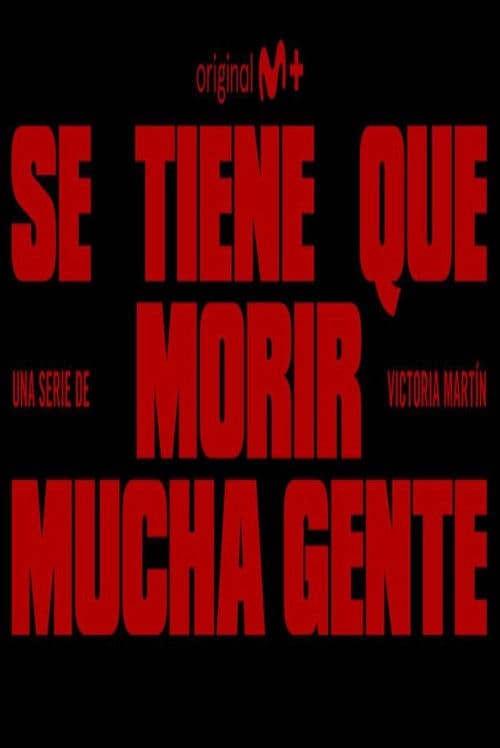
Se tiene que morir mucha gente is an upcoming Spanish-language television series scheduled to release on May 21, 2026.
Key features
- ·Spanish-language television series
- ·Scheduled premiere May 21, 2026
FAQ
When does Se tiene que morir mucha gente release?
Se tiene que morir mucha gente is scheduled to release on May 21, 2026.
About this release
Se tiene que morir mucha gente is a Spanish-language comedy series produced by Corte y Confección de Películas, set to arrive on May 21, 2026. The show runs to six episodes across a single season, placing it in the now-familiar territory of the limited comedy series — a format that has found particular traction in Spanish-language television over the past decade, where tight episode counts have suited everything from dark workplace satire to absurdist domestic drama.
The title itself — which translates roughly as "A Lot of People Have to Die" — carries an immediate tonal charge. It reads like a punchline without a setup, or perhaps the setup without a punchline, and that ambiguity is one of the more genuinely interesting things on offer before a single frame has been seen publicly. Spanish comedy has a long tradition of finding its sharpest material in subjects that other cultures might handle with more caution: inheritance disputes, generational grievance, the bureaucratic indignities of illness and mortality. Whether this series belongs to that tradition or is doing something structurally different with its title's bleak promise is not yet clear from what has been made available.
Corte y Confección de Películas is the production company behind the project. The name — which translates loosely as "Cut and Sew of Films," suggesting something of a craftsmanlike, perhaps boutique sensibility — is the sole production entity credited. No distributor, broadcaster, or streaming platform has been announced in the available information, which is notable given how close the release date sits. For a six-episode comedy from a Spanish production house, the most likely homes would be a domestic broadcaster or one of the major streaming platforms with a significant Spanish-language catalog, but nothing in the structured data confirms any such arrangement. That absence is worth flagging for anyone trying to plan around the May 21 date: it is not yet publicly established where the series will actually be watchable.
Similarly, the cast and creative team behind the project have not surfaced in the available material. No director, showrunner, or lead performer is named. For a comedy series, this is an unusually opaque pre-release profile. Performance and voice are everything in comedy — the question of who is delivering the material shapes every other expectation a viewer might bring. A sharp ensemble piece plays entirely differently from a single-lead vehicle, and a series with a title this pointed tends to hinge on whether the person or people at its center can sustain the joke, or the grief, or whatever combination of both the writers are working with, across six episodes without the premise collapsing under its own weight.
The six-episode structure is worth thinking about on its own terms. It is long enough to develop character and sustain a narrative arc, but short enough that the series cannot afford much drift. Spanish limited series in the comedy register have sometimes used this constraint productively, building toward a single tonal payoff that a longer run would dilute. Whether Se tiene que morir mucha gente is structured as a true serial — with plot carrying across episodes — or as something closer to a thematic anthology with recurring characters is another open question.
The title's specificity of sentiment — not just that someone dies, but that many people must — suggests either a plot mechanism that requires attrition of some kind, or a worldview the series is advancing more philosophically. Comedies that take death as their central subject often locate their humor in the gap between how death is supposed to feel and how it actually registers in the mundane texture of ordinary life: the paperwork, the family arguments, the absurd logistics. Others use death as a pressure system, something bearing down on characters whose responses reveal who they are. The phrasing of the title could support either reading, and the tension between those possibilities is, at this stage, most of what the series has to offer as a subject of curiosity.
What is unambiguous is the country of origin and language. This is a Spanish production, shot in Spanish, from a domestic production company with no apparent co-production partners listed in the available data. That positions it within Spain's own comedy ecosystem rather than as a co-production designed to travel immediately to international markets — though streaming economics have made that distinction less fixed than it once was, and plenty of Spanish-language series have found audiences well outside their home country without being engineered specifically for export.
The audience most likely to seek this out in its first weeks will be viewers already engaged with contemporary Spanish television comedy, and those who follow the output of Corte y Confección de Películas specifically. Beyond that existing base, the title alone may draw in viewers drawn to comedy that signals, from the outset, a willingness to sit with something uncomfortable — the kind of series that announces its subject matter plainly rather than easing an audience toward it. Whether the execution matches that implied ambition is the question that will determine whether it travels further.
Comments
Sign in to join the conversation.
Loading…