
 Hot
Details
- Language
- English
- Country
- US
- Studio
- End of Episode
- Seasons
- 1 · 8 eps
- TMDb Rating
- 6.9 (42 votes)
- Theme
- redemptionrivalry
- For
- family
Rating · Quality score from voters
TMDb
6.9/10
IMDb
6.1/10
Popularity · Search interest now
Popular
64.2
Based on TMDb activity
Hype score
leaderboard →63
/ 100↓ -13.8 in 24h
#130 globally#43 in tv
Nemesis ranks in the top 19% of TV Wikipedia searches this week.
Starring








Incoming Editorial TeamVerified
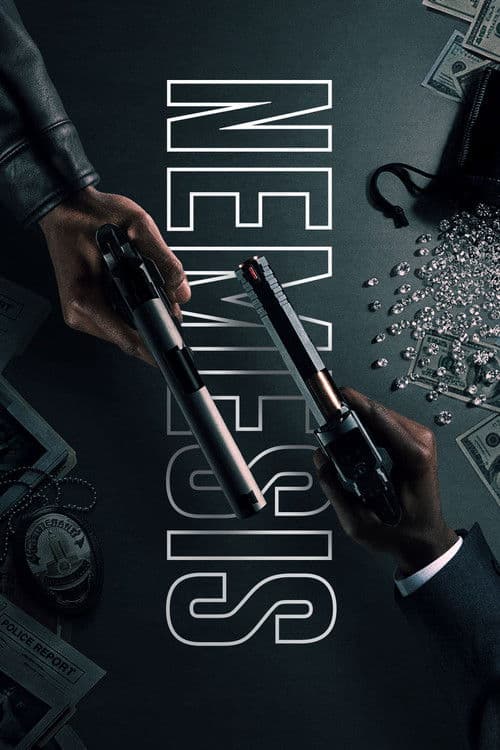
Nemesis is an upcoming television series following two men on opposite sides of the law — an expert criminal and a police detective — whose conflict forms the backbone of a heist-adjacent drama. It is scheduled to premiere on May 14, 2026.
Trailer
Gallery (9)
Episodes
✓ Previously aired
Key features
- ·Crime drama series
- ·Heist genre framework
- ·Dual protagonist structure
- ·Family dynamics and action
- ·Premieres May 14, 2026
FAQ
When does Nemesis release?
Nemesis is scheduled to premiere on May 14, 2026.
What is Nemesis about?
The series follows an expert criminal and a police detective whose conflict drives a story that engages with the heist genre while exploring themes of motivation, family, and self-destruction.
Where can I watch Nemesis?
No network or streaming platform has been announced for Nemesis at this time.
Who made Nemesis?
No creator, director, or production studio information is currently available for Nemesis.
About this release
Nemesis, a new eight-episode crime drama produced by End of Episode, is scheduled to arrive on May 14, 2026. The series is American in origin, English-language, and arrives as a first season with no announced predecessor or existing franchise to draw on — which makes its ambitions immediately worth examining on their own terms.
The premise is structured around a pairing that the crime genre has never quite exhausted, however many times it has returned to it: a highly skilled criminal and the detective who pursues him, each defined by the other's existence. The show frames this as a collision between an unstoppable force and an immovable object, language that suggests the series is more interested in stalemate and escalation than in clean resolution. Neither figure is described as a protagonist in the traditional sense. The criminal is characterized as an expert; the detective as brilliant. Both descriptors are professional rather than moral, which may be the most telling signal about the show's intended register.
What End of Episode appears to be reaching for — based on what's been disclosed about the series — is a heist drama that uses genre mechanics as a starting point and then works against them. The heist genre carries a well-established grammar: the crew, the plan, the complication, the pivot, the payoff. Television has found considerable traction in that formula, and crime procedurals have long organized themselves around the detective's mastery of a case. Nemesis, at least in its stated design, is interested in where that grammar breaks down. The phrase "subvert the heist genre at every turn" is doing real work in how this show is being positioned, though whether the execution delivers on that framing remains entirely to be seen.
The series description layers in two additional registers alongside the genre mechanics: family dynamics and an inquiry into psychological motivation. The question the show says it wants to ask is not simply who wins the cat-and-mouse game, but what drives the players into it, what keeps them there, and what it costs them. That pivot — from plot mechanics to character interiority — is characteristic of prestige crime television over the past decade and a half, a mode in which procedural tension becomes the surface texture for something more concerned with identity, obsession, and the way people construct meaning around their compulsions. Whether Nemesis is genuinely operating in that tradition or merely invoking its language is one of the central open questions about the project.
The eight-episode order is worth noting. It is a format that has become associated with a certain kind of intentional, limited storytelling — enough space to develop character across a sustained arc, compressed enough to demand discipline in the plotting. A single season of eight episodes implies either a complete story or a carefully calculated opening move. No second season has been announced, which suggests, at minimum, that the creative team is presenting this as a self-contained unit. Whether that reflects a genuine closed narrative or simply the realities of development remains unclear.
End of Episode is the sole studio credit attached. There are no listed directors, showrunners, writers, or cast members in the available materials. That absence is conspicuous. The critical questions a viewer would naturally bring to a new prestige crime series — who is playing these two men, who is writing and directing the episodes, what creative history the production team brings — are entirely unanswered in what has been disclosed. The show is, at this stage, a premise and a structure, not yet a set of names that carry their own expectations and reputations into the room.
That information gap shapes how the series can be evaluated in advance. The premise itself is solid enough and familiar enough to generate genuine curiosity. Two figures locked in professional and psychological opposition, a genre being pushed against its own conventions, and a promise that the stakes are personal as well as tactical — these are the ingredients for the kind of crime television that finds an audience. But they are also descriptions that have been applied to many shows, some of which have been genuinely distinguished and many of which have not. The distinguishing factor is almost always the execution: the specific texture of the writing, the choices made in performance, the way the direction handles both the action sequences and the quieter scenes where motivation is established. None of that is visible yet.
There is also the question of platform. Where Nemesis will stream or air has not been specified in what's available here, which affects the kind of release and audience it is likely to reach. A May 2026 date gives the production time to finalize distribution, but it also means that the show's actual accessibility — the most basic practical question — is still open.
The audience most likely to be drawn to Nemesis on release will be viewers who followed the wave of heist-adjacent prestige dramas and remain interested in the genre's capacity for self-examination, as well as those who respond to the psychological-portrait dimension of crime television rather than the procedural puzzle dimension. If the casting and creative team turn out to carry weight, that announcement alone will do more to define the show's audience than any structural description of the premise.
Comments
Sign in to join the conversation.
Loading…