
Starring








Incoming Editorial TeamVerified
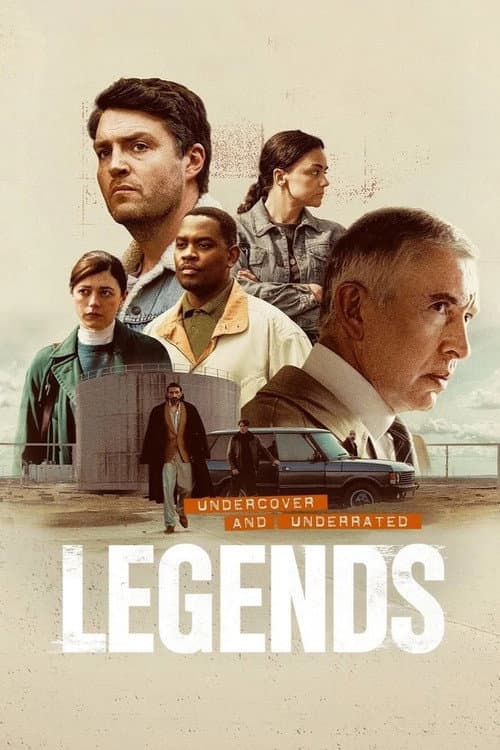
Legends is an upcoming English-language TV series set in 1990s Britain, following a team of civil servants working undercover to dismantle drug trafficking gangs. It is scheduled to release on May 7, 2026.
Trailer
Gallery (4)
Episodes
✓ Previously aired
Key features
- ·1990s Britain crime drama
- ·Undercover civil servants premise
- ·Drug trafficking narrative
- ·English-language series
FAQ
When does Legends release?
Legends is scheduled to release on May 7, 2026.
What is Legends about?
The series follows a team of civil servants who go undercover to dismantle the gangs responsible for a surge in drug trafficking across 1990s Britain.
What language is Legends in?
Legends is an English-language series.
About this release
A six-part British crime drama called Legends is set to arrive on Netflix — and Netflix Standard with Ads — on May 7, 2026. Produced by Tannadice Pictures, the series drops its audience into 1990s Britain at the height of a drug epidemic, following a team of civil servants who find themselves pulled into undercover work in order to dismantle the criminal networks responsible.
The premise sits at an intersection that British television has returned to repeatedly over the decades: the procedural logic of state institutions colliding with the chaos of street-level crime. What distinguishes Legends from the more straightforward police procedural tradition — think the long lineage of British cop dramas stretching from The Sweeney through to contemporary fare — is the civilian dimension of its protagonists. These are not detectives, not MI5 officers with gadgetry and official sanction, but civil servants: administrators, bureaucrats, people whose professional lives are ordinarily governed by paperwork rather than fieldwork. The tension between their institutional formation and the demands of undercover infiltration appears to be the engine driving the series. Whether the show treats that gap as a source of dark comedy, as genuine psychological pressure, or as straightforward dramatic irony remains to be seen from the material available, but the framing is pointed enough to suggest that the ordinariness of these characters is doing deliberate narrative work.
The 1990s setting carries its own weight. British popular culture has revisited that decade with increasing frequency in recent years, drawn back partly by nostalgia and partly by a sense that the period's social upheavals — the tail end of Conservative government, the arrival of New Labour, the spread of rave culture, and a very real surge in heroin and crack cocaine availability in urban and semi-urban communities — offer usable historical distance for stories that might feel too raw if set in the present. A drama about drugs flooding British streets in that era can draw on documented social history: the transformation of drug supply networks in the early 1990s, the emergence of more organized and geographically ambitious gangs following shifts in importation routes, and the pressure on law enforcement and government alike to respond to what was, by any measure, a genuine public health and public order crisis. Whether Legends engages with that documented history in any granular way, or uses the decade primarily as atmospheric backdrop, is one of the more interesting open questions about the series.
Tannadice Pictures is the production company behind the project. Beyond that credit, the structured information available does not extend to specifics about the writers, directors, or the cast assembled for the six episodes. That absence is notable. For a drama whose appeal is likely to hinge significantly on the performances — undercover work as a dramatic subject lives or dies by the audience's belief in the people doing it — the names behind the cameras and in front of them would ordinarily be among the most useful signals of what to expect. A single season of six episodes is a compact shape, suggesting either a self-contained story with a defined arc or a pilot-scale commitment from Netflix that leaves room for expansion depending on reception. Six episodes also implies a degree of narrative discipline: there is not a great deal of room to meander, and the series will need to establish its world, its characters, and its stakes in a hurry.
The early audience figures on the aggregation side are thin — 32 votes on TMDB at the time of writing — but the average rating among those who have seen advance material sits at roughly 7.9 out of 10, which suggests a reasonably warm response from a small sample. That number is worth holding lightly; early vote counts from preview audiences or industry screeners can skew in either direction and tend to stabilize as a broader viewership weighs in. Still, it is not a figure that signals obvious trouble.
Netflix's decision to carry the series — and to make it available on its ad-supported tier as well as its standard one — places Legends within the streamer's ongoing commitment to British drama, a category that has proven reliable for international audiences. The 1990s British setting gives the show a degree of geographic and temporal specificity that can work either as a draw for international viewers curious about that period of British social history, or as a point of friction for audiences who require more universal reference points. Crime drama, though, travels. The architecture of the undercover narrative — the assumed identity, the infiltration, the question of what happens when the cover starts to slip — is not culturally parochial in the way that, say, a drama rooted in regional British politics might be.
Viewers who follow British crime television closely, particularly those drawn to series that position the state as a flawed and sometimes compromised actor rather than a straightforward force for order, will likely find Legends worth tracking. So will anyone who has spent time with the growing body of 1990s-set British drama and is curious to see how the decade's particular social textures translate to the undercover format. The six-episode run makes the time commitment modest, and the premise is sufficiently singular — civil servants, not cops, going under — to merit attention when it arrives in May.
Comments
Sign in to join the conversation.
Loading…