
Details
- Language
- English
- Country
- US
- Studio
- Truly Original
- Seasons
- 1 · 4 eps
- Theme
- coming of age
- Format
- episodic
Popularity · Search interest now
Low
0.2
Based on TMDb activity
Starring





Where to watch
Not currently available for streaming or purchase.
Links may earn Incoming a commission at no extra cost to you.
Incoming Editorial TeamVerified
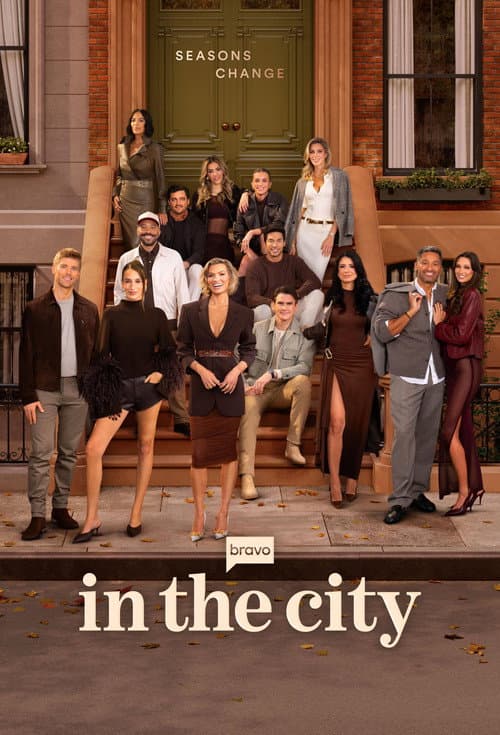
In the City is an upcoming reality television series featuring Summer House cast members Amanda Batula, Kyle Cooke, and Lindsay Hubbard. The series follows the group through major life transitions in New York City and is set to premiere on May 19, 2026.
Gallery (3)
Key features
- ·Reality television series
- ·Premieres May 19, 2026
- ·Set in New York City
- ·Features Summer House cast members
- ·Themes include marriage, parenthood, and separation
- ·Includes new ensemble of co-stars
FAQ
When does In the City premiere?
In the City is scheduled to premiere on May 19, 2026.
Who stars in In the City?
The series stars Amanda Batula, Kyle Cooke, and Lindsay Hubbard, all known from Summer House, alongside a new group of co-stars.
Is In the City a spinoff of Summer House?
In the City features several cast members from Summer House but is set in New York City rather than the Hamptons, and introduces new co-stars alongside the returning cast.
What is In the City about?
The series follows its cast through major life transitions including marriage, separation, parenthood, and personal reinvention while living in New York City.
About this release
Three cast members from Bravo's Summer House are moving off the lawn and back onto the sidewalk. In the City, a four-episode reality series produced by Truly Original, is set to premiere on May 19, 2026. The show follows Amanda Batula, Kyle Cooke, and Lindsay Hubbard as they navigate what the production describes as the biggest transitions of their lives — marriage, separation, parenthood, and reinvention — this time against a New York City backdrop rather than the Hamptons share house that made them recognizable figures in the Bravo ecosystem.
Summer House, which has run for multiple seasons on Bravo, built its audience around a specific and fairly contained premise: a group of friends renting a house together in the Hamptons each summer, the compressed social pressures of that arrangement producing the conflict and camaraderie that reality television depends upon. Batula, Cooke, and Hubbard became central to that show's long-running dynamics — Batula and Cooke as a couple whose relationship played out across multiple seasons, Hubbard as a figure whose personal life, including her own marriage and its subsequent dissolution, became prominent storylines. In the City appears to be drawing directly on where those storylines left off, transporting the same cast members into a different setting and a different chapter of their lives.
Truly Original, the production company behind the series, has a track record in the unscripted space, and the four-episode order suggests something closer to a limited docuseries than a conventional multi-season franchise entry. Whether this is a standalone project or a test run for something larger isn't addressed in the available information, but the compressed episode count is worth noting. Four episodes give the series room to follow a defined arc — the specific life transitions named in the show's framing — without the kind of sprawl that longer reality seasons sometimes produce.
The "fresh crew of co-stars" mentioned in the show's description is one of the more conspicuous unknowns heading into the premiere. The three Summer House alumni provide the connective tissue and the existing audience, but who joins them in New York, and what relationships those new cast members have to Batula, Cooke, and Hubbard, remains unspecified. In a genre where ensemble chemistry is often the primary variable determining whether a show holds attention, that's a meaningful blank. Summer House succeeded partly because its cast had genuine, complicated history with one another — the kind of layered familiarity that takes time to develop on screen. Introducing new personalities into an established dynamic, particularly in a short run, is a structural challenge the show will have to address quickly.
The thematic framing is also more explicitly adult than the premise of the parent series. Summer House was built around leisure — vacation as social laboratory. In the City is framed around consequence: marriage, separation, parenthood, the difficulty of maintaining friendships as lives diverge. That's a recognizable pivot in the reality genre, one that other franchises have attempted with varying degrees of success, but it does represent a tonal shift from the Hamptons format. Whether the New York City setting functions as more than backdrop — whether the city itself becomes a meaningful element of how the stories are told — is another open question.
Hubbard's storyline in particular carries some weight of public familiarity. Her marriage, and the events surrounding it, generated significant coverage within the Bravo media ecosystem. That the show explicitly lists "separation" as one of its central themes suggests her experience will be addressed directly rather than treated as background. How much of that material the show is prepared to examine with any depth, versus treating it as dramatic shorthand, is something viewers will be measuring from the first episode.
Cooke and Batula, meanwhile, appear under the banner of "marriage" — a different kind of transition, though one that Summer House audiences have watched develop across years of television. There's an inherent familiarity fatigue risk in following the same couple through yet another chapter, and the show's ability to find something genuinely new in that dynamic may depend on how the four-episode structure forces focus rather than diffusion.
The production's decision to frame everything under the language of "growing up without growing apart" positions the show as being about friendship under pressure — a durable reality television subject, but one that requires the friendship to feel real on screen rather than performed. With a cast that has spent years in front of cameras together, that authenticity may be easier to achieve than it would be with strangers, or it may be harder, because the habits of performing for the camera are also deeply ingrained.
Viewers who followed Summer House and have an investment in where these particular cast members land next are the obvious audience. But the limited run and the more sober thematic register might also attract viewers who find the classic Hamptons-party format less appealing than a show that is at least nominally about adults reckoning with adulthood. Four episodes is a low commitment, and the existing familiarity with the cast means the show doesn't have to spend much time on introduction — which, given the runtime, is probably exactly the point.
Comments
Sign in to join the conversation.
Loading…