
Details
- Language
- Dutch
- Country
- NL
- Studio
- Wise Monkeys
- Seasons
- 1 · 6 eps
Popularity · Search interest now
Low
0.1
Based on TMDb activity
Where to watch
Not currently available for streaming or purchase.
Links may earn Incoming a commission at no extra cost to you.
Incoming Editorial TeamVerified
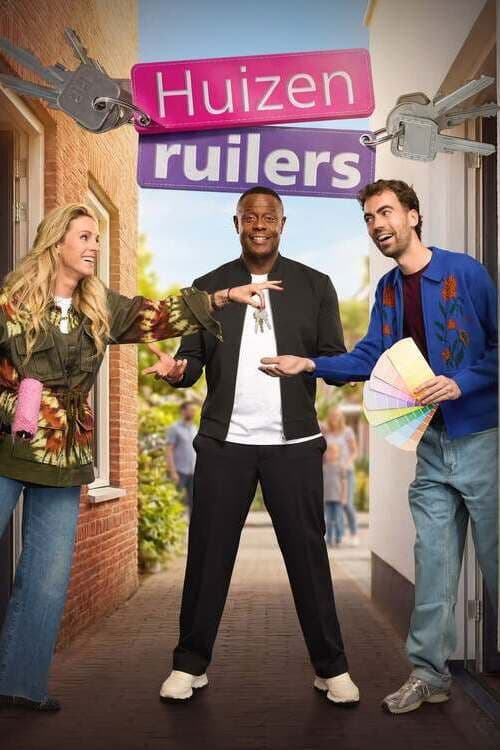
The housing market is still a disaster. To do something about it, RTL is now launching *Huizenruilers* (House Swappers). This program follows people who are stuck in their current situation. Think of families outgrowing their homes or people who simply want to downsize. Instead of endlessly searching for a new and, above all, suitable place to live, they decide to swap with another household. But there is a small catch!
About this release
RTL's Huizenruilers — Dutch for "House Swappers" — is scheduled to premiere on May 18, 2026, on RTL in the Netherlands. Produced by Wise Monkeys, the six-episode reality series takes its premise directly from one of the more persistent anxieties of contemporary Dutch life: the country's housing market, which has remained stubbornly difficult for buyers and renters alike. The show's central conceit is straightforward. Rather than competing for properties through conventional listings, bidding wars, or relocation agencies, the participants bypass the market almost entirely by trading homes with one another.
The format draws on a situation that many Dutch households recognize. Families who have expanded beyond the square footage of a starter apartment, retirees or empty-nesters sitting in houses that have become oversized for their daily lives, people whose neighborhoods no longer match their circumstances — these are the kinds of participants the show appears to be built around. What connects them is a shared stalemate: they have a home that someone else might want, and they want a home that someone else already has. The swap is the solution, at least in theory.
Reality television in the Netherlands has a long tradition of housing and lifestyle formats, and Huizenruilers fits into that lineage while sharpening its focus around a specifically economic premise. Where older formats often centered on renovation, interior decoration, or aspirational property tours, this one is grounded in constraint. The housing market isn't the backdrop — it's explicitly named as the reason the show exists. RTL's framing presents the program less as escapism and more as a reflection of a real logistical problem that a significant portion of the Dutch population is navigating.
Wise Monkeys, the production company behind the series, is handling a premise that has inherent structural drama built in. A home swap is not a simple transaction. Both parties must agree not only on the desirability of the exchange but on timing, condition, legal arrangements, and the accumulated particularities of someone else's living space. The source material teases that there is "a small catch" involved in the process, though what precisely that catch entails — whether it refers to logistical complications, emotional resistance, or some kind of format twist — is left unspecified in the available information. That ambiguity is either a deliberate piece of marketing restraint or a reflection of how the complications emerge differently for each household, case by case across the six episodes.
What remains genuinely open ahead of the premiere is the question of how the show handles the mechanics of the swap itself. Property exchanges outside the conventional market raise real legal and financial questions in the Netherlands, and it is not yet clear whether Huizenruilers addresses those directly — whether it follows participants through the bureaucratic and contractual realities of what a home swap actually requires — or whether it concentrates on the human and emotional dimensions while keeping the procedural scaffolding largely off screen. That distinction matters quite a bit for what kind of show this turns out to be. A program that treats the swap as a solved problem and focuses entirely on personalities and reactions would be a different viewing experience from one that takes the friction of the process seriously.
There is also the question of how the participants are matched. Whether the production team arranges the pairings, whether households find each other independently and come to the show with a swap already in progress, or whether the format involves some kind of facilitated search — none of that is detailed in the available material. The matching logic would shape the dramatic texture of the series considerably. A swap between households who are genuinely compatible on paper but discover unforeseen incompatibilities in practice is a different story from one where the mismatch is apparent from the beginning and both sides must negotiate their way through it anyway.
Six episodes is a modest run, which suggests either that the series is being tested carefully before any expansion, or that the format is designed to be self-contained — a limited run documenting a small number of cases in some depth rather than a broader survey. Whether each episode follows a single household pairing or whether the show interweaves multiple swaps across the season is another structural question that the available information doesn't settle.
The show arrives at a moment when Dutch audiences have had sustained and often frustrating exposure to housing-market coverage in the news, making a format that treats the subject with some direct practicality a potentially resonant proposition. Viewers who have themselves encountered the obstacles of the Dutch property market — whether as buyers priced out of desired neighborhoods, renters looking for more space, or older homeowners considering whether their current house still suits them — will likely find the premise immediately legible. It asks a simple question: what if two people who are stuck could unstick each other? The answer, across six episodes, is presumably more complicated than that sentence suggests, and that gap between the clean logic of the swap and the reality of executing one is where the show's actual content will live.
Comments
Sign in to join the conversation.
Loading…