 Warm
tvReleased
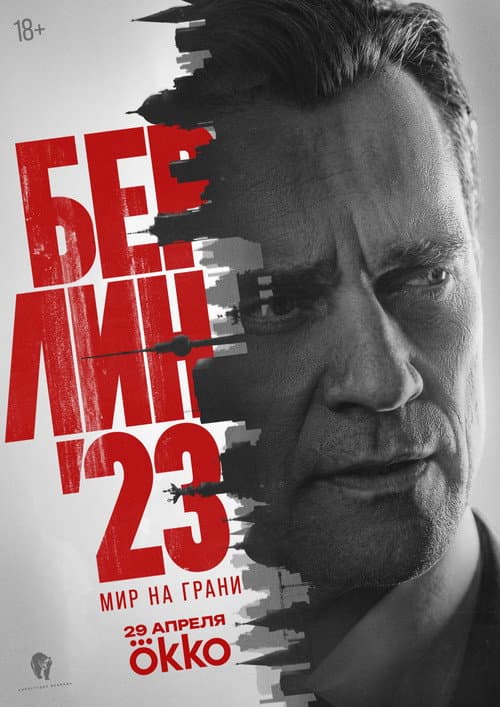
Berlin'23
Берлин'23
Released April 29, 2026
↑ 0.524h
Details
- Language
- Russian
- Country
- RU
- Studio
- Okko
- Seasons
- 1 · 8 eps
Popularity · Search interest now
Low
0.4
Based on TMDb activity
Starring





Where to watch
Not currently available for streaming or purchase.
Links may earn Incoming a commission at no extra cost to you.
Incoming Editorial TeamVerified
Berlin'23 (Берлин'23) is a Russian-language television series following a crisis manager and a special services operative navigating diplomatic and covert work in Berlin. It is scheduled to release on April 29, 2026.
Gallery (1)
Key features
- ·Russian-language drama series
- ·Diplomatic and espionage thriller genre
- ·Set in Berlin, Germany
- ·Sequel series following Warsaw mission
- ·Duo protagonist structure
- ·Scheduled release April 29, 2026
FAQ
When does Berlin'23 release?
Berlin'23 is scheduled to release on April 29, 2026.
What is Berlin'23 about?
The series follows crisis manager Vyacheslav Vasiliev and special services operative Sergei Nenashev as they work to restore a Russian embassy in Berlin and prevent a wider conflict in Europe.
Is Berlin'23 a sequel to another series?
The series references events from a prior mission set in Warsaw two years earlier, positioning it as a follow-up to that storyline involving the same two main characters.
What language is Berlin'23 in?
Berlin'23 is produced in Russian.
About this release
A Russian-language espionage series called Berlin'23 — subtitled in Cyrillic as Берлин'23 — is scheduled to arrive on April 29, 2026, produced by the streaming platform Okko and the production company Kinostudiya Medved. The single season runs to eight episodes.
The show centers on Vyacheslav Vasiliev, described as an experienced crisis manager, who travels to Berlin under circumstances that are anything but routine: Russian diplomats have been expelled, the embassy stands largely empty, and the broader geopolitical situation in Europe is described as trending toward open conflict. Vasiliev's mandate is both administrative and strategic — he must keep the diplomatic machinery of a deserted mission running while also working to contain what the premise frames as a gathering crisis. Alongside him is Sergei Nenashev, a special services operative who works as an illegal, meaning he operates outside the formal cover of diplomatic credentials. The two men divide the labor by disposition and by status: Vasiliev holds the official portfolio, Nenashev works in the shadows.
What makes the pairing more than a simple procedural structure is the history behind it. The series is explicitly positioned as a continuation. Vasiliev and Nenashev previously worked together in Warsaw, an operation that concluded successfully two years before the Berlin posting begins. That prior partnership was evidently not frictionless — their past conflicts are described as resolved rather than as never having existed — but something in the Warsaw experience apparently closed that chapter. Vasiliev is said to be grateful to Nenashev for saving his daughter, a detail that introduces a personal debt into what might otherwise be a purely professional relationship. The question of how that debt shapes their dynamic in a new city, under new pressures, gives the interpersonal dimension of the show some structural weight.
The Warsaw chapter presumably exists as prior material — whether as a previous season, a standalone production, or background that the series establishes through exposition is not clear from what has been disclosed. The show is produced in Russian and originates in Russia, through Okko, which has developed a catalog of original productions for its subscriber base. Kinostudiya Medved serves as the production company. No directors, writers, or cast members beyond the character names have been specified in the available materials, which is notable for a show arriving in April 2026 — the full creative apparatus behind the camera remains, at this point, unlisted in public-facing information.
The geopolitical setting — Berlin, a deserted Russian embassy, a European conflict that Vasiliev is tasked with preventing — places the show within a tradition of Russian-produced espionage drama that has grown more prominent on domestic streaming platforms over the past several years. The genre in Russian television has tended toward protagonists who are competent state actors navigating a hostile or indifferent West, often in cities that carry Cold War resonance. Berlin is perhaps the most symbolically loaded of those cities, carrying decades of divided-city mythology, checkpoint history, and intelligence folklore. Positioning a Russian operative there, working from an emptied embassy, draws on that reservoir of associations while grounding the premise in circumstances that clearly gesture at the present rather than the past.
The eight-episode count suggests a tightly structured season rather than an open-ended serial. Whether the show intends to resolve its central crisis within those episodes or leave threads open for further seasons is unknown. The description of it as a single season in the current metadata may simply reflect what has been ordered or announced rather than a definitive statement of intent.
Several things remain genuinely open. The daughter whose life Nenashev saved is mentioned as a motivating fact in the premise, but her role — whether she appears in the show, remains an offscreen backstory, or figures into the Berlin plot — is unspecified. Similarly, the nature of the "growing global conflict" that Vasiliev must help prevent is described only at that level of abstraction. Espionage series of this kind can range from tightly plotted thrillers driven by specific ticking-clock scenarios to more atmospheric character studies in which the geopolitical backdrop functions largely as pressure and texture. Where Berlin'23 falls on that spectrum will depend on creative choices that haven't been publicly detailed.
The show's original-language title uses the year as a suffix, echoing the Warsaw-set predecessor's naming logic and suggesting that the franchise, if it develops, may continue to be organized around city and year — a structure that would allow future installments to move across European capitals while following the same central characters.
Viewers likely to seek this out will be those already following Okko's original programming, audiences with an interest in Russian-language espionage drama, or viewers who have seen the Warsaw predecessor and are following the continuation of Vasiliev and Nenashev's partnership. The European setting and the contemporary geopolitical framing may also draw viewers who approach the show specifically for the perspective it represents — a Russian-produced account of Russian diplomatic and intelligence activity on German soil, shaped by assumptions and sympathies quite different from those of, say, a Western spy thriller set in the same geography.
Comments
Sign in to join the conversation.
Loading…