Starring


Where to watch
Not currently available for streaming or purchase.
Links may earn Incoming a commission at no extra cost to you.
Incoming Editorial TeamVerified
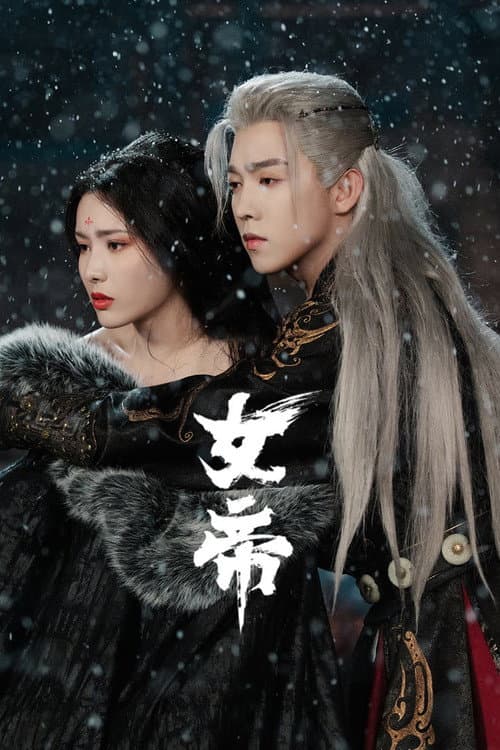
女帝 is an upcoming Chinese-language television series set in a dynastic fantasy world, releasing on April 27, 2026. The story follows Ji Mingyue, who is thrust into the role of empress amid political conflict, and Helian Jin, from an enslaved clan, as they confront corruption and war.
Key features
- ·Chinese-language dynastic fantasy series
- ·Premieres April 27, 2026
- ·Political intrigue and war narrative
- ·Dual lead characters across class divide
- ·Themes of rebellion and institutional corruption
FAQ
When does 女帝 release?
女帝 is scheduled to release on April 27, 2026.
What is 女帝 about?
The series follows Ji Mingyue, forced into the role of empress during a period of political upheaval, and Helian Jin, a member of an enslaved clan, as they challenge corrupt officials and the emperor to change the empire's future.
What language is 女帝 in?
女帝 is a Chinese-language series.
About this release
The Chinese drama 女帝 (roughly translatable as "Empress" or "Female Emperor") is scheduled to release on April 27, 2026. A single-season series originating from China and produced in Mandarin, it arrives in a genre space — the Chinese historical political drama — that has proven remarkably durable with domestic and international audiences alike over the past decade.
The premise centers on Ji Mingyue, a woman thrust into the role of empress not by ambition but by political necessity, as mounting tensions within an unnamed dynasty force the question of who holds power and at what cost. The world the series inhabits is not straightforwardly historical: it posits a society in which certain individuals possess gifts — abilities that set them apart — and are simultaneously feared and exploited because of those gifts. That tension between exceptional capability and systemic oppression gives the narrative a quality common to a strand of Chinese fantasy-historical drama that has grown considerably since the mid-2010s, where the trappings of imperial court intrigue are layered over speculative or fantastical premises. Series in that tradition tend to draw viewers interested in palace politics, elaborate costuming and set design, and the particular pleasures of watching characters maneuver through hierarchies designed to destroy them.
Ji Mingyue's counterpart in the story is Helian Jin, who is identified as a member of an enslaved clan — a designation that immediately establishes him as someone operating from the margins of the power structure that Ji Mingyue has been forced into the center of. The two characters' paths converge as they confront corrupt officials, navigate betrayal and shifting alliances, and eventually direct their combined effort upward toward the emperor himself. The framing is one of institutional challenge: the goal is not merely personal survival but a reshaping of the empire. That kind of structural ambition — a narrative that treats the imperial system itself as something that can and should be contested — has been a recurring theme in Chinese historical drama, though the degree to which individual productions lean into or soften that premise varies considerably.
The structural relationship between Ji Mingyue and Helian Jin as described suggests a partnership that crosses lines of social caste, with one character holding formal power she did not seek and the other holding none at all despite what appear to be significant abilities. How that dynamic is developed — whether it remains a functional alliance, becomes something more personally charged, or evolves into something more complicated — is among the things not yet visible from what has been released about the production. Similarly, the nature of the gifts that mark certain individuals within this world is described only in broad terms: they exist, they confer power, and that power makes their possessors targets. Whether the series treats this as a primarily political metaphor, as an action-oriented fantastical element, or as something woven more deeply into its worldbuilding is an open question.
The episode count is listed as one at this stage, which may reflect incomplete data rather than any intention to release the series as a single extended feature — a format that exists but remains unusual for Chinese drama productions of this type, which more commonly run to several dozen episodes. If the series does in fact consist of substantially more episodes than currently catalogued, that would significantly affect how the story's pacing and character development are likely to unfold. Long-episode Chinese dramas in the political-fantasy space typically use their runtime to build court factions slowly, allowing relationships and betrayals to accumulate weight over time. A shorter format would demand a different kind of compression. That ambiguity is worth noting for anyone trying to plan around the release.
No directorial or writing credits, no network or streaming platform affiliation, and no production company information are currently attached to the publicly available metadata for 女帝. That absence is not unusual for a title still roughly a year from release — Chinese streaming platforms, including the major domestic services that produce and distribute most of this genre, often confirm distribution arrangements closer to a release window — but it does mean there is currently no way to place the series within a particular production house's aesthetic lineage or to anticipate the production values it might bring. Viewers who have followed Chinese historical drama will know that the range within the genre is wide, from elaborately mounted prestige productions to more modestly scaled series that rely heavily on narrative momentum.
What can be said is that the subject matter sits squarely within a category of Chinese drama that has found substantial audiences both domestically and, through streaming distribution, internationally — particularly among viewers in other East and Southeast Asian markets and among diaspora communities elsewhere. The combination of a female protagonist navigating a male-dominated power structure, a speculative-fantastical premise, and a narrative arc aimed at systemic rather than merely personal change has proven to be a workable formula in this space. Whether 女帝 executes on that formula with distinction or merely occupies the genre competently is precisely what cannot be assessed before it airs. For viewers already disposed toward Chinese historical drama and its conventions, April 27, 2026 marks a date to track, if only to see how much of the premise's latent ambition the finished series chooses to realize.
Comments
Sign in to join the conversation.
Loading…