Details
- Language
- Chinese
- Studio
- 北京人民艺术剧院
- Series
- 北京人艺
Popularity · Search interest now
Low
0.1
Based on TMDb activity
Where to watch
Not currently available for streaming or purchase.
Links may earn Incoming a commission at no extra cost to you.
Incoming Editorial TeamVerified
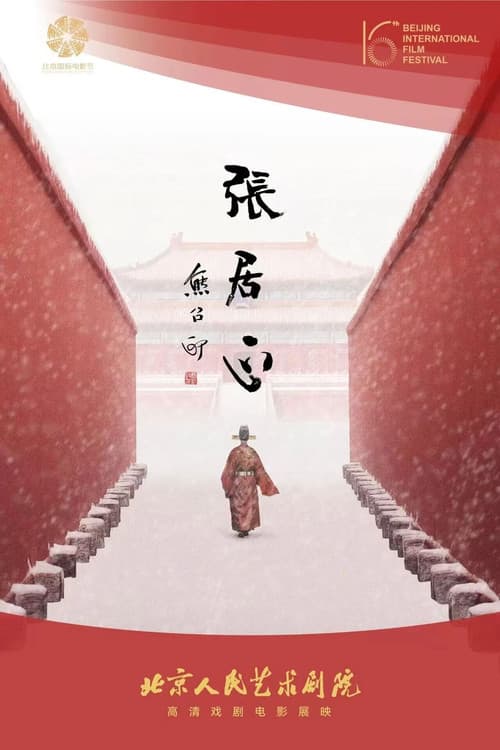
Zhang Juzheng, a play written by Xiong Zhaozheng, winner of the Mao Dun Literature Prize, and co-directed by Feng Yuanzheng and Yan Rui, adopts an alternating dual narrative of reality and unreality to depict the inner journey of Zhang Juzheng, grand secretary of the Ming Dynasty, during his reforms. From the mortal world to the wider realm, from the rivers and lakes to the imperial court, dramatic conflict runs throughout the work, which, amid echoes of history, inquires into the fate and aspirations of the reformer.On stage, three dragon thrones of different sizes and eight red pillars form a freehand stage design. The cinematic theatre production uses distinctive narrative shots to capture the cast’s delicate and precise performances, fully amplifying the stage audio-visual effects and creating a beauty of oriental artistic conception.
About this release
A filmed record of a stage production devoted to one of Ming Dynasty China's most consequential political figures arrives in cinemas on April 24, 2026. Zhang Juzheng — subtitled in Chinese as a stage documentary film of a spoken-drama production — comes from Beijing People's Art Theatre, one of the most storied theatrical institutions in mainland China, and brings together a notable set of collaborators: the playwright Xiong Zhaozheng, a recipient of the Mao Dun Literature Prize, China's most prestigious award for literary fiction, and co-directors Feng Yuanzheng and Yan Rui, who together shaped the production for the stage before this cinematic capture was undertaken.
The subject himself warrants some orientation. Zhang Juzheng served as grand secretary — effectively the most powerful administrator in the imperial government — during the reign of the Wanli Emperor in the latter half of the sixteenth century. His tenure was defined by sweeping fiscal and bureaucratic reforms, including the Single Whip Law, which rationalized tax collection across the empire. He remains a figure of enduring historical debate: reformer, centralizer, pragmatist, and, to critics, an autocrat who accumulated personal power well beyond the conventional limits of his office. That complexity — a man who remade institutions while bending rules, who served an emperor he also managed — makes him naturally suited to the stage, where ambition and self-justification tend to generate heat.
What Xiong Zhaozheng's text appears to pursue, based on the available description, is not a straightforward biographical chronicle but something more interior. The production employs what its makers describe as an alternating dual narrative of reality and unreality — a structure that moves between the observable world of court politics, with its rivers, lakes, and imperial chambers, and some less concrete psychological or metaphysical register. The intention, as framed, is to trace Zhang Juzheng's inner journey across the arc of his reforms, setting dramatic conflict not only in the corridors of power but within the reformer's own consciousness. Whether that translates to expressionistic staging, dream sequences, or some other theatrical device is not spelled out, but the framework suggests a production less interested in procedural history than in the question of what it costs a person to pursue reform from inside a system that both empowers and constrains him.
The physical staging is described with some specificity. Three dragon thrones of different sizes anchor the set, alongside eight red pillars — a freehand design that gestures toward the symbolic rather than the literal reconstruction of Ming court architecture. The variation in throne size carries obvious interpretive weight, though the production leaves audiences to draw their own conclusions about what that scalar difference is meant to convey. The red pillars, formally resonant with imperial Chinese visual tradition, contribute to what the makers characterize as an oriental artistic conception — a phrase that points toward an aesthetic deliberateness in how the production positions itself within a distinctly Chinese theatrical vocabulary, rather than reaching for a more internationally generic dramatic idiom.
The film itself belongs to a format sometimes called cinematic theatre — a mode in which a stage production is captured and edited using the grammar of cinema rather than simply recorded as documentation. The description notes that the production uses distinctive narrative shots to capture the cast's performances and to amplify the audio-visual effects of the stage. This matters because it positions the release as something other than an archival record. The camera work is apparently intended to function as an interpretive layer, selecting and framing what a fixed theatre seat could not, and in doing so making choices about emphasis, intimacy, and spectacle that a live audience member would not have experienced in quite the same way. Whether that amplification enhances the work or introduces a mediation that dilutes the liveness of theatrical performance is a tension inherent to the format — one this production will navigate in its own way.
Beijing People's Art Theatre has a long association with large-scale spoken drama rooted in Chinese history and social life, and this release sits within that institutional tradition. The franchise tag in the release data connects it to a body of work associated with the theatre, suggesting that this is not an isolated venture but part of a continuing effort to bring major stage productions to wider audiences through the cinema documentary format.
Several things remain open. The cast is not named in available materials, which is notable given that the description specifically highlights the delicacy and precision of the performances as something the filmmaking is designed to capture. The running time is unspecified. And the question of how widely the film will circulate — whether primarily within mainland China or with any international exhibition — is not addressed by what has been released so far.
The audience most likely to seek this out will include those already invested in the Beijing People's Art Theatre's work, viewers drawn to the hybrid form of cinematic theatre as it continues to develop as a genre, and anyone with an interest in Ming Dynasty history or in the perennial dramatic problem of the reformer who must operate from within the structures he is trying to change. That last theme has not become less resonant with time.
Comments
Sign in to join the conversation.
Loading…