Details
- Language
- English
Popularity · Search interest now
Low
0.2
Based on TMDb activity
Where to watch
Not currently available for streaming or purchase.
Links may earn Incoming a commission at no extra cost to you.
Incoming Editorial TeamVerified
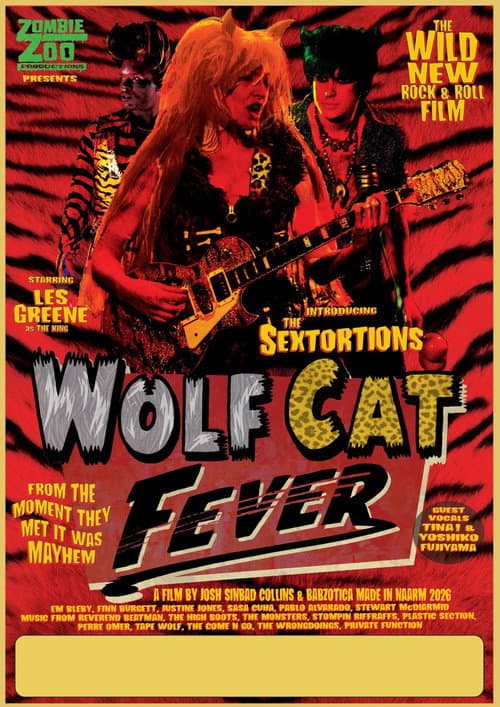
Furr Fever is the wild, fuzzed-up guitar-slinger of The Sextortions, a rockabilly band as deranged as they are irresistible. When Furr crosses paths with the howling, leather-clad Wolfy Howl, the two lost souls collide in a blaze of glitter and guitars in overdrive. But scheming music moguls, a corrupt Trump-ish mayor and a backstabbing bandmate are all gunning to tame them. Fortunately, the ghost of The King lives in Furr’s gold guitar, and rock and roll cannot be caged.
About this release
Wolf Cat Fever arrives in theaters on Friday, April 24, 2026, a comedy-music film whose premise plants itself squarely in the tradition of rock-and-roll fable — the kind of story where music isn't merely a backdrop but the entire moral architecture of the narrative.
The film centers on Furr Fever, described as the "fuzzed-up guitar-slinger" of a rockabilly outfit called The Sextortions. The band is characterized, in the film's own terms, as "deranged" and "irresistible" in equal measure, which is a reasonable thumbnail for a certain strain of rockabilly — a genre that has always trafficked in controlled chaos, in the tension between precision musicianship and the performance of wildness. Furr's world is disrupted by the arrival of Wolfy Howl, a leather-clad figure described as "howling," and the two collide in what the film frames as a meeting of kindred misfits. The collision is rendered in the language of glitter and overdriven guitars, which suggests the film is not interested in understatement.
What gives Wolf Cat Fever its particular shape is the roster of antagonists arrayed against its protagonists. There are scheming music moguls, a figure described as a "corrupt Trump-ish mayor," and a backstabbing bandmate — a fairly compressed catalogue of the forces that rock mythology has long identified as enemies of authenticity. The moguls represent commerce, the mayor represents political power dressed in populist clothing, and the bandmate represents betrayal from within. That these three categories of opposition exist simultaneously in a comedy-music film suggests the story is working with the familiar machinery of the underdog-versus-the-establishment narrative, filtered through a genre lens that is deliberately heightened and self-aware.
The most conspicuous single detail in what's known about the film is the ghost of Elvis Presley — identified here only as "The King" — said to inhabit Furr's gold guitar. This is not a subtle touch. The Elvis ghost is a device that immediately situates the film within a specific lineage of rock hagiography, one that treats certain musicians as quasi-sacred figures whose spiritual presence can be transmitted through instruments. It also functions as a thesis statement of sorts: the film appears to be arguing, through the conventions of comedy and music, that rock and roll possesses some quality that resists institutional domestication. The closing line of the premise — "rock and roll cannot be caged" — is less a plot summary than a declaration of the film's governing idea.
The genre designations on record are comedy and music, and the original language is English. What the available information does not clarify is the film's formal approach to its musical content — whether the performances are staged as set pieces, whether the soundtrack is original or draws on existing rockabilly material, and how much of the runtime is given over to the music itself versus the comic plotting. These are not trivial questions for a film of this type. The difference between a film that uses music as atmosphere and one that is genuinely structured around musical performance is significant, and it shapes the viewing experience considerably.
Similarly, the production background — who directed, who wrote the screenplay, who plays Furr Fever and Wolfy Howl — is not available in the materials at hand. For a film with this degree of stylization in its premise, those choices matter. Rockabilly as a visual and sonic vocabulary requires a particular commitment to execute without tipping into pastiche, and the success of the film's comedic register will depend heavily on whether it plays the heightened premise with conviction or holds it at arm's length. The presence of the Trump-ish mayor, in particular, is a choice that will read differently depending on how the film handles it — as a throwaway gag or as something with a bit more structural weight.
The Wikipedia title associated with this film in the metadata — "Keyboard Cat" — is a curious artifact that doesn't correspond to any element of the premise as described, and it's worth noting only as an unexplained discrepancy rather than a meaningful data point.
What's also open is the question of tone balance. The premise gestures toward genuine absurdism — a ghost living in a guitar is not a realist touch — while also invoking, through its antagonists, something that resembles satire. Comedy films that attempt to hold both registers simultaneously sometimes find a productive tension between them, and sometimes find the registers working against each other. Whether Wolf Cat Fever lands closer to affectionate genre parody or something with sharper edges is a question the release will answer.
The audience most likely to seek this out will be viewers with some existing investment in rockabilly's aesthetic mythology, fans of music-driven comedy films, and anyone drawn to narratives that frame artistic integrity against institutional power — a theme durable enough to work across a wide range of tonal registers. The Elvis-ghost premise alone will function as a sorting mechanism, drawing in those with a taste for the deliberately unhinged and probably deterring those who prefer their comedies tethered more firmly to the realistic.
Comments
Sign in to join the conversation.
Loading…