
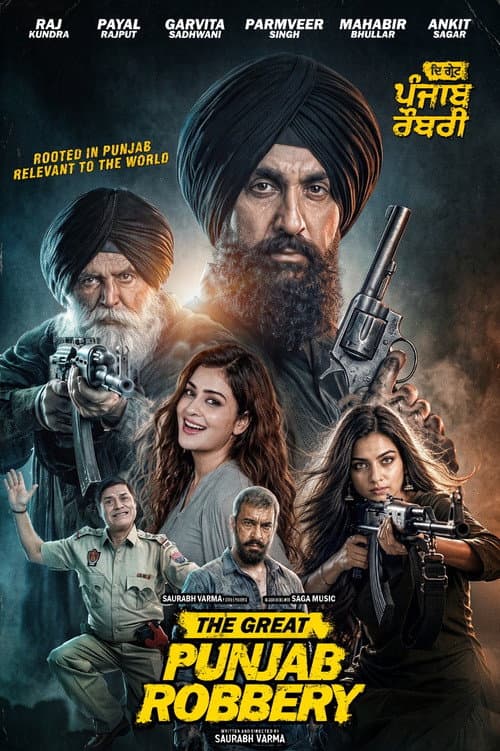
Details
- Language
- Punjabi
- Directed by
- Saurabh Varma
- Written by
- Saurabh Varma, Lawrennce John
- Theme
- heisttrue crime
- For
- adult
Popularity · Search interest now
Low
2.1
Based on TMDb activity
Starring




Incoming Editorial TeamVerified
The Great Punjab Robbery is a Punjabi-language thriller set around a bank heist in Punjab. Three robbers with unconventional names take over an ordinary bank, leaving no demands and no ransom — only cryptic riddles delivered to the police. It releases on August 7, 2026.
Gallery (8)
Key features
- ·Punjabi-language crime thriller
- ·Bank heist with no ransom demands
- ·Cryptic riddle-driven mystery plot
- ·Genres: thriller, crime, action
- ·Theatrical release date: August 7, 2026
FAQ
When and where does The Great Punjab Robbery release?
The Great Punjab Robbery is scheduled for release on August 7, 2026. No information about specific theatrical markets or a streaming platform has been announced at this time.
Where can I watch The Great Punjab Robbery online?
No streaming platform has been confirmed for The Great Punjab Robbery. Distribution details are expected to be announced closer to the August 2026 release date.
What is the plot of The Great Punjab Robbery?
Three robbers with unusual names seize an ordinary bank in Punjab without making any demands or seeking a ransom. Instead, they send cryptic riddles to the police, each one pulling investigators further into the mystery behind the heist.
What genre is The Great Punjab Robbery?
The film is categorized as a thriller, crime, and action release. Its premise — a ransom-free bank takeover paired with riddle-based clues sent to law enforcement — places it within the mystery-driven crime thriller tradition.
What language is The Great Punjab Robbery in?
The film is produced in Punjabi, making it part of the Punjabi-language cinema landscape.
About this release
There is something deliberately old-fashioned about the premise of The Great Punjab Robbery, a Punjabi-language thriller scheduled for release on August 7, 2026. Three robbers — identified in the film's setup by what are described as strange or unusual names — walk into an ordinary bank somewhere in Punjab and take it over. What follows, according to the available description, is not the familiar hostage-negotiation procedural that the genre has rehearsed countless times. There are no demands. There is no ransom. Instead, the robbers begin sending cryptic riddles to the police, each one pulling investigators further into a mystery whose shape has not yet been publicly defined.
That structural inversion — a heist with no apparent motive, conducted through puzzle rather than threat — places the film in an interesting position within crime cinema. The classic bank-robbery thriller tends to organize itself around legible desire: money, escape, revenge. When a heist film removes those anchors, it shifts the dramatic weight away from the question of whether the robbers will succeed and toward the question of what they actually want. Films that have operated in this register — withholding the motive as a narrative engine rather than a plot hole — tend to rely heavily on the quality of their riddle construction and the patience of their pacing. Whether The Great Punjab Robbery has the architecture to sustain that approach across a feature runtime is, at this point, unknown.
The film's original language is Punjabi, situating it within a regional cinema that has grown considerably in output and ambition over the past decade. Punjabi-language films have historically occupied a distinct space from Hindi-language Bollywood productions, cultivating their own star systems, distribution networks, and genre conventions. A crime thriller of this apparent scale — a bank siege with an investigative procedural component running alongside it — represents a genre mode that travels well across audiences, which may account for some of the strategic interest in a release structured around an enigmatic premise rather than a recognizable franchise or sequel.
One notable element in the film's metadata is an association with Jasmine Sandlas, a Punjabi singer who has become one of the more prominent figures in Punjabi popular music. The precise nature of her involvement — whether as a performer contributing to the soundtrack, as an actor, or in some other capacity — has not been specified in the available information. Her connection to the project is, however, worth noting, because in contemporary South Asian entertainment the boundary between music and film remains highly porous. Artists move fluidly between recording and screen work, and a soundtrack tie-in with a well-known name can serve as a significant distribution mechanism for a film's promotional reach, particularly in Punjabi-speaking markets across India, Canada, the United Kingdom, and the wider diaspora.
The three robbers at the center of the film are described specifically in terms of their names, which are flagged as strange or unusual — a detail that seems too specific to be incidental. In crime fiction, the naming of criminals is often a form of characterization in miniature: aliases and epithets compress personality, mythology, and function into a single word or phrase. The emphasis on strange names here may signal that the film intends its robbers to function as figures of heightened theatricality, perhaps closer to the folkloric outlaw tradition than to the naturalistic criminal. Whether that theatricality is played straight, with irony, or somewhere between the two will determine a great deal about the film's overall register.
The riddle structure deserves some scrutiny as a dramatic device. Riddles sent to police during an active crime create a peculiar kind of narrative: they imply that the criminals are performing for an audience, that the crime itself is less a transaction than a demonstration. This premise has resonances with certain strands of crime literature — the puzzle-mystery tradition in which the criminal's intelligence is the real subject — but it also carries risks. A riddle that feels clever in conception can feel contrived in execution, and the film will need to ensure that its solutions feel earned rather than arbitrary. The "no demands, no ransom" framing is intriguing precisely because it defers the question of purpose; at some point, that deferral has to resolve into something, and the quality of that resolution will likely determine how the film is received.
The action genre tag alongside thriller and crime suggests the film is not positioning itself as a purely cerebral puzzle. There is presumably physical propulsion — the kind of set-piece construction that gives crime films their momentum and provides relief from the more intellectually demanding work of the riddle sequences. The balance between those two modes, the kinetic and the cerebral, is one of the more interesting unanswered questions about the production.
The August 7, 2026 release date puts the film into summer, a window that in most markets favors genre entertainment with broad appeal. Audiences who follow Punjabi cinema — whether in Punjab itself or across the substantial diaspora communities in North America and the United Kingdom — will find here a film operating in familiar genre territory while apparently pushing against some of its conventions. Anyone drawn to crime thrillers structured around withholding and revelation, rather than action and escalation, will have reason to pay attention to what the film actually delivers once its riddles are finally solved.
Comments
Sign in to join the conversation.
Loading…