
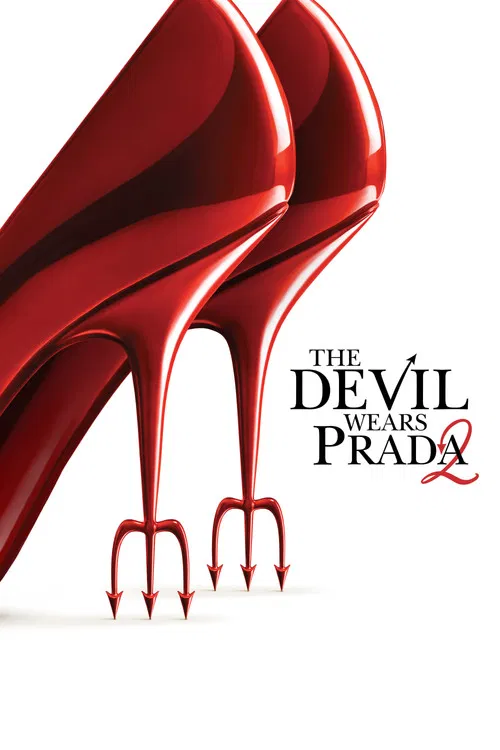
Details
- Language
- English
- Studio
- 20th Century Studios
- Series
- The Devil Wears Prada
- TMDb Rating
- 7.0 (2.3k votes)
- Directed by
- David Frankel
- Written by
- Aline Brosh McKenna
Rating · Quality score from voters
TMDb
7.0/10
IMDb
6.3/10
Rotten Tomatoes
78%
Metacritic
63/100
Popularity · Search interest now
Popular
59.1
Based on TMDb activity
Starring


Where to watch
Links may earn Incoming a commission at no extra cost to you. Streaming data via JustWatch — may not reflect today's catalog.
Incoming Editorial TeamVerified
The Devil Wears Prada 2 is the sequel to the 2006 fashion-world drama. It is scheduled for release on April 29, 2026, and follows Miranda Priestly as she nears retirement and reunites with Andy Sachs to confront Emily Charlton, her former assistant turned rival.
Trailer
Gallery (21)
Key features
- ·Sequel to the 2006 fashion drama
- ·Features Miranda Priestly nears retirement storyline
- ·Andy Sachs and Emily Charlton return
- ·Theatrical release April 29, 2026
FAQ
When does The Devil Wears Prada 2 release?
The Devil Wears Prada 2 is scheduled for theatrical release on April 29, 2026.
Is The Devil Wears Prada 2 a sequel?
Yes, it is a sequel to the 2006 film The Devil Wears Prada.
What is The Devil Wears Prada 2 about?
The film follows Miranda Priestly as she nears retirement and reunites with Andy Sachs to face Emily Charlton, a former assistant who has become her rival.
About this release
Nineteen years is a long time to wait for a follow-up, but 20th Century Studios and Wendy Finerman Productions are banking on the proposition that audiences still have appetite for the world of Runway magazine. The Devil Wears Prada 2 is scheduled for release on April 29, 2026, a sequel to the 2006 comedy-drama that became one of the more durable cultural artifacts of that decade — a film so thoroughly absorbed into the popular imagination that its title became shorthand for a particular species of workplace tyranny.
The original The Devil Wears Prada, produced by Wendy Finerman Productions and released through 20th Century Fox (now 20th Century Studios), was itself adapted from Lauren Weisberger's 2003 novel. It starred Meryl Streep as Miranda Priestly, the glacially imperious editor of a high-fashion magazine, and Anne Hathaway as Andrea "Andy" Sachs, the ambitious young journalist who survives a year as Miranda's assistant before escaping into what she presumably hoped would be a more ethical professional life. The film also featured Emily Blunt as Emily Charlton, Miranda's brittle, fashion-obsessed first assistant, in a supporting role that generated considerable attention in its own right. The picture was a commercial success and earned Streep an Academy Award nomination for Best Actress, one of several she has accumulated over a career that makes her the obvious focal point of any franchise continuation.
What is known about the sequel's premise is pointed and structurally clever, at least on paper. According to the available description, Miranda Priestly is approaching retirement — a condition that would, for a character defined entirely by her invulnerability, represent a genuine dramatic threat — and finds herself reuniting with Andy Sachs while facing off against Emily Charlton, who has apparently risen from subordinate to rival in the intervening years. The dynamic this sets up is worth pausing on: Emily, who spent most of the first film resenting Andy's proximity to Miranda and her own exclusion from the Paris trip she had coveted, now occupies an antagonist's position in a conflict that places her opposite both the woman she once served and the woman she once outranked. That triangulation, with Miranda caught between her former assistants on what appears to be opposing sides, suggests the sequel is less interested in replicating the original's mentor-and-novice structure than in examining what becomes of those relationships once the power dynamics that defined them have shifted.
The genre classification — drama and comedy — mirrors the original film's tonal register, which walked an occasionally uneasy line between satirizing the fashion industry and asking its audience to find Miranda's cruelty, if not sympathetic, then at least comprehensible. Whether the sequel intends to maintain that ambivalence or push harder in one direction is not yet clear from the available material.
What the production has not yet disclosed publicly is substantial. The director is unannounced in the available data, which is a notable absence given how much the original's particular texture owed to David Frankel's handling of the material — his ability to let Streep operate in near-silence while the rest of the cast scrambled around her. The screenplay's authorship is similarly unconfirmed here, as is the question of whether the adaptation has any relationship to Weisberger's 2013 novel Revenge Wears Prada: The Devil Returns, which also functioned as a sequel to the original book. The films and the novels have always maintained a somewhat arm's-length relationship to each other in terms of plot specifics, so the connection may be nominal at best, but it's a question the production has not yet answered in any detail available to the public.
The casting beyond the implied return of central figures is also unspecified in what's been made available. The first film's ensemble extended well beyond its leads — Stanley Tucci's Nigel, the art director who served as something of a moral compass within Runway's amoral halls, being the most obvious example of a character whose fate and potential reappearance would interest viewers returning to this world. Whether those threads are picked up or whether the sequel narrows its focus to the three-way dynamic at its center is an open question.
There is also the matter of setting and industry context. The fashion media landscape in 2026 bears only passing resemblance to the one depicted in 2006, a period when print magazines still commanded the cultural authority that the film took as a given. Miranda Priestly's power, in the original, derived from her control over a physical artifact — a glossy monthly that could make or ruin careers with a placement or an omission. How the sequel accounts for, or declines to account for, the structural collapse of that industry in the years since would tell a viewer quite a bit about the kind of film it intends to be. A sequel that ignores this context would be making a choice as clearly as one that places it at the center of Miranda's looming obsolescence.
The audience most likely to seek this out consists of viewers who have returned to the original in the two decades since its release — and the evidence suggests there are many of them, given how persistently the film circulates in streaming catalogs and cultural conversation. For that audience, the sequel's central promise is essentially character-based: the chance to see where these particular people ended up, and whether proximity to Miranda Priestly leaves marks that don't fade. The answer to that question, for Emily Charlton at least, appears to be yes.
Comments
Sign in to join the conversation.
Loading…