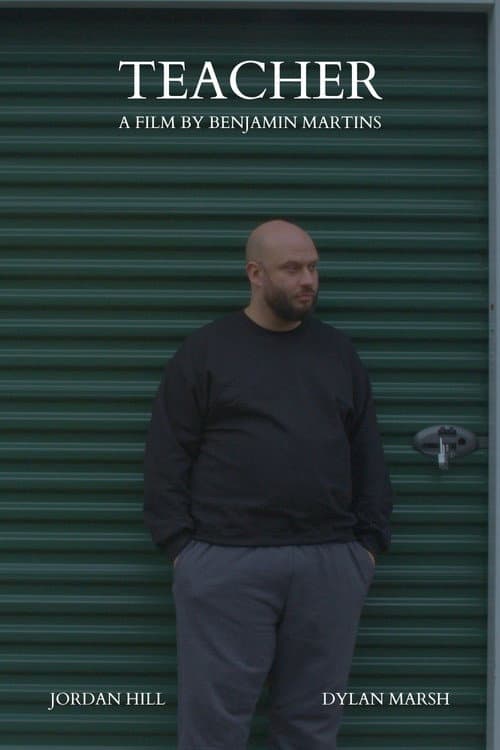
 Warm
movieReleased
Teacher
Released April 25, 2026
↑ 0.324h
Details
- Language
- English
- Directed by
- Benjamin Martins
- Written by
- Benjamin Martins
Popularity · Search interest now
Low
0.0
Based on TMDb activity
Starring
Where to watch
Not currently available for streaming or purchase.
Links may earn Incoming a commission at no extra cost to you.
Incoming Editorial TeamVerified
A high school gym teacher deals with the loss of his mother and his sense of self as he clears out her old storage unit.
Gallery (1)
About this release
A film called Teacher is scheduled for release on April 25, 2026. The project is an English-language movie centered on a high school gym teacher who, in the aftermath of his mother's death, finds himself sorting through her belongings at a storage unit — a task that becomes entangled with a broader reckoning over his own identity.
The premise is spare and domestic in the way that a certain strain of American independent drama tends to be: a man alone with boxes, confronting what a parent's accumulated possessions say about her, and by extension about him. The storage unit as a site of grief is a quietly rich setting — those anonymous, climate-controlled rooms where people warehouse the things they can't bring themselves to keep in their homes but can't bring themselves to throw away. For a child sorting through a dead parent's unit, every object becomes a question. The gym teacher detail adds a specific texture: here is a man whose professional life is organized around physical performance, schedules, and the supervision of other people's development, now faced with the fundamentally uncoachable experience of loss.
Beyond what the film's synopsis provides, the specifics of production — who wrote and directed the film, who stars in it, what studio or distributor is behind it — are not yet part of the public record in any detailed form. That absence is itself somewhat notable for a film arriving in spring 2026. April is a month that has historically served independent and arthouse releases well, sitting outside the summer blockbuster corridor and offering a window when audiences and awards attention alike can settle on quieter work. Whether Teacher is positioned for that kind of reception, or whether it is a smaller theatrical release aimed at a more limited circuit, remains unclear.
What the synopsis leaves open is considerable. The relationship between the gym teacher and his mother — whether it was close, estranged, complicated in the ways that adult-child relationships with aging parents often are — goes unspecified, and that ambiguity is where a film of this type lives or doesn't. The phrase "sense of self" in the description gestures toward an identity crisis that extends beyond grief, suggesting the film is interested in the man's life more broadly: what it means to be a gym teacher, whether he finds that identity hollow or sustaining, how the act of going through someone else's things forces a person to inventory their own. But whether the screenplay pursues that interiority with rigor or lets it remain atmospheric is an open question.
The "old storage unit" phrasing implies the mother had been using it for some time — that this is not a recent rental but an accumulated archive, which suggests the possibility that what the son finds inside spans decades, perhaps predating his own memory of her. Films in this register sometimes use such discoveries structurally, as a way of revealing information about a parent that reframes the protagonist's understanding of his own history. Whether Teacher takes that approach or stays closer to the purely emotional texture of grief and labor — the physical work of sorting, lifting, deciding — is another unknown.
The genre is unspecified in the available metadata, which is worth noting. A story like this could be played as quiet realism, as something more formally experimental, or as a drama with comedic undertones — the mundane absurdity of driving to a storage facility in the suburbs to handle a parent's leftover furniture is not far from the territory of contemporary literary fiction writers who find tragicomedy in exactly these logistical intimacies of death. Without knowing the filmmaker's sensibility, it is genuinely impossible to anticipate which register Teacher occupies.
The title itself is suggestive without being explanatory. It could refer to the protagonist's profession straightforwardly, or it could carry an ironic or thematic charge — the mother as a teacher of some kind, or the experience of grief itself as a form of instruction. Titles this simple often function as a kind of provocation, asking the audience to hold the word in mind and let the film gradually complicate it.
For audiences drawn to films about middle-aged men in quiet crisis — a durable genre that runs from the grittier American independent tradition through European art cinema — Teacher represents a recognizable proposition. The specificity of the gym teacher's profession, the concrete task of clearing a storage unit, and the framing around maternal loss all suggest a film more interested in the texture of a particular life than in broad dramatic stakes. That narrowness of focus is what distinguishes films of this type from more conventional grief narratives, and it is presumably the quality that will draw the viewers most likely to seek this one out: people who find something honest and useful in watching ordinary loss handled with ordinary detail, without resolution coming too easily or too neatly.
Comments
Sign in to join the conversation.
Loading…