
Details
- Language
- English
- Studio
- Film4 Productions
- Directed by
- Mark Jenkin
- Written by
- Mark Jenkin
Popularity · Search interest now
Low
1.2
Based on TMDb activity
Hype score
leaderboard →71
/ 100↑ +22.3 in 24h
#86 globally#49 in movie
30-day trendWP 72
Rose of Nevada sees steady Wikipedia engagement among film releases.
Starring






Incoming Editorial TeamVerified
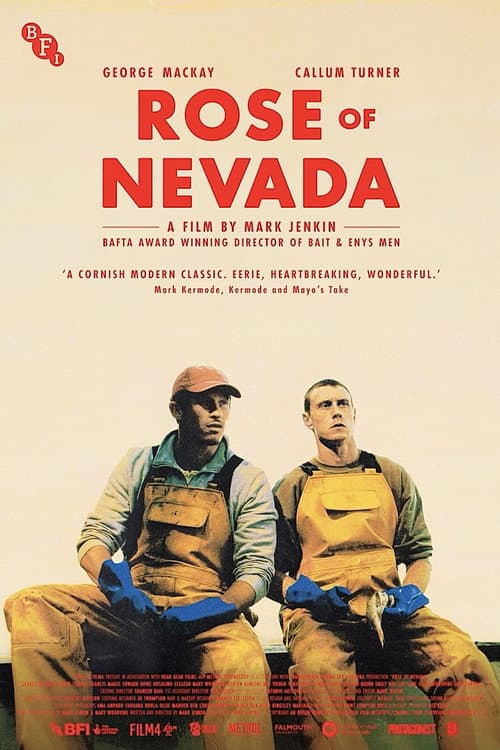
Rose of Nevada is an upcoming English-language film releasing on April 24, 2026. The story follows two men who join the crew of a boat that reappears in a village thirty years after it vanished, only to find themselves transported back in time after one voyage.
Gallery (11)
Key features
- ·English-language film
- ·Theatrical release April 24, 2026
- ·Time-travel narrative premise
- ·Mystery and drama genre elements
FAQ
When does Rose of Nevada release?
Rose of Nevada is scheduled to release on April 24, 2026.
What is Rose of Nevada about?
The film follows two men who board a boat that has reappeared in a village thirty years after vanishing. After one voyage, they find themselves transported back in time and mistaken for the vessel's original crew.
What language is Rose of Nevada in?
Rose of Nevada is an English-language film.
About this release
A film called Rose of Nevada is scheduled for release on Friday, April 24, 2026, produced by Film4 Productions, the BFI, and Head Gear Films. It is an English-language feature set in Cornwall, England, and its premise turns on a fishing boat that vanished thirty years ago and has now, inexplicably, returned to the village it once left. Two men, drawn by the promise of better fortune, sign on to its crew. After a single voyage, they find themselves displaced in time — transported back to the era of the boat's original disappearance, and mistaken by everyone around them for the crew who sailed it then.
That premise sits at the intersection of three genres the film's metadata explicitly claims: science fiction, mystery, and drama. It is a combination that has its own modest but durable tradition in British filmmaking — quiet, geographically rooted stories in which the uncanny arrives not through spectacle but through the rhythm of ordinary life being interrupted. The Cornwall setting is significant in that context. The county has served as backdrop for British literary and cinematic stories of isolation, folklore, and the sea for decades, a landscape that registers as simultaneously picturesque and faintly threatening, cut off from the mainland in ways that are as psychological as they are geographic. A fishing village in that setting, with a boat that has been missing for thirty years, lands inside a well-established imaginative tradition without necessarily being beholden to it.
The production consortium behind Rose of Nevada is worth noting. Film4 Productions has a long record of backing British films that occupy the space between genre entertainment and literary drama — films that tend to carry some ambition about character and place alongside their more commercial premises. The BFI's involvement, through its funding and development infrastructure, typically signals a project with cultural as well as commercial intentions. Head Gear Films, a financing and production company that has worked across a range of British independent productions, rounds out a consortium that suggests Rose of Nevada is positioned as a mid-budget prestige genre film rather than a low-budget experimental work or a large-scale studio production. That configuration — modest resources, recognizable institutional backing, a high-concept premise — is familiar territory for British science fiction, a mode that has often worked best when it treats the speculative as a pressure applied to ordinary people rather than a canvas for elaborate world-building.
What is known about the story establishes a fairly precise dramatic situation: two men, a disappeared boat, one voyage, and then the displacement. What is not yet visible from available information is how the film handles the mechanics and the emotional logic of what follows. Time-travel narratives of this kind live or die by the specificity of their central problem — not the time travel itself, which functions as a premise rather than a subject, but what the transported characters want, what they are mistaken for having done or been, and what it costs them to navigate a world that does not recognize them as who they actually are. The detail that they are mistaken for the original crew rather than simply present in the past is a particular narrative choice, one that implies the story will involve identity, reputation, and perhaps culpability. Whether the original crew's disappearance was accident, crime, or something else is precisely the kind of question the film's mystery genre classification suggests will be in play.
The Cornwall setting also raises questions that the available information does not resolve. Is the village a named, existing place, or a fictional one? Are the two men locals or outsiders — fishermen themselves, or simply men desperate enough to board a boat with a thirty-year gap in its history? The word "fisherman" appears in the film's keyword metadata, which suggests at least some of the central characters have that professional identity, but the degree to which the film is interested in the particulars of fishing life — its economics, its communities, its relationship to a coastline that has historically defined English regional identity — is not yet clear. British films with this kind of setting can range from deeply ethnographic to purely atmospheric in their treatment of place, and Rose of Nevada has not yet shown which direction it tends.
The title itself is not explained by any available information. Rose of Nevada is, on its face, an odd name for a Cornish fishing boat — Nevada is an American state, inland, far from any ocean. A boat named for a desert landlocked place carries its own quiet strangeness, and whether that strangeness is deliberate, historical, or incidental to the story is one of the small mysteries the film's eventual release will answer.
The audience most likely to seek out Rose of Nevada on or after April 24, 2026, is probably already attuned to British genre filmmaking in the Film4 tradition — viewers who found something to hold onto in quieter, place-specific science fiction and who are willing to follow a time-travel story that appears to be more interested in what two ordinary men do when history mistakes them for someone else than in the mechanics of how they got there.
Comments
Sign in to join the conversation.
Loading…