Details
- Language
- Chinese
Popularity · Search interest now
Low
0.1
Based on TMDb activity
Incoming Editorial TeamVerified
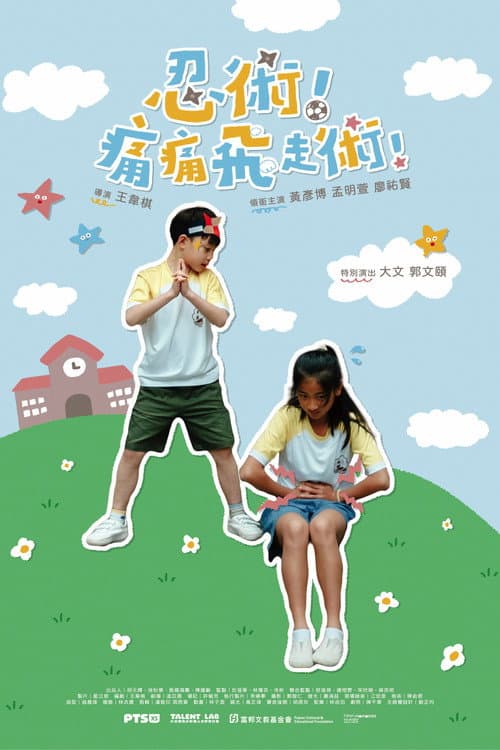
Sister Winnie, facing a growing-up challenge, and her ninja-aspiring brother Yoyo start a chaotic adventure over a coveted brown sugar candy. When Yoyo tries his ninja trick, things go hilariously wrong. As accidents pile up, he uncovers the truth behind Winnie’s hidden injury—can he save her in time?
Gallery (2)
About this release
A children's film titled Pain Pain Flies Away Jutsu! — rendered in Chinese as 忍術!痛痛飛走術! — is scheduled for release on April 25, 2026. The film is a drama produced in Chinese (Mandarin), centered on two siblings navigating a small but emotionally charged domestic crisis that spirals, as these things tend to do in stories about children, well beyond its modest starting point.
The premise is built around a piece of brown sugar candy — an object whose significance is exactly as outsized as it would be in the hands of a child who wants it badly enough. Sister Winnie is described as facing a "growing-up challenge," a deliberately vague phrase that gestures toward the particular kinds of private pain adolescence tends to generate, the sort a younger sibling would not immediately understand or even recognize. Her brother Yoyo, meanwhile, is occupied with a different ambition entirely: he wants to be a ninja, or at least to perform the kinds of tricks he associates with that aspiration. The film's title borrows from the vocabulary of jutsu — the Japanese term for a technique or art, familiar to audiences through decades of manga and anime — and frames Yoyo's attempted intervention as a kind of spell, a child's earnest belief that the right trick, performed correctly, can make pain disappear.
What the synopsis suggests is a film interested in the gap between what children understand and what adults (or older siblings on the cusp of adulthood) are actually experiencing. Yoyo's ninja logic — that pain can be dispelled with the right incantation or maneuver — is played for comedy at first. "Things go hilariously wrong" is the description offered, and the accumulation of accidents that follows sounds like the recognizable architecture of slapstick family filmmaking: chaos compounding itself until something underneath it is exposed. The tonal shift the story promises, from pratfall comedy to the revelation of Winnie's hidden injury, is the structural hinge the film appears to be built around. Whether that shift lands as earned emotion or tonal whiplash is, of course, one of the questions April 2026 will answer.
The original language being Chinese places the film within a tradition of Mandarin-language family cinema that has, over the past two decades, developed a fairly distinct register — often warmer in its emotional address than its Western counterparts, frequently interested in sibling dynamics and intergenerational feeling, and comfortable with stories in which children are both the comic engine and the moral center of the narrative. The ninja framing adds a layer of cross-cultural play that is well-established in Chinese-language children's media, where Japanese pop-cultural vocabulary — the jutsu, the headband, the earnest apprentice — has long been absorbed and redeployed with affection rather than anxiety.
The film's title in both languages is worth dwelling on briefly. "Pain Pain Flies Away" has the cadence of a children's rhyme, the kind of thing a parent says while kissing a scraped knee — a charm rather than a cure. Appending "Jutsu!" to that phrase reframes the charm as technique, as something Yoyo believes can be systematized and applied. The joke is that it cannot, and the drama is that something more honest has to take its place. That the film is categorized as drama rather than comedy or family suggests the marketing — or at least the cataloguing — wants to foreground the emotional weight over the slapstick setup, even if the synopsis leans into the comic machinery first.
What remains genuinely unknown at this stage is substantial. No director is named in the available information. No production company, distributor, or country of production beyond the language of origin has been specified, which makes it difficult to situate the film within any particular filmmaking tradition with precision. Its intended audience — strictly young children, or the kind of family film that courts parents as much as kids — is not spelled out, though the sibling dynamic and the growing-up subtext suggest something pitched at a slightly older child who might recognize Winnie's experience, with enough comic momentum to hold younger viewers. Whether the film is intended for theatrical release in specific markets, or carries any broader distribution ambitions, is not addressed in the available material.
The question of Winnie's hidden injury is the one the film holds back as its central reveal. The synopsis frames it as something Yoyo "uncovers" in the midst of the chaos he has created — which implies that the accident-prone journey is not merely obstacle comedy but is also, structurally, a process of discovery. Children's films that turn on a hidden wound, physical or emotional, tend to ask their young protagonists to cross a threshold: from the child who wants something for themselves to the child who sees, for perhaps the first time, that someone they love is carrying something they did not know about. Whether Pain Pain Flies Away Jutsu! treats that threshold with subtlety or sentimentality is the kind of thing audiences in spring 2026 will be in a position to judge.
The film is likely to appeal most directly to families with children in the seven-to-twelve range, particularly those with siblings close in age who recognize the specific texture of a relationship that is equal parts rivalry and loyalty. Viewers with an affection for the ninja-genre trappings — the aspirational posturing, the invented techniques, the very sincere belief in the power of a well-executed move — will find that familiar vocabulary deployed here in a domestic register, stripped of its usual stakes and made, intentionally, a little absurd.
Comments
Sign in to join the conversation.
Loading…