Details
- Language
- English
- Studio
- Gray Sky Pictures
- Directed by
- Hunter Nino, Joshua Brucker
- Written by
- Joshua Brucker
- Theme
- supernaturalsurvival
- For
- adult
Popularity · Search interest now
Low
0.6
Based on TMDb activity
Starring

Incoming Editorial TeamVerified
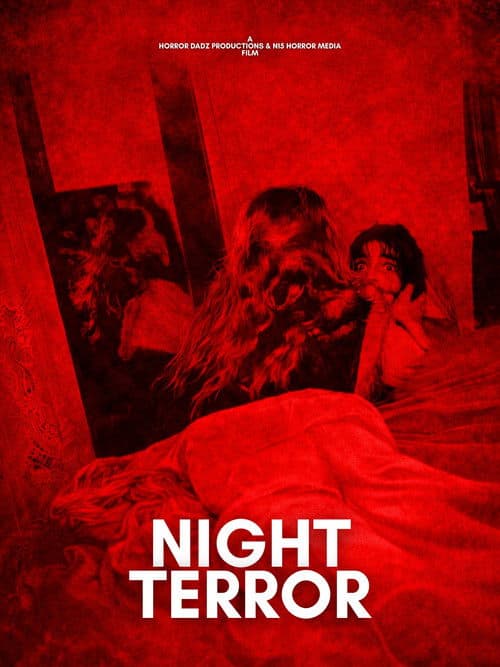
A woman battles lifelong sleep paralysis while living alone. As nightly episodes worsen her mental state, paranormal investigators suggest her condition may have supernatural origins.
Gallery (1)
About this release
Night Terror, a horror film produced by Gray Sky Pictures, Horror Dadz Productions, and N15 Media, is scheduled for release on April 24, 2026.
The premise is compact and familiar in its bones: a woman living alone suffers from sleep paralysis, a condition that has haunted her throughout her life. As her nightly episodes grow more severe and begin eroding her mental stability, paranormal investigators enter the picture with a suggestion that rattles the boundary between neurological disorder and something less easily explained — that her condition may have supernatural origins. It is a setup that draws on one of horror's more durable wells, the idea that the body's own vulnerabilities, the moments when the mind snaps awake while the muscles remain locked and unresponsive, might not be purely physiological. Sleep paralysis has a long cultural history as a vessel for supernatural dread, showing up in folklore ranging from the Old Hag tradition in Newfoundland to the mare of Scandinavian legend to the pressing demons of medieval European accounts. Cinema has visited this territory before, but it has rarely treated the condition as the sustained center of a narrative rather than a single set piece.
What distinguishes the framing of Night Terror is the explicit introduction of paranormal investigators as a structural element. Their presence implies the film is not content to let the ambiguity sit entirely in the protagonist's head. Where a certain kind of psychological horror is satisfied to leave the audience parsing whether the threat is real or symptomatic, the investigators suggest an external force — people who believe, or at least professionally entertain belief — pushing the narrative toward something more outwardly confrontational. How the film balances those two modes, the subjective terror of a woman alone in the dark and the more procedural presence of outside figures cataloguing her experience, is one of the more interesting formal questions the premise raises.
The production involves three companies: Gray Sky Pictures, Horror Dadz Productions, and N15 Media. The collaboration of three smaller production entities on a horror film suggests an independent financing model rather than a studio-backed production, which in genre terms often means a tighter budget and, correspondingly, a tighter reliance on atmosphere and performance over spectacle. Some of the more effective horror filmmaking of the past decade has come out of exactly these conditions — constraints that push filmmakers toward patience and economy. Whether Night Terror takes that path or pushes against it is not yet clear from what has been made public.
The central character's isolation is worth noting as a deliberate structural choice. Living alone matters in this kind of story not merely as a practical condition that removes witnesses and potential help, but because it strips the protagonist of the one thing that might anchor her experience in shared reality. Sleep paralysis is already a profoundly isolating condition in lived experience — it occurs in the hypnagogic or hypnopompic states, the thresholds between sleep and waking, and the sufferer is definitionally alone in the episode, unable to speak or move while consciousness runs. Setting the film around a woman with no domestic companion doubles down on that isolation, ensuring that whatever she sees or feels cannot be verified or dismissed by anyone sharing her space. The paranormal investigators, when they arrive, become the first outside presence to take her experience seriously rather than pathologize it, which in horror tends to be when things accelerate rather than resolve.
What remains genuinely open ahead of the release is how the film handles the medical and experiential texture of the condition itself. Sleep paralysis as horror filmmakers sometimes portray it can collapse into a visual shorthand — a figure at the foot of the bed, a pressure on the chest — that borrows the iconography without much fidelity to the actual phenomenology. The condition is documented to produce extremely varied experiences: some sufferers report auditory hallucinations, some a sense of presence without any visual component, some full-formed apparitions, and some purely physical sensation. Whether Night Terror commits to a specific and consistent version of these episodes, or whether it uses the condition more loosely as a permission structure for conventional horror imagery, will likely determine whether it resonates with audiences who have personal experience with sleep paralysis or simply functions as competent genre exercise.
The investigators' framing also carries a question about tone. Paranormal investigation narratives have their own genre conventions, and the found footage and documentary-style horror that dominated a period of the genre leaves a particular set of expectations around how investigators are presented — either as skeptics who convert or as believers whose certainty makes them unreliable narrators. Where these characters fall on that axis, and whether the film treats their conclusions as credible or as another layer of uncertainty to add to the protagonist's deteriorating sense of reality, will shape the film's final register considerably.
Night Terror is set for release on April 24, 2026. It will likely draw viewers who have an appetite for slow-burn, psychologically inflected horror over action-driven genre fare, as well as those with a particular interest in how cinema handles the intersection of mental health experience and the supernatural. Given the independent production context and the intimate domestic premise, it seems calibrated for audiences willing to sit with discomfort rather than those looking for immediate escalation.
Comments
Sign in to join the conversation.
Loading…