
Details
- Language
- English
- Studio
- Stampede Ventures
- TMDb Rating
- 6.1 (16 votes)
- Directed by
- Potsy Ponciroli
- Written by
- Chad St. John
Rating · Quality score from voters
TMDb
6.1/10
IMDb
5.7/10
Rotten Tomatoes
63%
Metacritic
63/100
Popularity · Search interest now
Rising
13.9
Based on TMDb activity
Starring








Incoming Editorial TeamVerified
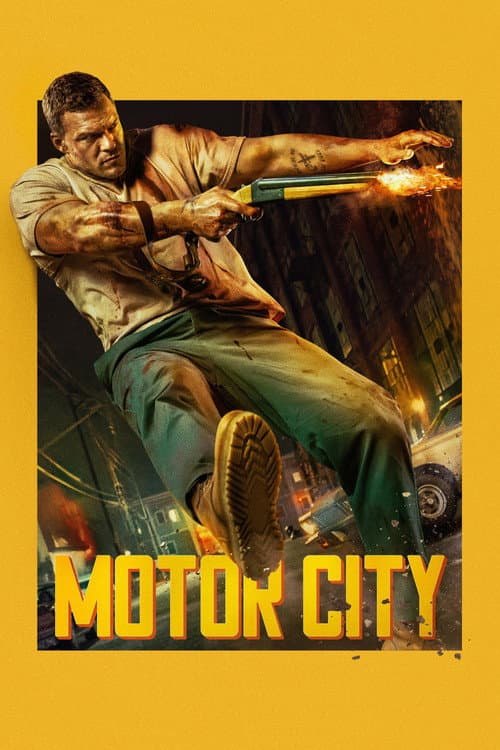
Motor City is an upcoming crime drama set in 1970s Detroit. The film follows John Miller, a man imprisoned for a crime he did not commit after falling for a local gangster's girlfriend, who later seeks revenge against the man responsible for his downfall. It is scheduled for release on July 23, 2026.
Trailer
Gallery (9)
Key features
- ·Crime drama set in 1970s Detroit
- ·Revenge-driven narrative
- ·Period setting: 1970s
- ·English language
- ·Theatrical release July 23, 2026
FAQ
When does Motor City release?
Motor City is scheduled for release on July 23, 2026.
What is Motor City about?
The film follows John Miller, a man in 1970s Detroit who is imprisoned for a crime he did not commit after falling for a local gangster's girlfriend, and later plots revenge against the gangster responsible.
What genre is Motor City?
Motor City is a crime drama set in 1970s Detroit.
About this release
Motor City arrives on July 23, 2026, a crime thriller produced by Stampede Ventures, Gramercy Park Media, and Peachtree Media Partners. Set in 1970s Detroit, it follows John Miller, a man who falls for a woman already claimed by a local gangster, pays for that misjudgment with a prison sentence for a crime he did not commit, and emerges consumed by the desire for revenge against the man who upended his life.
The premise belongs to a lineage of American crime cinema that has its roots in the post-studio era — specifically that window in the early 1970s when New Hollywood directors and their European-influenced counterparts were drawn to cities as pressure-cooker settings: corrupt, industrial, exhausted. Detroit carries particular iconographic weight in that tradition. As the American automobile industry was beginning its long contraction, the city became a kind of shorthand for a certain kind of masculine ambition colliding with institutional failure. A story of a wrongly imprisoned man plotting retribution against a gangster in that specific geography invites comparison to any number of films that used the urban decay of that decade as both backdrop and moral argument — pictures where the city itself seemed to conspire against the ordinary man trying to make something of himself or, failing that, to settle a score.
The revenge-wrongful-imprisonment structure is among the more durable frameworks in genre fiction. It carries an almost mathematical appeal: a man loses everything through no fault of his own, the audience is positioned to ratify whatever he does next, and the dramatic question becomes less about whether vengeance will be pursued than how, and at what cost. What distinguishes entries in this tradition from one another is usually texture — the specificity of the setting, the credibility of the relationships, the degree to which the mechanics of crime and punishment feel lived-in rather than generic. The 1970s Detroit framing suggests an interest in that kind of period texture, though how fully the film commits to historical specificity is not yet established from what has been made available.
What the production background does not readily clarify is who is behind the camera or in front of it. The three studios involved — Stampede Ventures, Gramercy Park Media, and Peachtree Media Partners — represent a production configuration that suggests independent or mid-budget financing rather than a major-studio release, which may bear on the film's scope and distribution footprint. Without knowing the director or the cast, it is difficult to gauge where Motor City sits in the current landscape of period crime films: whether it carries a recognizable filmmaking sensibility, whether the lead performance will do the work that this kind of protagonist-driven story requires, or whether the screenplay develops Miller's antagonist — the unnamed gangster — as anything more than a structural obstacle.
That figure, the gangster, is worth noting as an open question. The premise positions him primarily as the agent of Miller's destruction rather than as a character with his own interior life, which is a choice that genre films handle with varying degrees of sophistication. In some films of this type, the antagonist remains deliberately opaque, a force rather than a person, which can concentrate the audience's investment in the protagonist's psychological unraveling. In others, the villain's dimensionality is what elevates the material above formula. The description provides no indication of which approach Motor City takes, and that ambiguity touches on something larger: the film's apparent interest in the woman at the center of the triangle is also underdeveloped in what has been shared. She is, as described, the object over whom conflict erupts — but whether the screenplay affords her agency or consequence beyond that catalytic function shapes whether the film has something to say about 1970s Detroit or simply uses it as wallpaper.
The early audience response data, while drawn from a very small sample, is worth noting without over-reading. A modest IMDb rating and a middling Metascore, if they hold as more votes accumulate, would place Motor City in the category of competent genre work rather than a critical reassessment of the revenge picture — though early figures on a film this close to release, with this few respondents, tend to reflect self-selecting audiences whose tastes may not represent the broader range of viewers the film might eventually reach.
The audience most likely to seek this out in the near term is the one that has maintained a steady appetite for period American crime films: viewers who responded to the texture-heavy crime dramas that have appeared across streaming and theatrical platforms over the past decade, who find the 1970s setting intrinsically interesting, and who are not deterred by an unfamiliar cast or production entity when the genre bones are solid. Whether Motor City gives them something to argue about beyond its basic pleasures — whether the revenge, when it arrives, feels earned or merely mechanical — is precisely the kind of question that a July 23 release date will begin to answer.
Comments
Sign in to join the conversation.
Loading…