
🔥 Hot
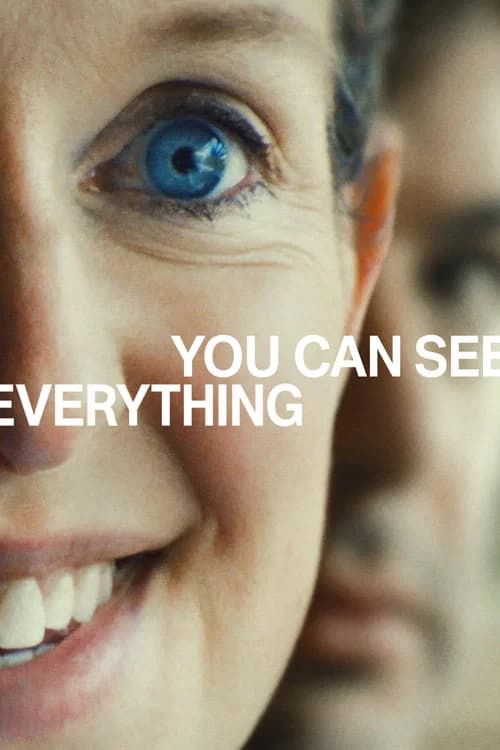
You Can See Everything
DocumentaryOct 16, 2026
You Can See EverythingReleased
Details
Popularity · Search interest now
Based on TMDb activity
Not currently available for streaming or purchase.
Links may earn Incoming a commission at no extra cost to you.
Incoming Editorial TeamVerified
I think of an ambiguous relationship between a woman from my hometown and a man from another city. They spent only a brief time together, yet could only keep talking. Unable to truly face one another, past scenes return to the surface of time. Was it a trace against the city's flow, or a reflection briefly allowed?
A South Korean documentary titled Mirrorless City View — known in its original language as 미러리스 시티 뷰 — is scheduled for release on April 30, 2026. Beyond those facts, and the spare description attached to the project, relatively little has surfaced about the film's production or the people behind it.
What does exist is the language the film uses to introduce itself, and it is worth sitting with. The source description, apparently written in the first person, frames the film around an ambiguous relationship between a woman described as being from the filmmaker's hometown and a man who comes from somewhere else — another city, unnamed. Their time together is characterized as brief, yet somehow inexhaustible in conversation. The two figures are portrayed as unable to fully face one another, and the description returns to an image of the past rising back to the surface — scenes that had, in some sense, receded. The closing questions are pointed: "Was it a trace against the city's flow, or a reflection briefly allowed?" That phrasing, with its interest in residue and in the conditional nature of human contact, does real work in setting a tonal register before a single frame has been seen.
The film is catalogued as a documentary, which is significant here. The first-person framing of that description — "I think of an ambiguous relationship" — suggests the filmmaker is not at a clinical remove from the subject but is implicated in it, or at minimum is treating memory and personal association as primary material. Korean documentary filmmaking has a tradition of this mode, one in which the distinction between essay film and documentary is porous, and in which the camera is understood as both instrument of observation and a means of working through something unresolved. Whether Mirrorless City View sits within that tradition or departs from it is impossible to say from what has been disclosed.
The title carries its own set of suggestions. A mirrorless camera — the kind that has largely displaced the digital SLR in contemporary photography — is defined technically by the absence of a reflex mirror between the lens and the sensor. Light passes directly through. The title might be read as a description of shooting style, or it might be a more figurative proposition: seeing the city without reflection interposed, or conversely, a city that offers no mirror back. "City View" holds the tension between two meanings — a view of the city, and the view that the city provides. Whether the film pursues this as visual metaphor or simply borrows the texture of the phrase is something only the finished work will clarify.
The relationship at the center of the film is described as ambiguous, which is not a word chosen carelessly in this kind of context. It doesn't mean undefined or underdeveloped — it means the film seems to be interested in the category of connection that resists easy classification, the kind that leaves both people unable to quite account for what happened between them. That is a legitimate and genuinely difficult subject for documentary filmmaking, which tends to be better equipped for the external and the verifiable than for the phenomenology of interpersonal uncertainty. Pulling off something interior and elusive in nonfiction form requires a particular kind of formal confidence.
There is no production background disclosed here — no director name, no cinematographer, no indication of where or how the footage was gathered, and no word of prior festival appearances or distribution arrangements. The popularity metric attached to the film is extremely low, suggesting it has not yet generated substantial online tracking. The TMDB vote count stands at zero, consistent with a film that has not yet screened publicly in any documented way. The metadata associates the film, somewhat puzzlingly, with the Wikipedia entry for Steven Soderbergh's 2024 film Presence, which appears to be an artifact of database categorization rather than a meaningful connection. The original language is listed as Korean, which aligns with the subtitle and the sensibility of the description.
April 30, 2026 is the release date, placing the film in a spring window. Beyond that, the platform and distribution context remain unknown. It is not clear whether this is a theatrical release, a festival premiere, an online release, or some combination. That uncertainty is worth naming not to flag a deficiency but because it shapes how an interested viewer would begin to track the film. Spring releases in the documentary space often travel through the festival circuit first, with broader availability following; whether that's the path here is unconfirmed.
The viewer most likely to seek this out is one drawn to contemplative, personal documentary work — the kind of filmmaking that takes its time with atmosphere and interiority rather than building toward revelation. Given the Korean-language original, the film will presumably require subtitles for most international audiences, and those audiences will likely be self-selecting: people already oriented toward contemporary Korean cinema or toward documentary work that operates closer to the essay or diary-film tradition. The description offers them something real to hold on to — a genuine formal and emotional problem, a preoccupation with what gets left behind in brief human contact — but delivers nothing so definite as to close off what the film itself might do with it.
You Can See Everything
DocumentaryOct 16, 2026
You Can See EverythingReleased ⭐ Popular
The Odyssey
AdventureJul 15, 2026
The Odyssey ⭐ Popular
Digger
ComedySep 28, 2026
Digger ⭐ Popular
Moana
FamilyJul 8, 2026
Moana ⭐ Popular
The Awakening
HorrorOct 29, 2026
The AwakeningReleased ⭐ Popular
Buddy
HorrorAug 27, 2026
BuddySign in to join the conversation.