Details
- Language
- English
- Studio
- Dream Light Pictures
Popularity · Search interest now
Low
0.3
Based on TMDb activity
Incoming Editorial TeamVerified
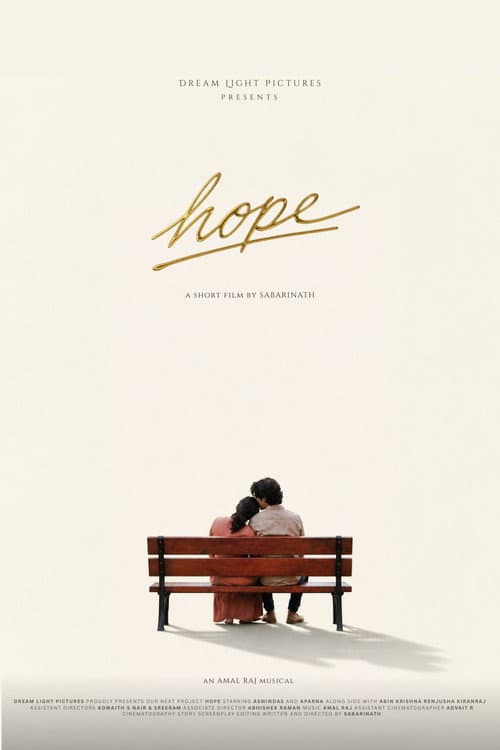
Hope is an upcoming drama film set on the last day of college, where three characters' lives intersect through unspoken feelings and pivotal choices. It releases on June 1, 2026.
Key features
- ·Drama genre
- ·Set on last day of college
- ·Three-character intersecting storyline
- ·Themes of love and timing
- ·English language
FAQ
When does Hope release?
Hope is scheduled for release on June 1, 2026.
What is Hope about?
Hope follows three characters whose lives quietly intersect on the last day of college, exploring themes of unspoken feelings, timing, and the choices that shape their lives.
What genre is Hope?
Hope is a drama film dealing with themes of love, memory, and emotional silence.
About this release
A film called Hope, produced by Dream Light Studio, is scheduled for release on Friday, April 24, 2026. Set on the last day of college, it follows three characters whose lives converge around memories, unspoken feelings, and the kinds of choices that only become legible in retrospect. The genres listed — romance, drama, and mystery — suggest something more layered than a straightforward love story, even if the emotional register described is quiet and interior.
The premise positions itself firmly within a particular tradition of collegiate coming-of-age storytelling, one preoccupied less with event than with atmosphere: the sensation of standing at a threshold, aware that the specific gravity of a place and a period is about to dissipate. Films in this lineage tend to treat physical setting — the campus, the dormitory corridor, the last afternoon of a final semester — as a kind of emotional architecture, and Hope appears to be working in that vein. The "last day of college" is not an arbitrary endpoint. It is a container for accumulated feeling, a date by which certain things must either be said or surrendered.
What distinguishes the framing here is the triangulation. Three figures, three emotional trajectories that "quietly collide" — the word quietly doing real work in that construction. This is not a film that appears to be organized around confrontation or dramatic rupture. Instead, the described tension is internal: longing held in check, words not spoken, the gap between what was felt and what was communicated. The inclusion of mystery as a genre tag is notable in this context. Mystery in a film otherwise described in lyrical, contemplative terms does not necessarily signal thriller mechanics or withheld information in the conventional sense. It may gesture instead toward the more diffuse mystery of other people's inner lives — what someone else was thinking, what they almost said, whether the moment that felt significant to one person registered the same way for another. That ambiguity, structural and emotional at once, is where the film appears to locate its central concern.
The production company, Dream Light Studio, is not one of the major distributors whose release strategies and house styles are well-documented, which means there is limited context to draw on regarding how Hope will reach audiences — whether theatrically in wide or limited release, or through some other platform. The original language is English, which situates it within a particular market, though the sensibility described — poetic, restrained, attentive to timing and silence — aligns as readily with international art-house cinema as with mainstream English-language romance.
The metadata popularity score is low, which is consistent with a limited-profile release at this stage, more than a year out from the date. That number can shift considerably as a release approaches, particularly if the film generates festival attention, acquires a distributor with strong platform reach, or becomes associated with recognizable talent. None of that information is available here. What the names of the performers or director might contribute to the film's emotional texture, and what choices were made in the screenplay or the cinematography to render this particular register of feeling on screen — these remain, for now, entirely unknown.
That absence is worth sitting with. A film described in terms this closely tied to interiority and atmosphere lives or dies on execution at the level of performance and image. The described premise — three people, one day, unspoken feelings — is structurally minimal, almost to the point of being a formal constraint rather than a conventional plot. Films built this way tend to foreground how something is shown over what is shown: the cut, the held shot, the ambient sound of a place that is about to become a memory. Whether Hope has the filmmaking resources and sensibility to make that approach work is exactly the kind of question that cannot be answered from a release description alone.
The mystery tag also raises a question that the available information does not answer: is there a withheld narrative element — something one character knows that the others do not, or a past event that the film gradually discloses — or is the mystery more purely tonal, a quality of mood rather than plot structure? Both readings are plausible given what's described, and the distinction would matter considerably to how the film functions as an experience. A film about unresolved feeling is one thing; a film about unresolved feeling that also has a structural secret is another, and the audience's relationship to the material would differ meaningfully between the two.
There is also the question of whose perspective, if any, organizes the three-character structure. The description presents the three figures symmetrically — "three hearts," three sets of experiences — but films rarely sustain true equidistance between multiple points of view. One character's interiority typically becomes primary. Whether Hope maintains its described balance or centers one of its three figures more strongly than the others will shape whether it reads as an ensemble study or as a more traditional romantic narrative with satellite characters.
Audiences drawn to restrained, feeling-forward drama — the kind attentive to silence as much as dialogue, to the emotional weight of ordinary physical space — will be the most natural constituency for this film. Given its low current profile, it seems likely to find its initial viewers through festival circuits or platform discovery rather than wide theatrical exposure, but release strategy, as noted, remains an open variable.
Comments
Sign in to join the conversation.
Loading…