 Warm
↑ 18.024h
Details
- Language
- Croatian
- Studio
- Lewa Productions
- Directed by
- Tatjana Božić
- Written by
- Jacob Gesink, Tatjana Božić
Popularity · Search interest now
Low
2.0
Based on TMDb activity
Hype score
leaderboard →54
/ 100↑ +18.0 in 24h
#181 globally#110 in movie
30-day trendWP 49
Fragments of Belonging gains Wikipedia momentum, entering the top 7% for movies.
Starring
Incoming Editorial TeamVerified
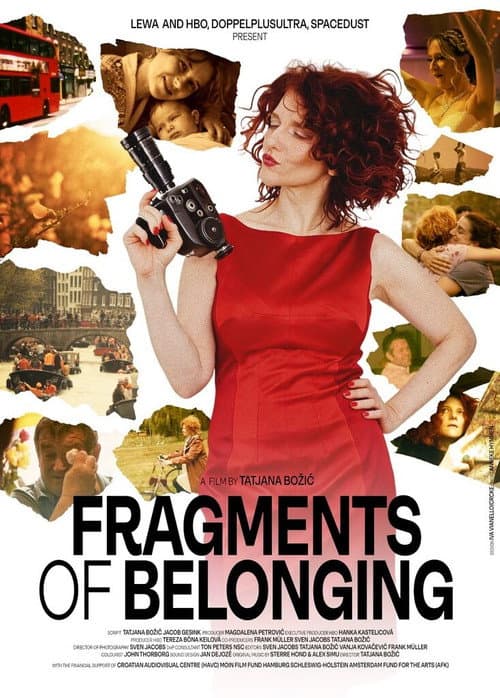
Tatjana is lonely. Born in Croatia, she has lived across Europe before settling in Amsterdam. Fifteen years later, her teenage son avoids bringing friends home, embarrassed by her dreadful Slavic accent and her lack of Dutch composure. But the real trouble is bigger: Tatjana feels foreign everywhere. Determined to belong, she starts knocking on doors across Europe, asking relatives and friends how they did it. Stumbling through cultural misfires and everyday bias, she finally confronts a dark pattern in her own family history.
Gallery (2)
About this release
A documentary titled Fragments of Belonging — known in its original Croatian as Tragovi pripadanja — is scheduled for release on April 24, 2026, produced by Lewa Productions, HBO Europe, and Doppelplusultra Film Productions.
The film centers on Tatjana, a Croatian-born woman who has spent her adult life moving across Europe before eventually settling in Amsterdam. By the time the documentary picks up with her, fifteen years have passed in the Netherlands, and still the friction of displacement has not smoothed itself away. Her teenage son avoids bringing friends home, embarrassed by what the film describes as her pronounced Slavic accent and her perceived failure to absorb the emotional register the Dutch regard as a kind of civic default — that particular brand of composure, neither warm nor cold, that outsiders often find inscrutable. This detail, small and domestic, is placed at the film's center not as anecdote but as symptom. The boy's embarrassment is the local expression of something larger.
That larger thing is the question the film sets out to examine: what does it mean to feel foreign everywhere? Not just foreign to a country, but foreign to the idea of belonging itself. Tatjana, as the documentary frames it, reaches a point of decision. Rather than wait for integration to arrive — through accumulated years of residency, language mastery, or whatever ritual absorption the adopted country demands — she begins traveling across Europe to speak to relatives and friends and ask, directly, how they managed it. The approach is almost anthropological in its bluntness, and the film appears to use that bluntness as a structural device. These are not expert interviews conducted in neutral settings. They are door-knockings, as the description pointedly puts it — a method that implies uncertainty, the possibility of a closed door, the risk of a conversation that does not go where the filmmaker hoped.
The film is produced in Croatian, which places it within a recent but notably growing tradition of European documentary work that refuses to translate its subject's primary identity into the language of the audience. HBO Europe's involvement signals a certain reach — the platform has distributed documentary and narrative work across the continent with enough regularity that its name on a project suggests access to a pan-European viewership rather than a single national market. Lewa Productions and Doppelplusultra Film Productions are the other producing entities, though the specific roles each company played in the film's development are not detailed in the available information.
What makes the film's premise structurally interesting is the turn it takes in its final movement. The description notes that Tatjana, in the course of these conversations, eventually confronts what it calls "a dark pattern in her own family history." This is the detail that lifts the project beyond a straightforward portrait of immigrant experience — a genre that has produced a great deal of earnest, well-intentioned work without always producing work that surprises. The suggestion here is that the question of belonging is not simply a matter of Tatjana's relationship to the Netherlands, or even to Europe as a general category of place, but to something older and more embedded. What that pattern is, precisely, the available material does not say. Whether it involves migration in earlier generations, historical rupture, family silence around displacement, or something else entirely remains unspecified. That ambiguity is probably intentional on the part of whoever shaped the film's public-facing description, but it leaves the most consequential narrative turn largely obscured.
It is also worth noting what the film's materials say about cultural friction in the specifics. The son's embarrassment is rendered in terms of accent and composure — two things that register immediately to strangers and that resist correction in ways that vocabulary and grammar do not. Accent, in particular, carries the record of where a person learned to speak before they had any choice in the matter; it tends to remain legible to native speakers even after decades. The Dutch composure the film references is a more elusive concept, culturally specific enough that the film seems to be locating Amsterdam not merely as a backdrop but as a chosen test case — a city and a national culture with a particular self-image around openness that does not always match the experience of those who arrive from elsewhere.
There is also the question of form. The film is described as a documentary, and the method of traveling to find interview subjects is established, but how the film handles its own construction — whether Tatjana appears as interviewer and subject simultaneously, whether there is a narrating voice, whether the cultural misfires mentioned in the description are staged as reconstruction or captured as they occurred — is information the current materials do not provide.
Fragments of Belonging will most likely find its initial audience among European viewers with personal experience of cross-border migration, particularly those who have spent long periods in countries where they remain perceptibly foreign despite years of residence. It may also attract attention from documentary audiences interested in first-person ethnographic work, and from viewers in the HBO Europe orbit who follow the platform's non-fiction output. The Croatian-language origin, combined with the Amsterdam setting and the pan-European production structure, positions it as a film that is itself, in a sense, an argument about what it means to come from one place and speak to many.
Comments
Sign in to join the conversation.
Loading…