
Details
- Language
- English
Popularity · Search interest now
Low
0.0
Based on TMDb activity
Incoming Editorial TeamVerified
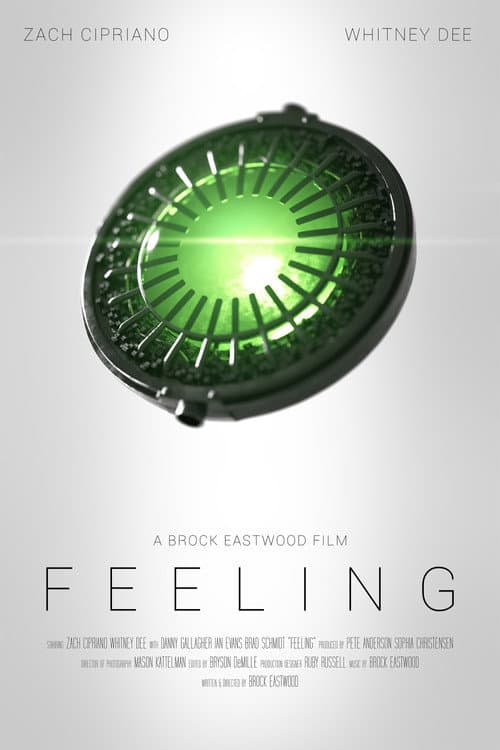
Feeling is an upcoming film releasing on April 28, 2026. The story follows a grieving father who, after the death of his son, pursues new technology that promises to eliminate his emotional pain.
Key features
- ·Dramatic science-fiction premise
- ·Themes of grief and technology
- ·Theatrical release April 28, 2026
- ·English-language film
FAQ
When does Feeling release?
Feeling is scheduled to release on April 28, 2026.
What is Feeling about?
The film follows a grieving father who, after losing his son, seeks out technology that promises to eliminate his emotional pain.
About this release
A science-fiction drama called Feeling is scheduled for release on April 28, 2026. The film's premise centers on a grieving father who, following the death of his son, seeks out a new technology that promises to eliminate his emotional pain. Beyond that single narrative thread, public information about the production remains sparse — no director, cast, or distributor has surfaced in the available data — which places Feeling in an unusual position for a film roughly a year and a half from its release date: known in outline, unknown in almost every other respect.
That outline, however, is doing considerable work. The combination of grief, parenthood, and technology as a proposed cure for suffering sits at a recognizable intersection within science fiction — a genre that has long used speculative machinery to examine what people would sacrifice to escape unbearable feeling. Films in this tradition tend to treat the technology itself as a kind of moral test: the question is never really whether the device works, but what it costs the person who uses it, and what the story believes about the value of pain. Feeling appears to be working in that register, though how far it pushes the premise — whether toward cautionary parable, psychological character study, or something more formally experimental — is not yet clear.
What the premise notably does not specify is the nature of the technology itself. That gap is worth sitting with. The range of possibilities is wide: surgical intervention, pharmaceutical, digital archiving of memory, some form of neural editing. Each carries different dramatic and ethical implications. A drug that chemically suppresses grief is a different kind of story than a procedure that selectively erases memory, which is again different from a technology that transfers or externalizes emotion into a medium that can be discarded. The specifics of the mechanism will shape whether the film reads as grounded near-future drama or something more allegorical, and the marketing so far has offered no clarity on that question.
The father-son relationship, and particularly a father's grief over a child, is a subject that science fiction has visited but that drama handles far more frequently. Placing that emotional core inside a sci-fi framework creates a particular set of expectations: the genre typically demands that its speculative elements do more than serve as backdrop, that the technology illuminate something about the human condition that realism alone could not reach. Whether Feeling earns that contract — whether the science-fictional premise is load-bearing or merely decorative — will be one of the central things to watch when the film arrives.
The title itself is spare to the point of being declarative. A one-word title that names the thing the protagonist is trying to escape carries a certain structural irony, and it may signal that the filmmakers intend a degree of formalism or self-awareness in how the story is told. Then again, titles are chosen for many reasons, and reading too much into a single word without the context of a director's body of work or a screenplay's pedigree is a limited exercise. What can be said is that the choice is deliberately simple, which tends to suggest confidence in the concept's legibility — or, less charitably, a project still in the process of defining itself.
The film's English-language production and April 2026 release date place it in what has historically been a transitional corridor on the theatrical calendar — past the awards-season frenzy of late winter, ahead of the summer genre blockbusters, in a window that tends to accommodate mid-budget dramas and prestige genre projects that studios or distributors believe can find an audience without the pressure of holiday competition. April releases have carried significant dramatic science-fiction films before, and the window has a reasonable track record for the kind of adult-skewing, concept-driven work that Feeling seems to be positioning itself as. None of that predetermines anything, but it does suggest whoever is releasing the film is thinking of it as a considered, somewhat serious work rather than a broad commercial genre exercise.
What would help clarify the picture enormously is any knowledge of who directed it. A grief-and-technology premise in the hands of a filmmaker known for intimate character work carries different implications than the same premise treated by someone with a background in high-concept genre construction. The absence of that information from the public record at this stage is notable, though not necessarily alarming — some productions maintain deliberate quiet during post-production and reveal key creative details closer to a marketing push.
Similarly, the cast is unknown here, and in a film that appears to rest heavily on a single protagonist's emotional journey — a father in the acute phase of loss, navigating an ethically murky technological offer — the central performance will matter enormously. The premise is not an ensemble one. It is built around interiority, around a person in pain making a decision that the audience will be asked to understand even if they cannot fully endorse it. That kind of film tends to succeed or fail based on whether the lead performance can hold the weight of the concept without being crushed by it.
The audience most likely to seek out Feeling in advance will be viewers drawn to science fiction that uses genre conventions as a lens on recognizable human experience — those for whom films like Eternal Sunshine of the Spotless Mind or Arrival represented the form working at a register beyond spectacle. The grief premise will also draw viewers who respond to domestic drama with emotional stakes, particularly stories centered on parenthood and loss. Whether both groups will feel the film belongs to them, or whether it will satisfy either fully, is the question that April 2026 will answer.
Comments
Sign in to join the conversation.
Loading…