Details
- Language
- English
- Studio
- Avani Films
Popularity · Search interest now
Low
0.0
Based on TMDb activity
Where to watch
Not currently available for streaming or purchase.
Links may earn Incoming a commission at no extra cost to you.
Incoming Editorial TeamVerified
A daughter grapples with dual inheritances from her birth family and marriage. The film examines the transmission of care, discipline, labor and faith through women’s daily work spanning different geographies and generations.
About this release
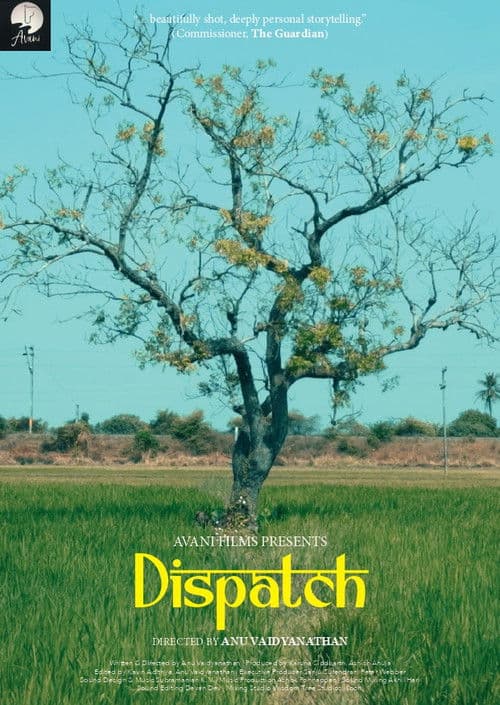
A documentary called Dispatch, produced by Avani Films, is scheduled for release on April 24, 2026. The film centers on a daughter navigating two distinct inheritances — one from her birth family, one from her marriage — and uses that dual position as a lens through which to examine how care, discipline, labor, and faith are transmitted across generations and geographies through the daily work of women.
The premise belongs to a tradition of personal documentary filmmaking in which the filmmaker or a closely observed subject becomes the organizing intelligence of a wider inquiry. The domestic and the archival share screen time; private routines carry the weight of larger arguments about how culture reproduces itself. Films in this mode tend to resist the conventions of biographical portraiture. They are less interested in the exceptional life than in the mechanisms — the repeated gestures, the inherited recipes, the quietly enforced expectations — through which ordinary life is structured and passed on. Dispatch appears to work within that tradition, though its specific formal approach remains publicly unconfirmed.
What the available description makes clear is that geography matters here at least as much as generation. The phrase "spanning different geographies and generations" implies a film that moves, physically or conceptually, between places — that the inheritances being examined are not simply chronological but also spatial, perhaps shaped by migration, relocation, or the kind of distance that opens between a family of origin and a family built through marriage. What those specific geographies are, and whether the film travels between them in documentary footage or reconstructs them through archival or testimonial means, is not yet known.
The framing around "women's daily work" as the vehicle for these transmissions is notable. The word "work" here carries weight beyond employment — it encompasses the labor of keeping households and relationships functional, the discipline involved in raising children or maintaining devotion, the care that circulates between women across a family's generations. By placing "labor" and "faith" alongside "care" and "discipline" in the same list, the description suggests a film unwilling to rank these modes of inheritance or treat any of them as incidental. They are presented as equivalent channels through which something essential about a family's identity — or a culture's self-understanding — gets carried forward.
The production company, Avani Films, is the sole credited entity in the structured data. No director is named in the available materials, which is itself a piece of information worth sitting with. Personal documentaries of this type often foreground their makers — the filmmaker's relationship to the subject is typically part of the film's argument — and so the absence of a named director in the public record at this stage is a gap that will presumably close as the film's release approaches. Whether the "daughter" at the center of the description is the filmmaker or a subject observed by someone else shapes almost everything about how the film positions its authority and its intimacy.
The dual-inheritance structure raises questions that the current description leaves open. How does the film handle the potential tension between the two family lines being examined? The birth family and the family acquired through marriage represent different orders of relationship — one into which the daughter was born without choice, one she presumably entered by choice — and the inheritance flowing from each may carry different kinds of obligation or meaning. Whether Dispatch treats these two inheritances as complementary, as competing, or as something more ambiguous is central to understanding what kind of film it is, and that remains to be seen.
The word "dispatch" itself invites some consideration. In its most common uses, it refers to sending something — a message, a person, an object — from one place to another with some urgency or purpose. It also carries a secondary meaning involving the completion of a task, a finishing of business. Both senses seem resonant with what the film appears to be investigating: the sending of values, practices, and expectations from one generation to the next, and the ongoing labor involved in receiving, carrying, and perhaps completing or transforming what has been sent. Whether the title is being used in one of these senses, in both, or in some other register entirely is not confirmed by the available materials.
The film's original language is English, though the geographic scope suggested by the description leaves open the question of whether other languages appear in the film. Documentaries examining women's labor and inheritance across different national or cultural contexts often involve multilingual subjects, particularly when the family lines being traced cross language communities.
Dispatch arrives at a moment when documentary filmmaking about domestic labor and intergenerational inheritance has found consistent audiences through festival circuits and streaming platforms, drawing viewers interested in the intersection of personal history and structural analysis. Audiences drawn to films that think carefully about how ordinary life is organized and reproduced — who find significance in repetition and routine rather than dramatic rupture — are the natural constituency for this kind of work. So, too, are viewers attentive to how women's labor in particular gets rendered visible or invisible across cultures and time.
Comments
Sign in to join the conversation.
Loading…