
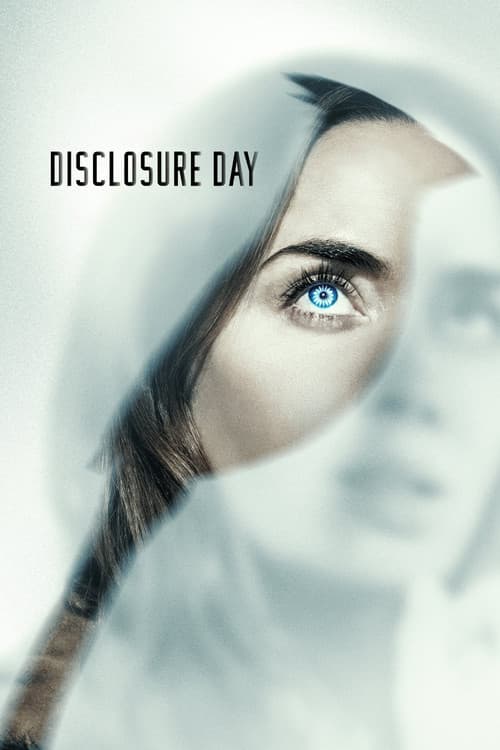
Details
- Language
- English
- Studio
- Universal Pictures
- TMDb Rating
- 7.5 (3.5k votes)
- Directed by
- Steven Spielberg
- Written by
- Steven Spielberg, David Koepp
- Theme
- supernatural
- For
- adult
Rating · Quality score from voters
TMDb
7.5/10
IMDb
6.4/10
Rotten Tomatoes
79%
Metacritic
74/100
Popularity · Search interest now
Popular
83.3
Based on TMDb activity
Hype score
leaderboard →94
/ 100↑ +16.1 in 24h
#9 globally#7 in movie
30-day trendWP 97
Disclosure Day attracts consistent research from viewers exploring the political thriller.
Starring





Where to watch
Links may earn Incoming a commission at no extra cost to you. Streaming data via JustWatch — may not reflect today's catalog.
Incoming Editorial TeamVerified
Disclosure Day is an upcoming thriller in which a cybersecurity expert turned whistleblower exposes corporate secrets about extraterrestrial life, releasing June 10, 2026.
Trailer
Gallery (21)
Key features
- ·Science fiction thriller
- ·Whistleblower and conspiracy premise
- ·Dual protagonist narrative structure
- ·Extraterrestrial subject matter
- ·English language
FAQ
When does Disclosure Day release?
Disclosure Day is scheduled for release on June 10, 2026.
What is Disclosure Day about?
The film centers on a cybersecurity expert who goes on the run after leaking corporate secrets about aliens, and a meteorologist who joins him after experiencing strange phenomena.
Who made Disclosure Day?
No director, studio, or production company has been confirmed in the currently available data.
About this release
A cybersecurity expert turned reluctant whistleblower, a meteorologist unsettled by phenomena she cannot explain, and the question of whether extraterrestrial life has been deliberately hidden from the public — these are the coordinates of Disclosure Day, a science-fiction thriller scheduled for release on June 10, 2026, from Universal Pictures and Amblin Entertainment.
The film arrives under the banner of one of Hollywood's more storied production partnerships. Amblin Entertainment, the company Steven Spielberg founded, has long maintained a particular relationship with science-fiction that leans toward the personal and the terrestrial — stories in which the extraordinary intrudes on ordinary lives rather than dwarfing them entirely. Whether Disclosure Day falls into that tradition in any meaningful way remains to be seen, but the institutional fingerprints are worth noting. Universal's distribution muscle paired with Amblin's production identity places this somewhere in a recognizable quadrant: big-canvas subject matter, human-scale protagonists.
The premise, as it has been described, turns on two characters whose paths converge from very different starting points. The first is a cybersecurity expert who uncovers information about extraterrestrial life held by a corporation and, rather than staying quiet, decides to go public — a choice that immediately puts him in the corporation's crosshairs. The second is a meteorologist who begins experiencing phenomena she cannot account for through conventional scientific frameworks. The film's dramatic engine appears to be their eventual alliance, the two of them working in tandem to substantiate what he has leaked and what she has witnessed.
That dual-protagonist structure is a familiar device in the thriller genre, and the alien-conspiracy framework it's wrapped around has its own long history in English-language cinema and television — from the paranoid government-cover-up films of the 1970s through the extraterrestrial mythology that dominated American genre entertainment in the 1990s. What makes the premise of Disclosure Day somewhat specific is its grounding in professional expertise rather than civilian accident. A cybersecurity expert and a meteorologist are both, in their respective ways, people trained to read signals in data — one in digital systems, one in atmospheric ones. The strange phenomena the meteorologist encounters presumably have a quality that her scientific training makes legible in ways that would escape a layperson, just as the whistleblower's technical background is presumably what gave him access to corporate secrets in the first place. Whether the screenplay does anything substantive with that parallel is a question the available information cannot answer.
The corporate antagonist is another element worth noting. Alien-conspiracy narratives have historically placed the cover-up apparatus inside government — secret agencies, military black sites, classified programs. Relocating that function to a private corporation is a different kind of story, one with different implications about accountability, motive, and the mechanics of concealment. A government hiding something operates under at least the theoretical pressure of democratic oversight; a corporation has no such structural constraint. That framing, if the film pursues it seriously, positions Disclosure Day as something slightly more contemporary in its anxieties than the genre's Cold War–inflected predecessors.
What remains genuinely unclear from what's publicly known is almost everything about the film's execution. No director has been announced in the available material, and no cast members are identified. For a film with a release date in June 2026, the absence of those details at this stage is notable — though not necessarily alarming, given that studio productions sometimes hold announcements until they can generate maximum attention. Still, the names attached to a film like this would do a great deal to signal its register: a prestige director would suggest one kind of project, a genre specialist another, a first-time feature filmmaker yet another. The same applies to casting. The whistleblower and the meteorologist are roles that could be played very differently depending on who's in them, and the film's tonal center of gravity — whether it leans toward procedural tension, paranoid atmosphere, or something more emotionally expansive — will depend significantly on those choices.
The original language is English and the film appears to be a domestic American production, though no country of origin is formally listed in the available metadata. June is a competitive corridor in the theatrical calendar, sitting at the edge of the summer season when studios tend to position films with broad commercial aspirations. A mystery-science-fiction-thriller hybrid from Universal and Amblin fits that window reasonably well — it's a combination of genres that can draw audiences across demographics, from viewers who follow science-fiction to those who gravitate toward corporate conspiracy thrillers.
The early audience response reflected in the available data is based on a very small sample and carries limited predictive weight at this stage. What it suggests, cautiously, is that the concept has generated some early enthusiasm among those tracking it, which is consistent with the subject matter: alien disclosure narratives have a durable cultural grip, particularly in a moment when government-acknowledged UAP reports have kept the topic in mainstream conversation in ways that would have seemed fringe not long ago. Disclosure Day enters a cultural environment that has, in some sense, already been primed for it.
Audiences who seek this out in June 2026 will likely be drawn from overlapping groups: science-fiction viewers with an appetite for grounded, human-scale stories rather than spectacle-driven ones, thriller fans interested in corporate malfeasance as a dramatic engine, and the broader contingent of viewers for whom the alien-disclosure premise carries genuine cultural resonance. The Amblin association may also draw older audiences with long memories of what that production company has historically delivered in this genre register.
Comments
Sign in to join the conversation.
Loading…