
Details
- Language
- Portuguese
- Studio
- Lagosta Filmadora
Popularity · Search interest now
Low
0.1
Based on TMDb activity
Hype score
leaderboard →73
/ 100↑ +0.9 in 24h
#75 globally#44 in movie
30-day trendWP 88
BRAINROT lands in top 7% of movie search traffic.
Where to watch
Not currently available for streaming or purchase.
Links may earn Incoming a commission at no extra cost to you.
About this release
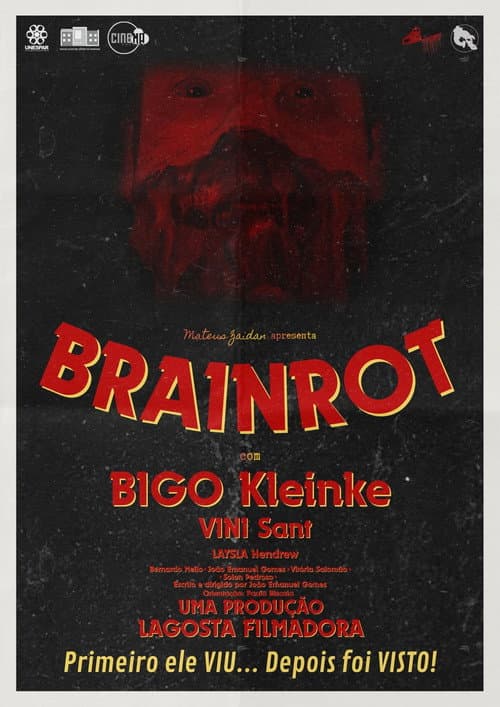
A Portuguese-language horror film titled BRAINROT, produced by Lagosta Filmadora, is scheduled for release on April 24, 2026. Beyond that bare framework, the production is notable less for what it announces than for what it implies — namely, that someone has decided to build a feature film around one of the stranger cultural phenomena to emerge from internet spaces in recent years.
The film's metadata connects it directly to "Italian brainrot," the Wikipedia entry that documents a loose genre of AI-generated absurdist imagery that proliferated across social media platforms beginning in the mid-2020s. That content — characterized by surreal hybrid creatures, deliberately degraded aesthetics, and a tone that oscillates between childlike nonsense and low-grade menace — accumulated an enormous and largely youth-driven audience with remarkable speed. It is, in formal terms, barely content at all: algorithmically produced images and short videos that weaponize incoherence as their primary aesthetic principle. That a production company has now tagged a horror film to that cultural referent is, at minimum, an interesting bet.
The keyword "student-film" attached to the project introduces a layer of ambiguity worth sitting with. It may be a literal descriptor — a production originating from a film school or student cohort working under the Lagosta Filmadora banner — or it may be a stylistic signal, indicating that the film deliberately courts the low-fi, handmade texture that student productions carry. Horror has a long and productive relationship with that texture. The found-footage cycle that ran from the late 1990s through the following decade depended on audiences accepting the premise that technical impoverishment was authenticity, and plenty of genuinely unsettling films came out of that bargain. Whether BRAINROT is pursuing something in that lineage, or whether "student-film" is simply an administrative tag, is not something the available information settles.
What the production language does clarify is that this is a Brazilian work. Portuguese as the original language, combined with a studio name that translates roughly from Portuguese as "Lobster Camera," places the film within Brazil's independent film sector rather than within any European or North American horror tradition. Brazilian horror has its own history — one that has periodically attracted international attention without ever quite consolidating into a recognized export genre — and a production emerging from that context with explicit ties to an internet-native phenomenon carries a different set of cultural coordinates than, say, an English-language studio appropriation of the same material would.
The conceptual friction at the center of this project is worth examining. "Italian brainrot" as a phenomenon is, fundamentally, anti-narrative. Its appeal derives from the absence of coherent story, character, or interpretive payoff — it is content that resists the kind of meaning-making that conventional film form demands. Translating that into a horror film, a genre that depends at least minimally on tension, escalation, and some form of dread, requires either a significant transformation of the source material or a willingness to let the film itself become formally disorienting in ways that challenge what an audience expects from a theatrical experience. Neither path is obviously easy, and the project gives no indication which it is taking.
The horror genre has accommodated formally experimental work before, including films that deliberately frustrate narrative comprehension. But those films have generally had some anchor — a performance, a sound design choice, a visual grammar — that gave audiences something to hold onto even as the surrounding structure destabilized. A film built on material that is, at its core, a refusal of coherence would have to decide early whether it is illustrating that refusal or embodying it, and those are very different films.
There is also a generational question embedded in the premise. The audience that knows "Italian brainrot" as a living cultural reference is, by and large, young — the kind of viewer who encountered these images on short-video platforms and internalized their logic as a kind of ambient visual language. Whether BRAINROT is addressed to that audience, or whether it is using that phenomenon as raw material for something aimed more broadly, shapes almost every other judgment one might make about the project. A horror film that flatters its audience's familiarity with the source material operates differently from one that uses that familiarity as a trap.
The production's low popularity score suggests it is not yet widely tracked outside of the communities where Lagosta Filmadora and the project's actual creators have been discussing it. That is unremarkable for an independent foreign-language horror film more than a year from release, but it does mean that the interpretive context available here is genuinely thin. What the film looks like, who directed it, what its actual narrative (if any) involves — none of that is established by the information currently attached to it.
Practically speaking, the audience most likely to seek out BRAINROT on or after April 24, 2026, falls into a fairly specific overlap: viewers with enough investment in internet visual culture to recognize what "Italian brainrot" refers to, sufficient tolerance for low-budget or formally unconventional horror to accept a student-adjacent production on its own terms, and enough interest in Brazilian independent cinema — or at least no aversion to subtitles — to follow a Portuguese-language release. That is not a mass audience, but it is a real one, and it is the kind of audience that has historically been willing to do the work of finding films that meet them on unfamiliar ground.
Comments
Sign in to join the conversation.
Loading…