
Details
- Language
- English
- Studio
- Atomic Monster
- TMDb Rating
- 7.0 (3.9k votes)
- Directed by
- Kane Parsons
- Written by
- Will Soodik
- Theme
- supernaturalsurvival
Rating · Quality score from voters
TMDb
7.0/10
IMDb
6.7/10
Rotten Tomatoes
86%
Metacritic
76/100
Popularity · Search interest now
Popular
72.3
Based on TMDb activity
Starring


Where to watch
Links may earn Incoming a commission at no extra cost to you. Streaming data via JustWatch — may not reflect today's catalog.
Incoming Editorial TeamVerified
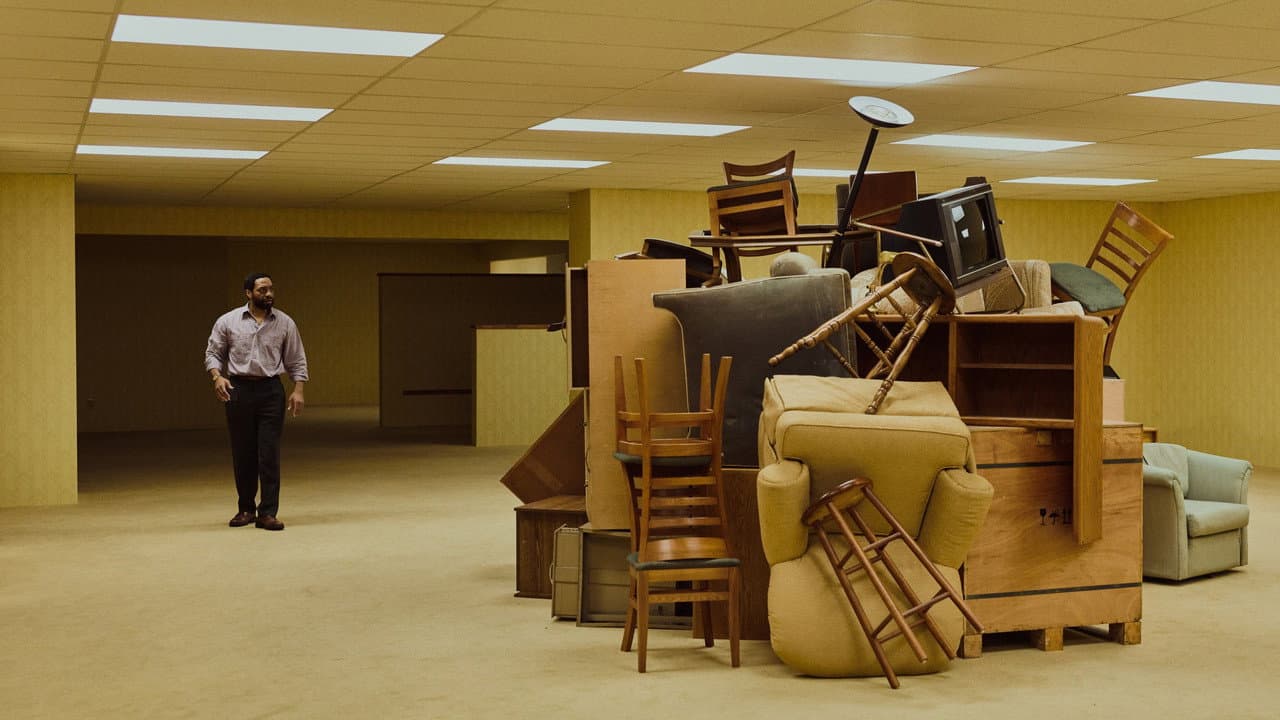
A strange doorway appears in the basement of a furniture showroom.
Trailer
Gallery (21)
About this release
A feature film called Backrooms is scheduled for release on May 27, 2026, produced by Atomic Monster and 21 Laps Entertainment and distributed by A24. The premise, as disclosed, is spare and deliberately disorienting: a strange doorway appears in the basement of a furniture showroom. What lies beyond that threshold, and what happens to whoever — or whatever — passes through it, is the essential question the film will spend its running time answering.
The source material, such as it is, carries its own cultural weight. The Backrooms originated as an internet creepypasta, a piece of anonymous collaborative folklore that described a liminal space — carpeted in monochromatic yellow, lit by humming fluorescent tubes, extending infinitely in all directions — that one might "noclip" into accidentally, as though falling through a glitch in the geometry of ordinary life. The concept metastasized across forums and social media into an elaborate shared mythology, spawning subcategories of levels, entities, and survival rules that thousands of contributors refined over years. It is, in the taxonomy of internet horror, less a single story than a worldbuilding exercise sustained by collective imagination. Whether this film draws strictly from that tradition or uses the doorway-in-a-furniture-showroom as its own point of departure — a premise that evokes the mythology without necessarily being bound to it — is not made explicit in the available material.
What is clear is the production coalition behind it. Atomic Monster is the production company associated with James Wan, a figure who has shaped contemporary mainstream horror across multiple franchises. 21 Laps Entertainment, the company behind projects operating across thriller and science-fiction terrain, joins as a co-producer. A24 distributes. That last credit carries particular significance in this context: A24 has, over the past decade, become the studio most associated with prestige-adjacent horror — films that foreground atmosphere, ambiguity, and formal restraint over explicit visceral shock. Their involvement positions Backrooms in a particular corner of the genre, one that prioritizes dread and psychological unease over the mechanics of a conventional scare machine. Whether the film will lean into the more surrealist, architecturally strange qualities of the Backrooms mythology — the endless corridors, the wrongness of space itself as horror — or ground itself in more conventional narrative stakes is an open question.
The genre classifications attached to the film — horror, mystery, science fiction — suggest a broader tonal range than straight supernatural horror. The science-fiction designation in particular is interesting. The Backrooms mythology, in its more elaborate iterations, has often been framed not as supernatural but as a kind of dimensional or physical anomaly, a place that follows rules, however alien. A horror film that operates at the intersection of those genres occupies a space closer to something like Annihilation than to the haunted-house tradition, though that comparison is inferential rather than confirmed by anything in the available data.
The furniture showroom setting is worth dwelling on briefly. It is a quietly inspired anchor for this kind of story. Few commercial spaces are more inherently strange — rooms staged to resemble home but hollowed of personhood, furniture arranged in the semblance of domestic life without inhabitants, corridors between display sets that go nowhere in particular. The showroom is already a liminal space in the loosest cultural sense: a threshold place, neither public nor private, neither functional nor purely decorative. Placing the doorway into the Backrooms in such a setting does not read as incidental. It suggests a production that has thought carefully about the resonance of location.
Several things remain genuinely unknown. The cast is not listed in the available material, which means there is no information about whether the film centers on recognizable performers or takes the kind of lower-profile ensemble approach that A24 has sometimes favored with genre material. The director is not identified. For a film arriving in May 2026 with a notable production and distribution pedigree, the absence of those credits in circulating data is unusual and worth noting — it may simply reflect how early the promotional apparatus is, or it may be a deliberate strategy. Either way, the authorial perspective behind the film remains opaque. Who is interpreting this particular mythology, and what their relationship to it is, would substantially affect expectations.
The release date — May 27, 2026 — places it in the late-spring window, which is not the traditional Halloween-adjacent slot that horror films often occupy. A24 has shown some willingness to release horror material outside peak season when the project warrants it, and a late-May date positions Backrooms in a period when the competition tends to skew toward blockbuster action and franchise tentpoles. Whether the film is being positioned as a counterprogram to that environment, or whether the date simply reflects production scheduling, is not possible to determine from the current information.
Digital availability at launch is confirmed across Amazon Video, Apple TV Store, Fandango At Home, and Plex for purchase or rental, with no announced streaming home listed, suggesting theatrical exclusivity as the primary initial window.
The audience most likely to seek this out first will be those already embedded in the internet horror communities that built the Backrooms mythology — people with strong opinions about which interpretations of the lore are faithful and which are reductive. Alongside them, the A24 brand will draw viewers who follow the distributor's output as a matter of habit, expecting a particular register of horror that values atmosphere over formula. For both groups, the furniture showroom and the doorway in its basement will serve as the first test of whether the film understands what made the original idea unsettling: not monsters in the dark, but the specific vertigo of a space that should not exist.
Our coverage
- What CinemaScore Actually Measures, and What Eight 2026 Grades Told Us About Box Office Staying Power
CinemaScore polls opening-night audiences and publishes a letter grade. How it works, what it can and cannot tell you, and how eight 2026 films' grades lined up with their second weekends.
- Five Horror Films, Two Patterns: Budget Sets the Return, and the Audience Grade Seems to Set the Run
Four horror films are in the 2026 domestic top 15, led by Obsession. Comparing five of them, the budget sets the return and the audience grade appears to say more about how long a film runs than the critics' score.
Comments
Sign in to join the conversation.
Loading…