Details
- Language
- English
Popularity · Search interest now
Low
0.1
Based on TMDb activity
Incoming Editorial TeamVerified
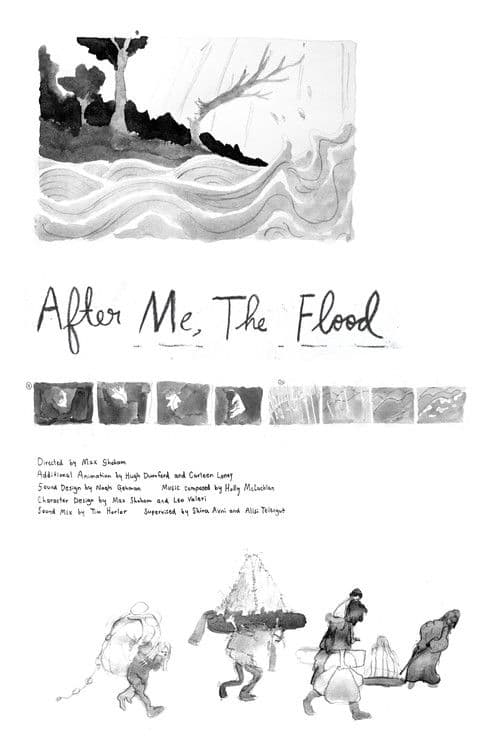
After Me, The Flood is an upcoming film releasing on April 28, 2026. The story follows a group of nomadic merchants who emerge from a forest and attempt to cross an unpredictable river, carrying their cargo as they navigate the crossing.
Key features
- ·Nomadic merchants crossing a river
- ·English-language film
- ·Theatrical release April 28, 2026
FAQ
When does After Me, The Flood release?
After Me, The Flood is scheduled to release on April 28, 2026.
What is After Me, The Flood about?
The film follows a group of nomadic merchants who emerge from a forest and attempt to cross an unpredictable river, carrying their cargo on their backs.
About this release
"After Me, The Flood" is an animated film scheduled for release on April 28, 2026. Beyond that date and its genre classification, the available information about this production is limited, though what does exist sketches an intriguing premise with enough texture to consider what kind of film it might be positioning itself as.
The logline places a group of nomadic merchants at the edge of a forest, preparing to cross a river with cargo on their backs and, as the description puts it, their lives in the hands of the wind. That framing — elemental, spare, almost fable-like — suggests a film interested less in conventional narrative mechanics than in atmosphere and physical experience. Rivers as thresholds, merchants as wanderers between worlds, cargo as both literal weight and symbolic burden: these are the materials of myth and folklore, the kind of imagery that animated cinema has long been willing to carry further than live-action tends to go.
Animation as a category encompasses an enormous range of approaches, from the kinetic spectacle of major studio productions to the contemplative, hand-crafted work associated with festivals and art-house circuits. The tone of this premise leans distinctly toward the latter. The image of figures emerging from a forest and committing themselves to an unpredictable crossing has more in common with the quiet, observation-driven tradition of independent animation — work that uses the form not to exaggerate reality but to distill it — than with anything engineered for broad commercial audiences. Whether the film's visual language matches that interpretive lean is, of course, unknown at this stage.
The title itself carries a certain historical and literary resonance. The phrase "après moi, le déluge" — attributed, with varying degrees of historical confidence, to Louis XV of France and later to Karl Marx in "Capital" as a descriptor of capitalist short-termism — carries connotations of indifference to the consequences one leaves behind, a recklessness about what follows. Whether the film is drawing on that tradition deliberately or using the flood as purely literal geography remains an open question. The tension between those two readings is, if anything, interesting in itself: a story about merchants crossing a river could be purely physical and immediate, or it could be reaching toward something about accountability, legacy, and what we burden others with when we move through the world.
The original language is listed as English, which places it outside the tradition of European or East Asian art animation — though, as with any animated production, language of dialogue and country of production are not always the same thing, and the spare, movement-focused nature of the premise raises the question of how much dialogue the film actually contains. A story about crossing a river, carried on the wind, may not require much speech at all.
What remains genuinely unclear from everything available is nearly everything a potential viewer would want to know before committing their attention. Who directed this film? Who produced it, and under what circumstances? Is it a short or a feature? The premise description is short enough that it could plausibly be either. The absence of any vote data or community tracking on standard aggregation platforms suggests the film has, as of now, very little public footprint — which is common for independent animated productions well before their release date, but which also means that the usual ecosystem of preview materials, festival buzz, and early reviews has not yet surfaced in any traceable form. Whether it has screened at festivals ahead of its April 2026 release, whether it was produced by an established studio or an independent collective, whether it is a debut feature or the work of a filmmaker with prior credits — none of this is answerable from the available record.
The April 2026 release date is worth noting on its own terms. Late April occupies an interesting position in the release calendar — past the early-year awards doldrums, not yet into the summer season that tends to favor large-scale productions. For a film with the sensibility this premise implies, a spring release in limited or specialized distribution would be a natural fit, though nothing in the available data confirms that framing.
There is also the matter of what the title's possessive construction suggests about point of view. "After Me, The Flood" implies a narrator — a consciousness speaking about the aftermath of their own passage. Whether the film is narrated, whether one of the merchants is its focalizing intelligence, or whether the title is operating more abstractly as a thematic declaration rather than a character's voice, the grammar of it suggests someone looking back, or forward, from a position of having already crossed. That perspective — retrospective, resigned, perhaps guilty — sits in interesting contrast to what sounds like an essentially active, present-tense story of people moving through a landscape.
Viewers drawn to animation that operates outside the genre's commercial center — work attentive to landscape, physical labor, and the kind of slow tension that comes from elemental forces rather than plot mechanics — will likely find the premise worth following as more information about the production becomes available.
Comments
Sign in to join the conversation.
Loading…