Details
- Language
- Spanish
- Directed by
- Max Del Río
- Written by
- Max Del Río
Popularity · Search interest now
Low
0.7
Based on TMDb activity
Starring




Incoming Editorial TeamVerified
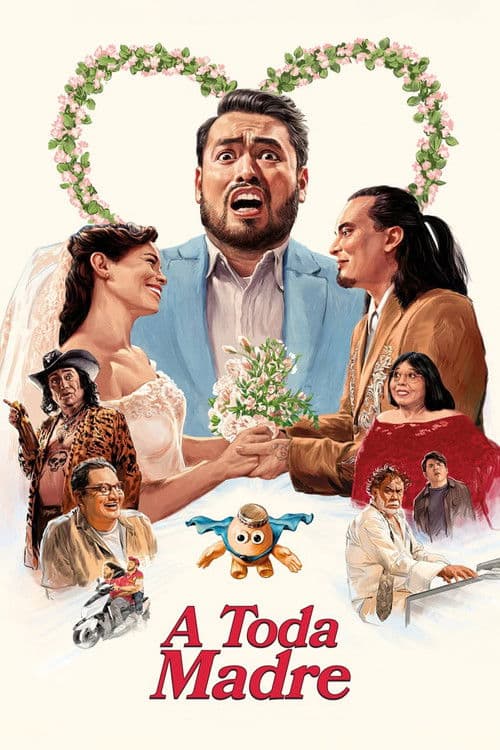
Upon learning that his mother is going to marry the bully who tormented him as a child, Martín does what any son would do: sabotage the wedding.
Gallery (1)
About this release
There is a particular kind of family comedy that locates its engine in the gap between a child's old grievances and an adult's new obligations — the grudge that refuses to age even as the person carrying it does. A Toda Madre, a Spanish-language drama-comedy scheduled for release on April 24, 2026, works squarely within that tradition. Its premise is compact and immediately legible: a man named Martín discovers that his mother is engaged to the man who bullied him as a child, and responds by setting out to destroy the wedding before it can happen.
The film's Wikipedia metadata points to a title, Papá a toda madre, that suggests a prior entry in what may be a related franchise or series — the "toda madre" construction appearing in both, with the earlier title's "Papá" giving way to something unnamed in this iteration. Whether A Toda Madre is a sequel, a spinoff, a reboot, or simply a film sharing a thematic and linguistic register with that predecessor isn't confirmed by the available information, but the connection is worth noting for anyone who has encountered the earlier project. Spanish-language comedies built around family dysfunction and generational tension have a long and crowded tradition, and a title that echoes an established property tends to carry audience expectations alongside it, whether or not those expectations are strictly warranted.
What the premise does establish clearly is a tonal commitment to escalation. Sabotage-the-wedding comedies depend on a rhythm of schemes, complications, and the slow (or sudden) collapse of the protagonist's certainties about what he actually wants. Martín's situation is structured to produce that rhythm almost automatically: the woman whose happiness he is ostensibly protecting is also the person whose choice he is working to override. The bully, meanwhile, occupies a double role — antagonist from Martín's past and prospective family member in his present — which means the film carries at least two unresolved questions into its runtime simultaneously. Has the bully changed? And, more uncomfortably, does Martín's resentment still deserve the weight he assigns it? Those questions don't require a film to answer them generously or even honestly, but they are the live wires running under the comedic structure.
The drama designation alongside comedy in the genre tags is worth taking seriously. Films that list both tend to be signaling something about proportion — that the laughs are not expected to hold without some weight behind them, or that the emotional stakes of the central relationship (here, between Martín and his mother) are treated as genuinely consequential rather than as a backdrop for set pieces. A pure farce wouldn't need the drama tag. Its inclusion suggests that whatever Martín's schemes produce, the film intends to land somewhere that asks more of its characters than the next gag.
The original Spanish language positions the film within a production context aimed primarily at Spanish-speaking markets, though Spanish-language comedies with domestic family premises have shown considerable crossover appeal on streaming platforms serving global audiences. The wedding-sabotage comedy, whatever its cultural specifics, translates across markets in a way that more locally coded genres sometimes don't. The central conflict — a son who believes he knows better than his mother about the man she loves — is not a regional premise.
What the available information leaves entirely open is the film's production context: who directed it, who wrote it, who stars as Martín or as the mother or as the former bully now attempting to become a stepfather. The absence of those names means it's impossible to read the project against a body of work or to situate its tone relative to a filmmaker's known sensibility. A director with a background in broad physical comedy would approach the sabotage sequences differently than one whose instincts run toward irony or restraint. The cast would similarly shape expectations considerably — a comedic lead with an established persona of bumbling sincerity reads differently than one known for sharp, self-aware characters. Without those anchors, the film exists mainly as a premise and a release date.
The premise itself, it should be said, is durable precisely because it is not neutral. Martín's project of sabotage is not heroic — it is, on its face, an adult man treating his mother's romantic life as territory he has some right to control, motivated by a childhood injury that she may not even know shaped his view of her fiancé. The comedy can play that straight, mining Martín's obliviousness for laughs, or it can complicate it, allowing the film to arrive somewhere more honest about who actually gets to make decisions about whose future. That the genre tags include drama suggests the latter is at least on the table.
The film arrives in late April 2026, a release window that tends to accommodate mid-range comedies finding their audience without the pressure of a major summer or awards-season slot. Viewers drawn to Spanish-language comedies with family dynamics at their center — and those who followed Papá a toda madre specifically — are the most obvious audience. But the structure of the conflict is plain enough, and the emotional territory familiar enough, that anyone with a complicated relationship to the intersection of old wounds and new family arrangements will find the premise resonant before the first scene plays.
Comments
Sign in to join the conversation.
Loading…