 Cool
movieReleased
A PHOENIX FEATHER
Released April 25, 2026
↓ 42.024h
Details
- Language
- Persian
- Directed by
- Ronak Jafari
Popularity · Search interest now
Low
0.0
Based on TMDb activity
Where to watch
Not currently available for streaming or purchase.
Links may earn Incoming a commission at no extra cost to you.
Incoming Editorial TeamVerified
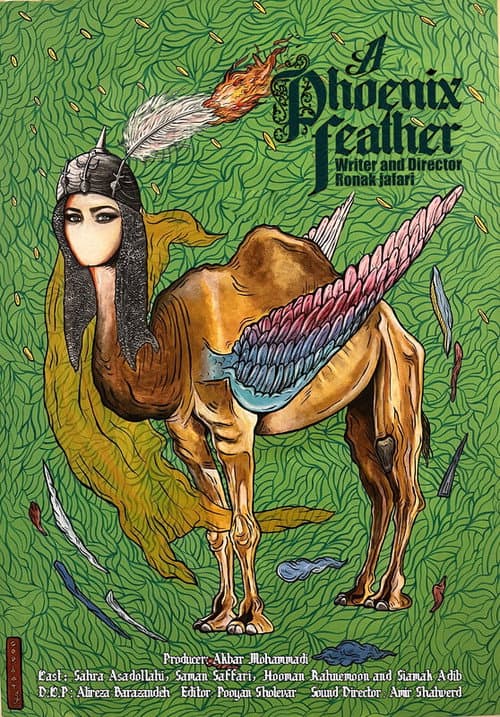
A woman political prisoner escapes execution in Iran. Three different narratives are intertwined to tell her story: the reality, the story of a camel that ran away from being sacrificed and a subjective journey in the world of Persian myths. Shall she find a way to save her life by using the help of a powerful phoenix, magical feathers and inspiring forces?
Gallery (1)
About this release
A Phoenix Feather is a Persian-language film scheduled for release on April 25, 2026. Its premise is unusual enough to warrant attention even in the absence of detailed production credits: the film follows a woman who has been sentenced to execution in Iran and manages to escape that fate, with her story told across three separate but interwoven narrative strands.
Those three strands are where the film's structural ambition becomes apparent. The first is rooted in observable reality — the escape itself, the political imprisonment, the concrete circumstances of a woman navigating a system that has condemned her. The second shifts register entirely, following a camel that flees before being sacrificed, an animal parallel that seems designed to rhyme thematically with the human story rather than illustrate it literally. The third strand moves further still, into a subjective interior space built from Persian mythological tradition, where a phoenix, magical feathers, and what the film describes as "inspiring forces" become the operative elements of the narrative.
The structural decision to braid these three modes together — realism, animal fable, and myth — places A Phoenix Feather in a particular tradition of Iranian cinema that has long found ways to encode politically sensitive material within layers of allegory and symbolism. Iranian filmmakers working under censorship constraints have frequently developed sophisticated formal vocabularies: the use of children as proxies for adult experience, pastoral or rural settings as displacement for urban political realities, and mythological frameworks as containers for stories that could not be told directly. Whether A Phoenix Feather is operating within that tradition by necessity or by artistic choice is not something the available information settles, but the architecture of the film — the way it appears to surround a politically charged core story with increasingly abstracted outer layers — suggests an awareness of that lineage.
The phoenix itself carries obvious symbolic weight in Persian cultural history. The Simurgh, the mythological bird of Iranian tradition, is among the most durable images in Persian literature, appearing in works like Attar's twelfth-century Conference of the Birds as a figure of transcendence and self-knowledge. The decision to anchor the film's mythological strand in the phoenix lineage connects it to a literary tradition that is both deeply Persian and widely legible to international audiences familiar with the broader symbolism of rebirth through fire. How closely the film hews to specific mythological sources versus working with more generalized phoenix imagery is an open question.
The camel strand is perhaps the most formally surprising element. The use of an animal fleeing ritual slaughter as a narrative thread running alongside a human story of escaping execution is a pairing with a certain blunt poetic logic — both figures are marked for death by institutional or ceremonial authority, both attempt flight — but how the film manages that parallel without reducing one story to a simple metaphor for the other is not yet clear. Animal-perspective filmmaking has its own distinct history in Iranian cinema; Abbas Kiarostami's work, among others, used animals and the natural world in ways that complicated easy symbolic readings. Whether A Phoenix Feather is working in that tradition or treating its camel strand more schematically is something the film itself will have to answer.
The original language of the film is Persian, which is consistent with the material. Iranian political cinema — particularly work dealing with imprisonment, state violence, and the experience of women under the Islamic Republic — has been a subject of international festival attention for several decades. Films dealing explicitly with the execution and imprisonment of women in Iran have appeared at major European festivals and reached art-house audiences globally, though they have also sometimes been made by filmmakers working in exile or under significant personal risk. The available information does not specify the conditions under which A Phoenix Feather was produced, who directed it, or where it has screened or is expected to screen ahead of its April release. Those are meaningful absences. A film on this subject made in Persian, dealing with political imprisonment and execution of women in Iran, raises immediate questions about its production circumstances that the current information does not resolve.
The April 25, 2026 release date is a Saturday, a conventional wide-release or limited-release day in most Western markets, though again the specific release configuration — theatrical, streaming, festival-driven — is not available here.
What is clear is that the film is trying to do several things simultaneously: bear witness to a specific political reality, work within a fable tradition, and access the symbolic and spiritual resources of Persian mythology. Whether those three ambitions cohere or pull against each other is the central formal question the film poses before it is seen.
Audiences most likely to seek out A Phoenix Feather will be those already engaged with Iranian cinema as a body of work, viewers drawn to politically urgent narratives about imprisoned women and state violence, and those with a particular interest in how mythological frameworks get adapted to contemporary political storytelling. Given the subject matter and linguistic origin, a festival or art-house theatrical context seems the most probable point of first contact for most of those audiences.
Comments
Sign in to join the conversation.
Loading…