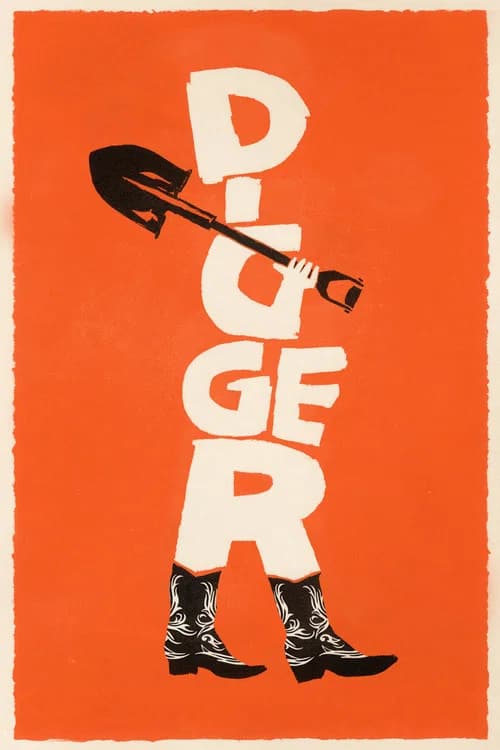
 ⭐ Popular
Digger
ComedySep 28, 2026
Digger
Details
Popularity · Search interest now
Based on TMDb activity
Incoming Editorial TeamVerified
1974 is a Spanish-language drama film releasing on April 25, 2026. The story follows Aurelia, a self-destructive woman in the late stages of her life, who returns to the decaying beachfront hotel where she once vacationed with her family in the 1970s.
1974 is scheduled for release on April 25, 2026.
The film follows Aurelia, a self-destructive woman, who returns to a rundown beachfront hotel where she vacationed with her family in the 1970s and is forced to confront echoes of her past.
1974 is a Spanish-language film.
No distribution platform or theatrical details have been announced for 1974 as of now.
A drama titled 1974, produced by Trikon Productions, Julian Films, and DVL Productions, is scheduled for release on April 25, 2026. Shot in Spanish, the film centers on a woman named Aurelia who returns to a beachfront hotel she once visited with her family during the 1970s. The hotel is now derelict — its hallways empty, its pool dry, its coastline described as haunting — and the film frames this return as a reckoning, a confrontation with whatever Aurelia has spent decades avoiding.
The premise belongs to a durable tradition in European and Latin American cinema: the return narrative, in which a character travels back to a place freighted with memory and finds that the geography has preserved something the psyche would rather have discarded. Films working in this register tend to be slow and interior, more concerned with atmosphere than plot mechanics, and the details provided here — the deserted hotel, the empty pool, the coastline — suggest 1974 is positioning itself within that lineage. The specific decade named in the title functions almost as a character in itself, a fixed point of origin against which Aurelia's present state is measured. The gap between then and now, roughly half a century by the film's own description, is the film's central tension before a single frame is shown.
Aurelia is described in terms that resist easy sympathy: self-destructive, yet charming, and at the "twilight of her life." That phrasing is doing a fair amount of work. It places her at an age where the calculation of what remains versus what has passed becomes unavoidable, and it implies that whatever she must confront has been deferred for a very long time. The pairing of self-destruction with charm is a familiar but still interesting character combination — it suggests someone who has managed to remain socially legible, even compelling, while conducting a slower form of ruin in private. Whether the film intends to explain the origins of that self-destruction, or simply observe its late-stage expression against the backdrop of a crumbling hotel, is not clear from what has been made available.
The production involves three companies — Trikon Productions, Julian Films, and DVL Productions — and the film's original language is Spanish, which places it somewhere within the Spanish-language film world without yet specifying a country of origin. The title itself, a bare year with no subtitle or qualifier, is a fairly bold formal choice. It commits the film to a specific historical moment as its organizing reference, even as the action appears to take place in the present. That structural decision opens questions: how much of the film will actually inhabit 1974, whether through flashback, memory sequence, or some more experimental formal approach, and how much will remain anchored in the present-day return? The marketing, such as it is, has not answered this.
The beachfront hotel setting carries its own set of associations. Decayed resort spaces have served as backdrops for a particular kind of melancholy in European film for decades — places designed for pleasure that have outlasted their moment and now stand as monuments to a particular era's optimism. The empty pool is an especially loaded image in this context, a space built for leisure and social display now reduced to a concrete void. Whether 1974 uses this iconography straightforwardly or complicates it is another open question. The description offers the setting as "haunting," which could mean supernatural resonance or simply the ordinary haunting of personal history — the way a place where something significant happened becomes impossible to experience neutrally.
What the available information does not address is the film's authorship. No director is named, no screenwriter, no lead actor playing Aurelia. For a film built so explicitly around a central character — her psychology, her age, her particular combination of damage and charisma — the casting and direction will determine almost everything about whether the premise lands or collapses into familiar territory. A character like Aurelia, positioned at the intersection of age, charm, and self-destruction, requires a performance of considerable precision. Without knowing who is bringing her to the screen, or who constructed the script, it is difficult to assess what the film is likely to do with the material it has set up. That absence is notable, though not necessarily indicative of anything beyond what has simply not yet been released publicly.
The film's low current popularity metric suggests it has not yet penetrated wide awareness, which is unsurprising for a foreign-language drama scheduled more than a year out and produced by companies not immediately recognizable to English-language audiences. That profile — a quiet, character-driven Spanish-language drama built around memory, aging, and a specific historical moment — is the kind of film that tends to find its audience through festival circulation before any wider release.
The audience likely to seek out 1974 will be drawn to Spanish-language cinema, to character studies organized around older protagonists, and to films that treat physical setting as an active element of psychological drama. Those with patience for slow, ruminative work — the kind of film in which a long shot of an empty pool carries argumentative weight — will find the premise congenial. What remains to be seen is whether the execution honors the architecture of that premise or simply inhabits it.
⭐ PopularDigger
ComedySep 28, 2026
Digger ⭐ Popular
Primetime
ThrillerSep 23, 2026
Primetime ⭐ Popular
Michael
MusicApr 22, 2026
Michael 📈 Trending
Peddi
ActionJun 3, 2026
Peddi 🔥 Hot
The Social Reckoning
DramaOct 7, 2026
The Social Reckoning
LA BOLA NEGRA
DramaSep 25, 2026
LA BOLA NEGRASign in to join the conversation.