🍅85%Tomatometer
The End of Oak Street opened in U.S. theaters on August 14, 2026. Directed by David Robert Mitchell (It Follows) and starring Anne Hathaway and Ewan McGregor, the film earned glowing reviews out of the gate. RogerEbert.com awarded it four stars, calling it "the most thrilling dinosaur movie in ages," while IndieWire hailed it as "the biggest surprise of a summer that's delivered on all fronts."
It opened to $21 million domestically.
Days before its debut, Warner Bros. released a promotional video featuring AI-generated dogs hosting a fake podcast to "interview" each other about the film. Following swift social media backlash, the clip was quietly deleted. The film itself contains zero AI-generated content.
Something went wrong in marketing.
1982 Nostalgia Meets Prehistoric Terror: Inside Summer 2026's Sharpest Sci-Fi
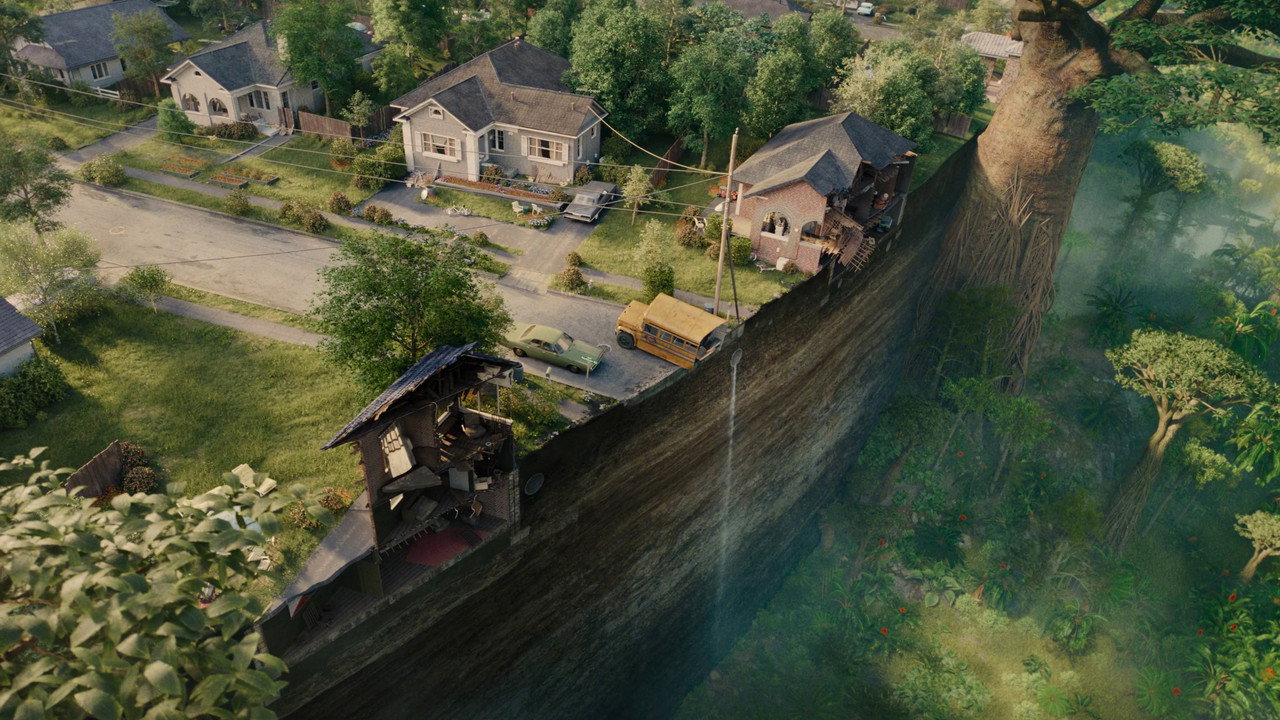
Set in Flowervale, Michigan in 1982, The End of Oak Street follows a cosmic event that rips an entire suburban neighborhood out of reality and drops it into a prehistoric era. Denise (Anne Hathaway) and Greg Platt (Ewan McGregor) must navigate their collapsing marriage while fighting off prehistoric predators to keep their children safe.
The film is a loving homage to 1980s Amblin Entertainment classics — balancing genuine family stakes with creature-feature spectacle. Industrial Light & Magic handled all dinosaur VFX, paired with a score by Michael Giacchino and cinematography by Michael Gioulakis.
The RT critics consensus: "Tapping into the primal pleasures of the classic creature feature, The End of Oak Street is pulpy good fun carried off with a light touch and a sharp bite."
Editorial note: Warner Bros. used AI-generated clips to market an $80 million film built on ILM craftsmanship and 1980s analog filmmaking instincts. The irony was not lost on the audience that would have been most likely to champion it.
From $2M Indie Horror to $80M Blockbuster: David Robert Mitchell's High-Stakes Leap
Mitchell built his reputation with It Follows (2014), made for approximately $2 million, which holds a 95% Tomatometer. He then made Under the Silver Lake (2018), a polarizing Los Angeles noir that found its audience slowly on streaming over several years.
The jump from indie precision to studio scale frequently strips directors of whatever made them interesting. Mitchell did not lose it here. His signature deliberate pacing, precise camera framing, and refusal to over-explain remain intact at $80 million.
Speaking to The AU Review, Mitchell on his visual approach: "I like to put a lot of love into the camera placement and whether something is subjective or objective...what does that framing make you feel?" On the film's deliberately unresolved edges: "I like that maybe not everything is completely resolved for some people...another viewing can unlock a little more."
"Hall of Fame Performance": Why Anne Hathaway Outshines the Dinosaurs
Playing Denise Platt — a woman harboring years of unfulfilled ambition — Anne Hathaway delivers what critics are calling one of her best performances in years. David Ehrlich at IndieWire noted she is "continuing her Hall of Fame-worthy year."
Ewan McGregor stepped in after Oscar Isaac exited pre-production and provides steady, if less prominent, support. The Hollywood Reporter dismissed the film as "high-end trash" and McGregor specifically as "terrible." Eighty-five percent of critics disagree.
Editorial note: The gap between the Hollywood Reporter's response and the rest of critical consensus is itself worth noting. A film that inspires this kind of conviction in both directions is rarely boring.
The AI Podcast Disaster: When Tone-Deaf Marketing Alienates the Audience You Need
Before opening weekend, Warner Bros. partnered with DogPack — a social media platform for dog owners — to release a promotional clip featuring AI-animated dogs: a golden retriever named Goldie, a French bulldog named Frenchie, and an AI version of Starbuck, the dog character in the film. The three animals "hosted" a podcast interview about the movie.
The clip was widely mocked and deleted.
In a moment when film audiences are actively resistant to AI in creative contexts, attaching an AI gimmick to a film built on ILM visual effects and 1982 Amblin-era craftsmanship alienated exactly the audience most likely to be enthusiastic about it. The people who care about David Robert Mitchell films care about handmade things. The promotional clip signaled that Warner Bros. did not understand what they had made.
$21M on $80M: Can Word-of-Mouth Save an Original IP?
Opening to $21 million domestically and $47 million worldwide against an $80 million production budget — plus an estimated $40–60 million marketing spend — puts the film in a financially challenging position. It needs strong legs through late August to close the gap.
The factors working in its favor: an 85% Tomatometer, genuine critical enthusiasm, and Pete Hammond at Deadline calling it "if ever there is a movie to see in a packed theater, it is this one." Original IP without franchise infrastructure lives or dies on word-of-mouth, and the word-of-mouth is good.
The factors working against it: the film has now been delayed twice (from May 2025 and again from March 2026), which typically signals audience awareness problems that don't resolve themselves at release. The AI dog controversy added noise in the wrong direction.
Should You See It in Theaters?
Yes. The film was built for a large screen in the dark with an audience. The ILM dinosaur sequences carry physical weight that streaming cannot replicate at the same scale. Giacchino's score was designed for theater speakers. Mitchell's pacing, which rewards patience and attention, works better without the friction of a home environment.
It will reach Max. The theatrical version is not a mandatory upgrade for every film — it is here.
Frequently Asked Questions
What is The End of Oak Street about? A 1982 Michigan neighborhood is transported through a cosmic event into a prehistoric era full of dinosaurs. An estranged couple (Anne Hathaway and Ewan McGregor) must set aside their marital problems and fight to protect their family while searching for a way home.
Who directed The End of Oak Street? David Robert Mitchell, best known for It Follows (2014) and Under the Silver Lake (2018). The End of Oak Street is his first studio-scale blockbuster.
What is The End of Oak Street's Rotten Tomatoes score? 85% Tomatometer (253 reviews) and 78% audience score. The critics consensus: "Tapping into the primal pleasures of the classic creature feature, The End of Oak Street is pulpy good fun carried off with a light touch and a sharp bite."
Who stars in The End of Oak Street? Anne Hathaway and Ewan McGregor lead as Denise and Greg Platt. Ewan McGregor replaced Oscar Isaac, who was originally attached to the project.
How much did The End of Oak Street make at the box office? $21 million domestically and $47 million worldwide in its opening weekend (August 14–16, 2026) against an $80 million production budget.
What was the AI dog controversy? Warner Bros. released a promotional video featuring AI-generated dogs "podcasting" about the film. The clip was mocked on social media and deleted. The film itself contains no AI-generated content.
Where can I watch The End of Oak Street? Currently in theaters only. Based on Warner Bros.' standard distribution timeline, it is expected to arrive on Max approximately 31–32 days after theatrical release — around mid-September 2026. No official streaming date has been announced.
Is The End of Oak Street connected to any existing franchise? No. It is an original IP with no connection to any existing franchise or prior film.