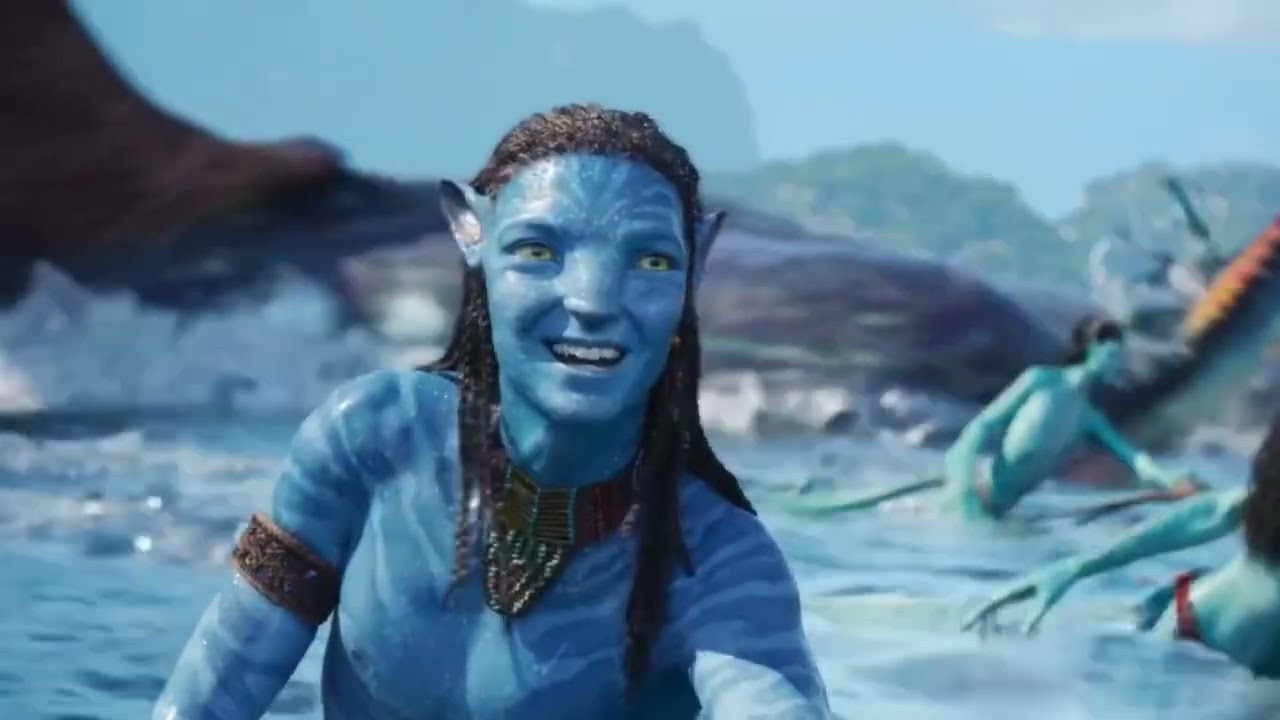
I watched Avatar (2009) for the first time in December 2022, right before going to see Avatar: The Way of Water (2022) in theaters. The reason was embarrassingly simple: everyone was talking about the sequel, and I didn't want to walk in without context. I had spent years absorbing the cultural joke that Avatar was a visually impressive film that somehow left no impression on anyone who saw it: blue aliens, Dances with Wolves in space, the highest-grossing film of all time that nobody seemed to care about. I expected to be underwhelmed.
I wasn't. It didn't change my life, and I didn't feel like I'd missed something essential by waiting thirteen years, but it held my attention in ways I hadn't expected, and I've been trying to work out why ever since.
Pandora is the point
The thing about watching Avatar without 2009 nostalgia is that you arrive with lower expectations and no memory of what it felt like when nothing had looked like that before. For audiences in 2009, James Cameron was showing people something genuinely unprecedented, and that shock of the new is essentially unrecoverable. For me in 2022, high-fidelity CGI was Tuesday, so the visual achievement landed differently: impressive, yes, but not staggering in the way the reviews described.
What held up was something the jokes never prepared me for: Pandora feels like a real place, and not just visually.
Cameron built the world from the inside out. The bioluminescence is not decorative; it is an ecosystem with internal logic. The neural bond the Na'vi form with animals and trees, the tsaheylu, is not mysticism dressed up as sci-fi; it is a consistent biological mechanism applied uniformly across the planet, from the ikran they fly to the Tree of Souls at the center of their spiritual life. Eywa, the deity the Na'vi pray to, is essentially a planetary nervous system, a network of electrochemical signals stored across the root structure of every living thing on Pandora. When the forest responds to Jake's prayer in the final act, Cameron is not invoking magic. He is showing you the planet's immune response. That coherence is harder to build than it looks, and most blockbusters do not bother trying.
The story, by contrast, is as thin as advertised. Jake Sully is a vessel, not a character; his function is to give the audience a point of entry, and Cameron never develops him beyond that role. More seriously, the white savior structure is a real problem: Cameron spent years building a film about indigenous people defending their home from colonial extraction, and then could not imagine those people organizing their own resistance without a human to lead it. That contradiction sits in the middle of the film and does not resolve. But the world outlasts the story, and that is genuinely what surprised me.
The Way of Water is actually the better film
Avatar: The Way of Water is a different kind of film, and I think it is the better one, largely because Cameron figured out that the most interesting question in the first film wasn't who wins the battle, but what it costs to stay.
The shift from outsider-goes-native to family-under-threat changes everything structurally. Jake and Neytiri are parents now, and their children are the ones who carry the story. Lo'ak, the second son who can't do anything right in his father's eyes, ends up forming a bond with Payakan, an outcast tulkun and enormous intelligent whale-like creature, that mirrors Jake's arc in the first film but with more emotional honesty, because Lo'ak isn't trying to become a hero. He's just a kid who recognizes a fellow outcast. Cameron is also doing something quietly interesting with Kiri, Neytiri's adopted daughter born inexplicably from Grace Augustine's avatar. Kiri has an instinctive connection to Pandora's neural network that no other Na'vi shares, and the film doesn't explain it; it lets it sit as a mystery that the later installments will presumably inherit.
The ocean Metkayina setting brings with it underwater sequences that are extraordinary in a way that is genuinely hard to describe without sounding like a press release. But the scene that stays with you is Neteyam's death. He dies quickly, in the chaos of a combat retreat, covering Lo'ak's escape, with no grand farewell, no slow close-up, just the sudden fact of it. What Cameron does with the grief afterward is the most emotionally honest moment in either film: Jake snaps at Lo'ak ("you've done enough"), and Neytiri's anguish turns toward Spider, the human boy she has never fully accepted. Loss bends toward blame, and Cameron doesn't soften it.
The tulkun hunt sequence works differently. Cameron films it like documentary footage of actual whale hunting rather than action cinema: the tulkun suffers visibly, for longer than is comfortable, and a calf stays at the mother's side while the film refuses to cut away. It is the moment the environmental themes stop being a backdrop and become something you actually have to reckon with.
Fire and Ash and what comes next
Avatar: Fire and Ash (2025) is the weakest of the three, and the reviews are right that it repeats the pattern: new tribe, new biome, same RDA assault, same climax near water. By the third film, the formula is visible enough that you can feel the seams. Cameron is building a mythology across installments, but the mythology keeps arriving at the same beat.
What rescues it from feeling disposable is Varang. She is the first Na'vi villain in the series, which matters more than it might seem. Until Fire and Ash, the moral universe of Avatar is essentially binary: Na'vi are noble, humans are extractive, and the conflict runs along that line without complication. Varang breaks that open by introducing the possibility of Na'vi who are neither noble nor coerced: she is cruel, calculating, and genuinely threatening on her own terms. Her existence doesn't just complicate the third film; it retroactively deepens the first two, because it raises the question of what Pandora's indigenous politics looked like before the humans arrived. The best reason to keep watching this franchise is finding out what Cameron does with that question.
What the jokes get wrong
The honest version of what Avatar is: a franchise that is significantly better at building a world than at telling stories inside it, and better at creating visceral experiences than at creating characters you carry with you afterward. Those are real limitations, and the cultural jokes are not entirely wrong to point at them.
But the "Avatar has no cultural footprint" argument treats fandom infrastructure as the only valid measure of impact (no merchandise, no wiki wars, no cosplay), and that is a surprisingly narrow definition. Pandora is a place I believe in, in the specific way I believe in a small number of invented places: Tolkien's Shire, Le Guin's Anarres, the Discworld. The belief is not about nostalgia or attachment to particular characters; it is about whether the internal logic holds, whether the world feels like it would keep existing if the camera looked away. Pandora does. Most invented worlds do not.
I came to Avatar late, without nostalgia, knowing all the punchlines. What I found was messier and more interesting than the punchlines suggest: a filmmaker who cannot write characters but can build civilizations, whose stories keep defaulting to the same beats but whose world keeps getting larger. That is an unusual combination, and I don't think the discourse has quite figured out what to do with it yet.
All three Avatar films are available to stream. Tracking what's coming next at incoming.to.