
Apparently, Sir Cameron Needs to Die
FantasyFeb 3, 2026
Apparently, Sir Cameron Needs to Die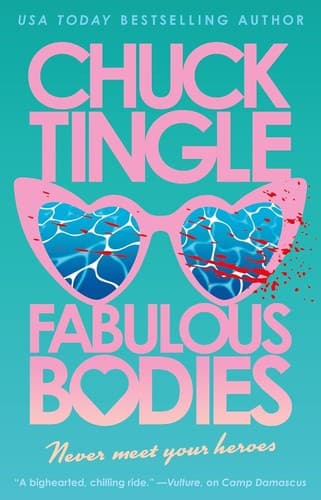
Details
Links may earn Incoming a commission at no extra cost to you.
Chuck Tingle's Fabulous Bodies is scheduled for release on July 7, 2026, with ISBNs 9781250398567 and 1250398568. The book runs to 304 pages and is categorized under horror and queer fiction — a combination that has come to define the particular register Tingle has been developing across their recent long-form work.
Tingle is a figure whose career resists easy summary. Best known for years as the author of a sprawling catalog of absurdist, sexually explicit short fiction published under provocative titles, Tingle began a quieter but substantial pivot toward novel-length horror in the early 2020s. That transition produced Bury Your Gays, Camp damascus, and Uncanny Valley, books that earned Tingle a readership well beyond the audience that had followed the short fiction — readers drawn specifically to horror that foregrounds queer identity not as subtext but as structural concern. Fabulous Bodies arrives as a continuation of that trajectory, a third or fourth movement in what has become a recognizable project: literary horror written from and for a queer perspective, where the genre's traditional mechanics of threat, vulnerability, and survival are organized around the particular textures of queer experience rather than borrowed from a default heteronormative template.
The title itself is the most prominent piece of information available about the book, and it rewards some attention before the text exists to clarify it. "Fabulous" carries at least two distinct registers — the colloquial queer affirmative and the older, stranger root meaning of the fabulous as that which belongs to fable, to story, to a world adjacent to but not identical with the real. "Bodies" is horror's most reliable unit of currency. Whether the title is functioning ironically, literally, affectionately, or all three simultaneously is a question the book's 304 pages will eventually answer, but the pairing is not an accidental one for an author whose work consistently sits at the intersection of identity, physicality, and dread.
What the available metadata does not disclose is nearly everything a reader might want to know going in: setting, narrative structure, whether the book is a standalone or engages with any of Tingle's previous novels, what form the horror takes, and whether the 304 pages constitute a single continuous narrative or something more fragmented. Tingle's longer work has varied considerably in its structural approach, and nothing in the current record indicates which direction Fabulous Bodies takes. The July 2026 publication date places it in a season that has historically been hospitable to horror releases — summer has long been the genre's commercial peak — but whether the book is positioned as a beach read, a prestige literary release, or something in between is not yet clear from the data on hand.
The page count of 304 is worth noting in context. Tingle's novels have generally occupied a similar range, substantial enough to develop character and atmosphere with some leisure but not sprawling in the manner of epic horror. That length suits the kind of focused, single-location or single-situation horror that Tingle has favored — books where the ideological and psychological pressures are concentrated rather than diffused across a large cast or an extended timeline. Whether Fabulous Bodies follows that structural preference is unknown, but the page count at least suggests it isn't departing radically in scope.
The dual categorization as horror and queer fiction is worth examining for what it implies about audience and critical framing. Queer horror as a marketing category has expanded considerably over the past decade, moving from a niche designation to something with enough commercial and critical weight to appear on major publishers' lists with regularity. Tingle's work has been part of that expansion, and Fabulous Bodies will arrive into a genre conversation that is more developed and more contested than it was even five years ago. Questions about what queer horror is for — whether it primarily offers catharsis and representation, or whether it interrogates the genre's historical relationship to queerness as something to be feared and destroyed — are live questions in criticism, and Tingle's books have generally engaged with them directly rather than sidestepping them. Whether Fabulous Bodies continues that engagement or approaches the intersection differently is among the open questions.
There is also the matter of Tingle's authorial voice, which has evolved noticeably across the novel-length work. The early novels retained more of the associative, high-energy quality of the short fiction; the more recent books have moved toward something slower and more considered in their horror. Readers who came to Fabulous Bodies expecting either mode might find themselves in unfamiliar territory — or they might find a synthesis. The title offers no clear signal either way.
The readers most likely to seek out Fabulous Bodies on or around its July 7, 2026, release are the audience that has followed Tingle's longer fiction with attention — readers for whom queer horror is a primary interest and for whom Tingle's authorial perspective has become a meaningful reference point within that genre. Beyond that core, the book will likely attract the broader horror readership that has become increasingly attentive to work emerging from queer perspectives, as well as readers who track Tingle's career out of general curiosity about an author whose trajectory has been genuinely unusual. What they will find in those 304 pages remains, for now, entirely open.
Apparently, Sir Cameron Needs to Die
FantasyFeb 3, 2026
Apparently, Sir Cameron Needs to Die
You Did Nothing Wrong
HorrorMar 17, 2026
You Did Nothing Wrong
The Rythm Guys
Jan 1, 2026
The Rythm Guys
Amour contraire
Jan 1, 2026
Amour contraire
安達としまむらSS2
FranchiseJan 1, 2026
安達としまむらSS2Cœur de renard T.1
Jan 1, 2026
Cœur de renard T.1Sign in to join the conversation.